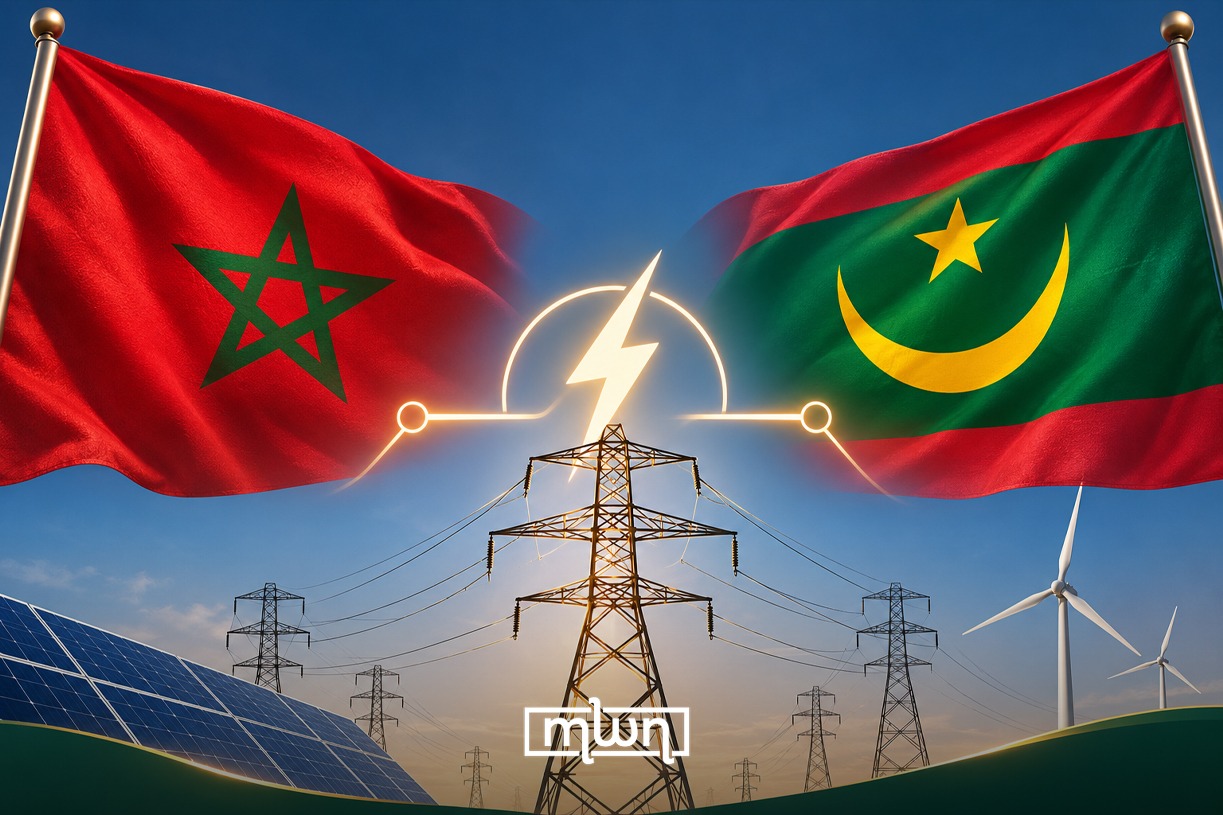
Marrakech – Morocco’s ambassador to Mauritania, Hamid Chabar, announced that studies for the planned high-voltage electricity interconnection between the two countries are now complete, pointing to the project as one of the clearest markers of a relationship moving from routine cooperation toward joint implementation.
Chabar spoke at the opening of the third edition of “Morocco Week” in Nouakchott, an economic and cultural event held this year under the theme of building a solidarity-based partnership.
He told the audience that bilateral ties have reached “a stage of maturity,” and that they now lean “more than ever” toward practical projects that can be realized on the ground. Relations between Rabat and Nouakchott, he added, are “in the process of moving from traditional relations to a strategic partnership.”
The ambassador tied that shift to the political will of King Mohammed VI and Mauritanian President Mohamed Ould Cheikh El Ghazouani, framing the energy file as proof that the two governments are translating intent into infrastructure.
The high-level Mauritanian turnout at the event, he noted, including the presence of three ministers, reflected the weight Nouakchott places on the partnership.
The interconnection agreement itself was signed last year. On February 4, 2025, the director general of Morocco’s National Office of Electricity and Drinking Water (ONEE), Tarik Hamane, and his counterpart at the Mauritanian Electricity Company (SOMELEC), Sidi Salem Mohamed Elabd, signed the accord in Nouakchott in Chabar’s presence.
The two sides also signed a separate convention on partnership between the two utilities, covering the exchange of experts and the training of staff.
The project falls within Morocco’s Atlantic Initiative and the broader push for South-South cooperation, and is designed to strengthen the reliability of both grids and ease electricity exchange between Morocco and Mauritania, as well as between Europe and West Africa through the West African Power Pool (WAPP).
For Mauritania, the stakes are concrete. Chabar explained that the completed project will allow the country to secure its future energy needs and, over time, to export electricity toward Europe or West Africa through the Moroccan grid.
The studies advanced steadily through 2026. In late August, then-Minister of Energy Transition and Sustainable Development Leila Benali held a phone call with her Mauritanian counterpart, Energy and Petroleum Minister Mohamed Ould Mohamed El Amine Ould Khaled.
The two reviewed progress on the interconnection studies, then proceeding on schedule for completion before December. That timeline has now been met. The same call addressed Morocco’s support, delivered through ONEE, in restoring power in Nouakchott after an incident struck two electricity transformer stations in the Mauritanian capital.
Electricity was not the only project Chabar placed on the table. He also pointed to a road agreement, a framework accord signed last September to rehabilitate the roughly 480-kilometer route linking Nouakchott and Nouadhibou, a corridor that connects Mauritania’s political capital with its economic capital.
The accord extends further, tying Nouakchott to the Moroccan city of Dakhla by way of the Guerguerat border crossing. That segment, too, forms part of the Atlantic Initiative, which aims to open an Atlantic outlet for Sahel states, with the Dakhla port expected to be completed by the end of 2028.
Beyond the two flagship projects, Chabar described a cooperation agenda that runs across several sectors, including trade, tourism, agriculture, maritime fishing, and vocational training, each supported by joint government programs.
Trade targets and a 2027 roadmap
The commercial track drew its own announcements. On the sidelines of the event, Mauritanian Prime Minister Mokhtar Ould Diay received Morocco’s Delegate Minister for Foreign Trade, Omar Hjira, and the two countries agreed to modernize a trade agreement dating back 40 years and to double their exchanges.
Hjira noted that bilateral trade reached about MAD 3.7 billion ($370 million) in 2025, up 15% on 2024. That volume makes Mauritania the second African market for Moroccan exports and its first Arab market, while Morocco accounts for 37% of Mauritania’s African imports. He set a target of lifting bilateral trade to MAD 6 billion ($600 million) by 2030.
Hjira argued that the objective should not stop at trade volume, but extend to diversification and development in both directions. He called for mutual investment in agriculture, food industries, fishing, renewable energy, and tourism, and described updating the trade agreement concluded in August 1986 as a priority.
He also presented Mauritania as a potential gateway for Moroccan companies into the rest of Africa, while a separate land route between the Guerguerat crossing and the port of Tangier on the Mediterranean, roughly 2,200 kilometers long, would give Mauritanian exporters access to European markets.
The two governments attached a calendar to those ambitions. According to a joint statement issued by the Mauritanian trade minister and the Moroccan delegate minister, the sides agreed to hold the second session of their Joint Trade Committee in Morocco on January 27, 2027, and to form a joint working group on agricultural and food flows before the end of January.
The roadmap also includes an investment forum in Mauritania in early 2027, mutual recognition of food health accreditations, a tourism-training partnership with the Moroccan city of Ouarzazate, and the creation of a modern wholesale market in the Mauritanian capital, with its studies set to conclude at the end of 2027.
Morocco Week, organized from November 16 to 22 by the Moroccan Embassy and the “Forum du Sud” association, drew more than 50 Moroccan companies across a range of sectors.
Read also: 5G: Maroc Telecom Chairman Meets Mauritanian Prime Minister