























































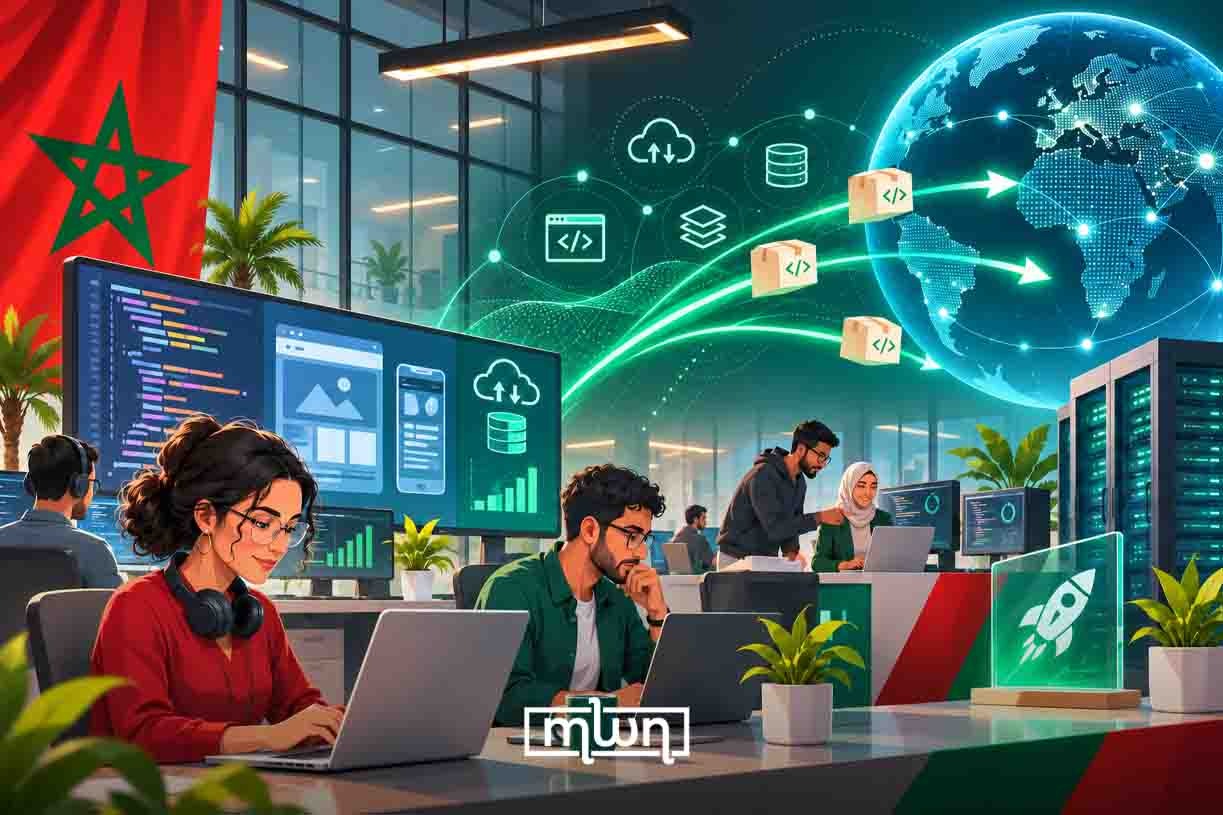
For years, Morocco’s place in the global tech economy has been described in one way: a source of talented engineers and a destination for offshoring and call centers. That reputation is earned, and it matters, but it undersells what Moroccan tech companies can do. We can do more than supply hours of work to foreign firms. We can build and sell complete digital products and services to clients in Europe, the Gulf, and beyond, under our own names.
I say this from daily experience. Our company in Marrakech builds websites, software platforms, and AI automation for clients in Morocco, Europe, and the Gulf. What I have learned is that the barrier is rarely technical skill. It is everything around it: how we present ourselves, how we sell, and how we earn trust from buyers who have never worked with a Moroccan company before.
Our real advantages
Morocco’s strengths for exporting digital services are concrete.
The first is language. Moroccan teams can work in French, Arabic, and English, and often Spanish. That is not a small detail. It means one team can serve a client in Paris, a distributor in Riyadh, and a start-up in London without a translation layer in between. Very few countries can offer that combination naturally.
The second is time zone. Morocco works during European business hours and overlaps comfortably with the Gulf. Clients do not have to wait until the next day for an answer, which removes one of the main complaints about outsourcing to distant regions.
The third is culture. Moroccan professionals understand both European business habits and Arab ones. In the Gulf in particular, where business still relies heavily on relationships and trust, that understanding is an advantage that cannot be bought.
What holds us back
If the advantages are so clear, why are so few Moroccan tech companies selling their own services abroad?
Part of the answer is visibility. When a buyer in Germany or the UAE searches for a software partner, Moroccan companies rarely appear. Many local agencies have websites written only for the Moroccan market, in one language, with little proof of work for international clients. A buyer abroad has no way of knowing they exist, let alone trusting them.
Another part is how we sell. Selling hours of developer time is simple to explain, but it keeps companies in a race on price. Selling a defined outcome, such as a working platform, an automated process, or a measurable increase in qualified leads, requires clear scoping, written proposals, and accountability for results. That is harder, but it is where the value is.
Finally, there is trust. International clients want to know who owns the code, where their data is stored, and what happens if something goes wrong. Moroccan companies that answer these questions clearly, in writing, before signing, win clients that others lose.
What needs to change
None of this requires large investment. It requires a change in mindset.
Moroccan tech companies should present themselves to the markets they want to serve, not only to the local one. That means websites and proposals written for buyers abroad, in their language and with their concerns in mind.
We should sell results, not hours. Clients pay more willingly for a clear outcome, delivered by a team that takes responsibility for it.
We should be transparent by default: clients own their code, their accounts, and their data. In a market where trust has to be earned from scratch, transparency is the fastest way to earn it.
And we should be proud to say where we are from. “Built in Morocco” can and should become a mark of quality, not something to hide behind an address in Paris or London.
A moment to seize
Demand for digital services keeps growing in Europe and the Gulf, and companies there are looking for reliable partners outside their own expensive markets. Morocco is close, connected, and multilingual. Our engineers are already respected.
The next step is for Moroccan companies to stop being invisible suppliers and start being recognized brands. The talent is here. What we need now is the confidence to sell it under our own name.