Rabat – Between the still pertinent but less raucous debate of pan-Africanism vs afro-politanism, there might still be today, roughly speaking, two ways of looking at Africa and Africanness. There are those who fetishize an elevated and monolithic idea of Africa while blaming the non-African world — mostly the West — for all of Africa’s problems. And then there are those for whom Africa is both an idea and a complex reality.
While the former group revels in revolutionary finger-pointing and impassioned invocations of Mother Africa, the latter speaks in terms of “shared responsibility” and of taking advantage of the opportunities to make things better.
Hicham El Habti, president of Morocco’s Mohammed VI Polytechnic University (UM6P), comes across as belonging to the second breed of pan-Africans. “African development;” “pan-African vision;” “our continent;” “innovation adapted to African realities;” “African solidarity” — these are the hallmarks of the Moroccan academic’s discourse as he presented his university’s “African vision” in an interview with Morocco World News.
When asked where UM6P stands in the cacophonous debate over clashing notions of Africa and pan-Africanism, El Habti appeared to fudge theoretical disputes to focus on what, to him, matters the most: action on the ground, statistics that measure tangible impact and the change that his institution aims to inspire in Morocco and across Africa.
Africa as land of opportunities
“We have an idea about Africa as a land of huge opportunities, whether intellectual or scientific,” El Habti told MWN. “So our vision for Africa comes from the fact that we are convinced that the continent represents for any researcher a fertile ground in terms of research topics, in terms of ideas, in terms of new scientific approaches,” he stressed.
El Habti emphasized that “every researcher is driven by the need for innovation, the appeal of working on a subject that he or she cannot find elsewhere, or the desire to implement a process or an invention that cannot be found elsewhere. For all of us, we are all convinced that Africa offers us this opportunity for innovative research on a golden platter.”
Being the president of a university that has been described as the “MIT of Africa” and the ultimate embodiment of Morocco’s intellectual pan-African project of training a new cohort of researchers and leaders passionate about African development, El Habti was somewhat bound to give some indications of his university’s take on what pan-Africanism and the very notion of Africa should entail today.
“We are convinced that Africa is the solution for the world of tomorrow, whether this is in terms of food security or in terms of solutions to fight against climate change. We see the continent as a rather virgin land on which there is a lot to build. And we want to be a leading force of ideas and projects to show how to build on this ground; how to fight against climate change; how to imagine future cities,” he explained.
“We especially want to respond to the emerging needs of African populations, especially with the youth who today are very invested in issues such as climate change and sustainable development.”
Addressing African challenges
UM6P is a university that is not even a decade old; it was founded in 2013, while its main state-of-the art campus in Benguerir did not open until 2017. So it beggars belief that such a young institute could be compellingly thought of as the pinnacle of Morocco’s intellectual pan-Africanism. Then again, perhaps it would be helpful in this instance to bear in mind French dramatist Pierre corneille’s untimely insight about nobility, worth, or prestige not depending on the passing of years.
It is not a stretch to say that UM6P, despite its four magnificent campuses around Morocco, definitely entered the consciousness of most ordinary Moroccans with last year’s news that the country’s Crown Prince would be studying at the university’s Faculty of Governance and Economic and Social Sciences (FGSES).
But the young university had long been on the radar of those who have been watching closely the most central thread running through Moroccan politics today: South-South diplomacy and African solidarity. For example, the university’s imposing, iconic campus in Benguerir near Marrakech has been a go-to place to visit for almost all African leaders who have visited Morocco in the past three to four years.

An Ivoirian delegation visiting UM6P in July 2017.
The symbol of being the equivalent of an intellectuel Mecca for most foreign leaders on visits to Morocco is doubtless an essential component of the university’s growing reputation as the country’s new laboratory of Africa-focused development projects and solutions. For El Habti, though, far more important are the university’s practical aspirations, the materialization of its idea of “leaving an important footprint on the development of Africa.”
Read also: Africa and COVID-19: The Sick Man of Globalization?
Armed with a motto that urges its students to “learn by doing,” UM6P’s curriculum appears intent on equipping its students to meet specific 21st century development challenges. It builds on the idea that alumnis should be groomed to be comfortable with both the hard (technical and managerial) and soft (theoretical) challenges in their respective fields.
“Our project is to bring to all these crucial issues of climate change, food security, and future urban planning science-based solutions adapted to African realities,” declared El Habti. Is that the reason for the “Excellence in Africa” initiative UM6P recently signed with the Ecole Polytechnique Federale de Lausanne (EPFL) in Switzerland?
El Habti’s response is a wholehearted “yes.” As with all UM6P initiatives, the goal of the UM6P-EPFL alliance is to truly invest in adequately trained African youth who will be ready to satisfactorily meet the continent’s future challenges in terms of “high-level innovative research” and bold policymaking tools.
“Over a period of ten years, we will train 100 African doctoral students who will be co-supervised by EPFL professors on topics related to Africa. The starting point is “what are the challenges facing Africa today?” he explained.
Another part of the partnership “will be the production of high quality digital content on development issues in Africa.” UM6P intends to make this content available to all African youth. The material will be there for all those who are interested in new, original perspectives on how to think about “the Africa of tomorrow” at the dawn of an inexorable digitization of the world.
Throughout the interview, “human capital” appeared to be the beating heart of almost all of El Habti’s answers. He insisted on stimulating a dynamic led by the ambition and need to produce critical intellectuals or thinkers, outside-the-box-thinking social entrepreneurs, and socially committed and well-trained political actors. At UM6P, there appears to be a Nietzschean sense of “eternal return” of the initial question of what being African or pan-African ought to entail in the 21st century.
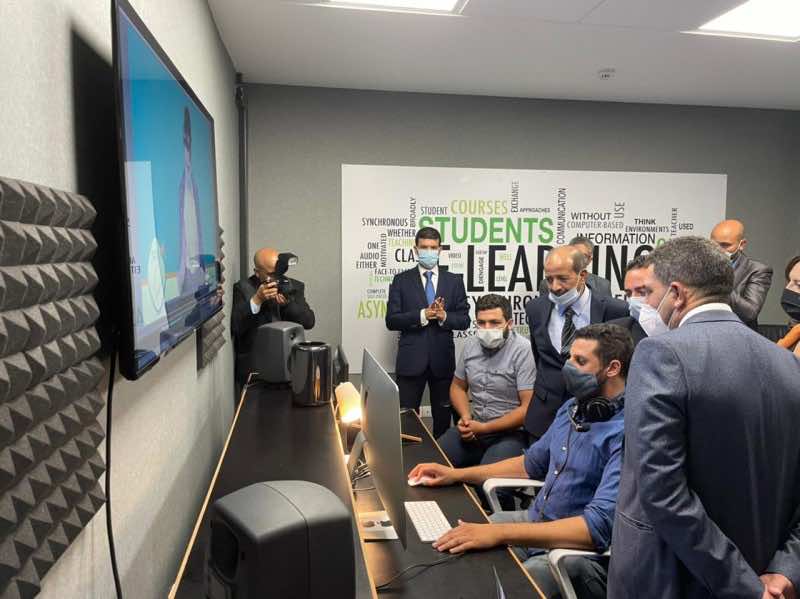
Inauguration of the center for digital education in June 2021. Photo: UM6P website
A new horizon of possibilities
In his newly published book, Le Temps du Maroc (Morocco’s Time), Abdelmalek Alaoui contends that Morocco’s African diplomacy is “an audacious bet” that is mainly driven by the need to broaden the horizons of political feasibility for development in Africa.
This follows the widely held belief in policy circles that with the invaluable accompaniment of companies like OCP Africa, Morocco is quickly becoming the bellwether of a brave new postcolonial Africa. It is also consistent with the notion that King Mohammed VI has reconciled Morocco with its Africanness while making the kingdom a model for African development.
But for all the encouraging talks about the imperative of African solidarity and intra-African exchanges, for all the chorus of adulation that Morocco regularly receives from continental leaders and observers, there still remain questions about the weight of blackness in Morocco’s social imagination, about the sincerity of Morocco’s identification with Africanness.
For El Habti, what his university brings to the table in this debate is the mainstreaming of the idea that Moroccans are Africans. “For us, we are Africans; let’s always remember that,” he said at the very beginning of our interview. Little wonder, then, that questions of African mobilities, African projections in modernity, and other Africa-themed notions are foundational in the publications of the think tank and research laboratories affiliated to UM6P.
Another step the university has taken in this regard is the diversification of its partnerships with universities in sub-Saharan Africa. It does so by offering competitive scholarships to students from the four corners of the continent, having a sizable presence of students, sub-Saharan staff, and faculty members, as well as actively convincing their graduate students to work on Africa-related topics and travel to sub-Saharan Africa for their projects.
Rethinking Africa
Here again, we seem to be harking back to the initial, lingering question: What does it mean to be pan-African today? As El Habti’s answers suggest, UM6P’s pan-Africanism is about investing in innovation and “applied research” oriented towards addressing current and emerging challenges in Africa.
Put in the context of the prevailing theoretical discussions about what the Congolese philosopher Vincent Yves Mudimbe calls the “idea of Africa,” fundamental to El Habti’s rhetoric is the belief that, as the continent wrestles with the far-reaching consequences of the COVID-19 crisis, the challenge for African policymakers is to create platforms of genuine cooperation and shared responsibility.
Despite the broad-ranging perspectives from which political leaders, businesses, and academics may look at Africa, El Habti appeared to suggest throughout the interview, a key driver of a sincere pan-African attitude should be to insist on the need for the continent to assertively reinvent itself and take its destiny into its own hands.
But this requires confronting the ever-shifting sands of today’s aggressively globalized and digitized economy — by looking at challenges with realist and possibilist eyes, asking the hard and right (and sometimes wrong) questions, and never shying away from complexities, as Ghanaian writer Tiaye Selasi persuasively argued in her celebrated essay on “Afropolitans.”
Above all else, for a university, this requires producing a generation of adequately trained thinkers and leaders with the passion and desire to be part of making that African future possible. “We are an applied research university focused on issues that are very much related to the development of the African continent,” El Habti concluded.
“We want to be a platform of excellence for Africa. One of our ambitions is for all our students to go on exchange programs. And in our engineering school, for example, we do not direct them towards the countries of the Global North.
“We tell them to go to the countries of the Global South instead. We tell them that they are expected to be actors in the development of the future of the South and not the North. And so they go to sub-Saharan Africa, to the Americas, to Asia to develop in their DNA this, our passion for the development of the South.”