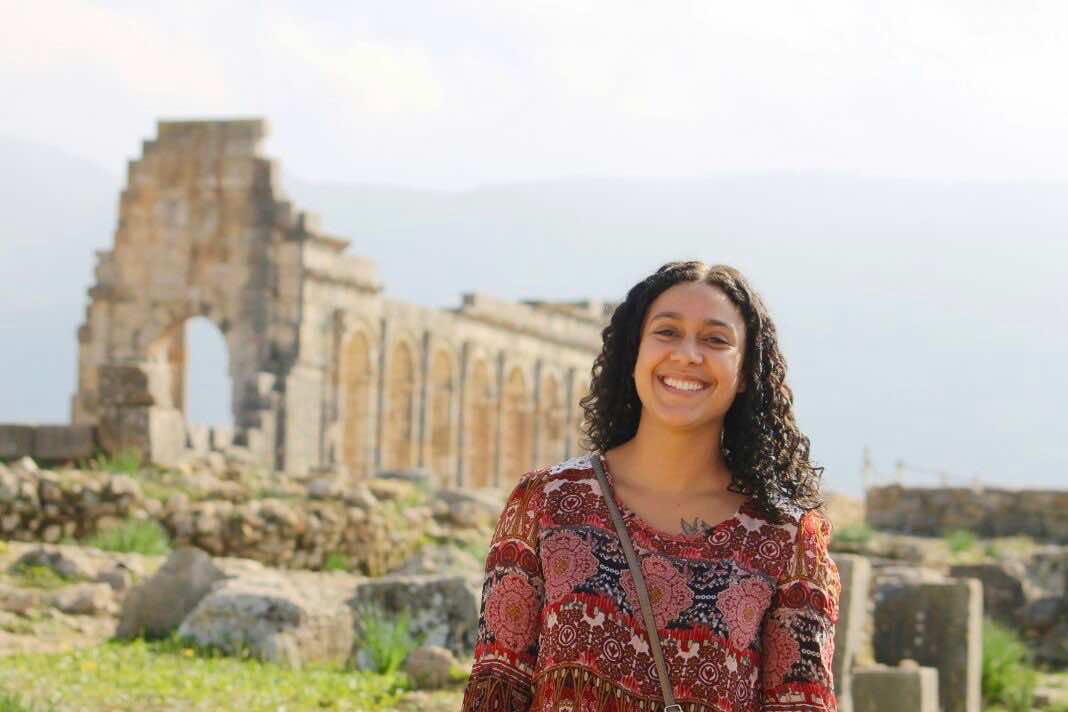
By Samantha Tropper
Rabat – Living in the southern part of the US, I’m frequently made aware that my looks are unique. I am different, and people want to know why. But in Morocco, ironically, my experience was the opposite. I was the same.
I have the same hair color and texture, the same skin tone, the same eye color and shape, even a fairly similar facial form as many Moroccan women I saw. People did not inquire about my family background. That is, until I started talking.
I was in Morocco learning Arabic, but I was studying Modern Standard Arabic, not Darija (the Moroccan dialect). Not knowing Darija, I struggled to understand native Moroccans when they spoke to each other. But people still spoke to me in Darija.

I would respond in French, the language many Moroccans use with foreigners. Cue a pronounced look of surprise. “Oh, you are not Moroccan?” they would ask. They would be surprised again when I would say that I am American.
I am not exactly the image that springs to mind when people envision a generalized American person.
Morocco was not the first time I had this experience. I lived in Cairo for a few months in 2011, where I also fit in physically. I am familiar with the shocked expressions that come with discovering that I am, in fact, American, not North African.
At that time, I was not sure how I felt about it all. But I have come to realize over the years and after more travel that this kind of assumption can seldom be negative. People love to fit in. People sometimes actively try to change things about themselves, whether they physically or in personality, in order to be accepted by their peers.
I have done it. I have seen others do it. I feel like I would be hard pressed to find someone who has honestly never done that. It is not necessarily a bad thing.
Read Also: Fez’s American Fondouk Promotes Equine Welfare
So if other people go to great measures trying to be the same, why have I felt awkward in the past about being assumed to be the same, when, in reality, their perception of similarity is inaccurate? Does that matter anyway?
Of course, it matters that I am not actually North African. I would not pretend to be something that I am not. But it does not matter in the way that it matters that a dog is different from a snake because each one’s basic biological needs are vastly dissimilar.
It matters because being American has brought me different life experiences than I would have had if I were Moroccan, simply because of geographical and cultural diversity. But it does not make it overly difficult to relate to others.
I have one advantage over the “stereotypical” American, however: I have a connection.
I do not mean a connection because of language or the fact that I studied the Middle East and North Africa in college. I had an automatic connection with many people I met in Morocco before they knew any of that. My connection came from a relational conclusion, however inaccurate, that they presumed when they first saw me.
Even after finding out that I am American, people were still interested and friendly, perhaps more so than if there were no obvious similarities between us.
I lost count of how many times I was told, in English, “You have a Moroccan face,” especially by taxi drivers. I quickly realized the statement was meant as a compliment, and I enjoyed taking it as such!
Since I was able to converse in French instead of only English, some great conversations then ensued after the typical exchange in which I told them I was American. I felt like I had an advantage, a privilege even, simply because of how my genes made my face look, genes which have quite the opposite effect in the US.
So how can that assumption be a bad thing? It usually is not. I can change it too, if I want.
If I responded as if I were offended by the assumption, presumably the conversation would not usually go in a positive direction. Each party has a share in the outcome of that seemingly inevitable assumption. But it works out well.
In fact, during my entire 7-week stay in various parts of Morocco, of all the copious times I was greeted with the same surprised look, nothing negative ever occurred.
Because of this perceived connection, I felt more relaxed around people I met and felt more included in daily life. I was given the opportunity to engage in the culture on a deeper level, almost as a part of it, instead of only as an outside observer. It was a great feeling.
For that, I am proud of and grateful for my “Moroccan face.”