 Join on WhatsApp
 Join on Telegram
Rabat – There have been times when Morocco was miles above the standard they put on display against South Africa today. But this should not be a pretext to question what has rapidly become a major line of contention among followers of this Africa Cup of Nations: Morocco is a serious contender for this year’s continental showpiece.
As South Africa seemed to outperform Morocco in some critical moments, with the Moroccan Lions struggling to sustain the agility and sense of purpose they exuded against Ivory Coast, it is sure that many questions will be asked of the Atlas Lions as they wait to discover who their opponents will be for the next round.
Perhaps talks of so many missed opportunities; of impotence and insufficient application in front of goal; of the point of constantly passing the ball even in the few moments when a long-range strike looks like the better option; of sloppy final passes.
In the end, though, and in fairness to Hervé Renard’s lads, not letting in a single goal in the course of three matches is nothing to be sniffed at.
That, in fact, however measured, is an achievement. Most important, it suggests that this is not only a team that thrives in attacking; they can shift plans when circumstances dictate so, rotating between an intensive attacking gusto and a compact defensive backline to then hit the adversary with the pace and kinetic genius of the likes of Amrabat, Achraf Hakimi, and Mazraoui, for example.
This is a team that can adjust, and that should be laudable, at least as far as Moroccan fans are concerned.
Besides, Renard was blunt in the pre-match press conference: “We must win and maintain the good level of play developed since the start of CAN,” the Frenchman said. They may have won, but they were largely inferior to the team they were against Ivory Coast. But that will matter little anyway, especially after claiming 9 points out of 9 possible.
Morocco was good at the start. For much of the first fifteen minutes, the Moroccan middle field won most of the game-defining duels. The passes were abundant and the quick succession between the backline and the front four was particularly mouth-watering.
For those minutes when it looked like South Africa was in for a stinging defeat against a Moroccan side that succeeded in everything it tried, it would have not been unwarranted to foresee a 2, 3-0 final score line.
Lest it be forgotten, the sublime 4th minute long-range pass to En-Nesyri was no offside, and that would have changed the entire complexion of the game had the referee not wrongly ruled it out.
That pass, barely conceivable from the angle whence it came—which is perhaps why the referee decided it could not have been done without the receiver being off side—was another reminder of Morocco’s tactical maturity.
But South Africa was not here to endure only. With three points in their pockets, the Bafana Bafana did come to make something of their CAN. If victory was implausible, they could at least land a draw sufficient enough to cross fingers and hope to be among the tournament’s four best third-placed teams.
And they fought, and there were even moments when they appeared slightly superior. In hindsight, after those exciting first 25 minutes or so, the first half was largely, for both squads, an exercise in finding the crack that never showed up.
As in the first half, South Africa came back exceedingly lively for the first quarter of the second. For minutes, Morocco looked overwhelmed, relatively beleaguered and clueless. Passes were missed and, quite unbelievably, given his record in such situations, the unassailable Amrabat gave away balls and lost clashes.
The Bafana were now growing more venturesome. Sensing the unease their confidence was causing in the Moroccan tactical disposition, they pushed and pushed, only to be blocked by what looked like an impenetrable Moroccan defensive fortress.
In those minutes when the Bafana dictated the direction of the game, the Moroccan midfield was subsumed, rendered inexistent for at least 15 minutes. Nonetheless, for a squad that has made its name on its fretful attacking football, Morocco’s backline was solid, composed.
And, as the Bafana struggled to make something meaningful of their short-lived moment of supremacy, there was a growing sense that, for all that it was worth, the Bafana’s few magic moments were but a temporary blip before Morocco stroke back and claimed what it had been desperately seeking: a victory to finally end a history of CAN confrontations that has mostly gone South Africa’s way.
Now striking back, Morocco made a light alteration to the game. In the throes of the formidable work rate in South Africa’s midfield, the Atlas Lions decided to use their elite-filled flanks.
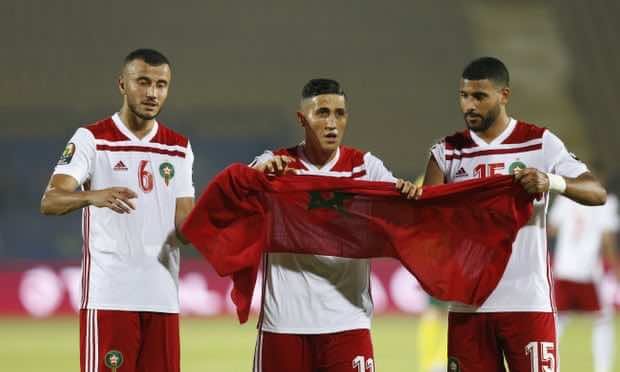
Instead of Belhanda and Hakim Ziyach, the inspiration and most of the actions now came from Hakimi, Mazraoui, and—who else but him?—Amrabat. More than a liberation—because the tempo was now Morocco’s, Boussoufa’’s last-minute goal was a vindication, a validation that this was no confrontation between the late 1990s’ Bafana and Atlas Lions.
For Renard, this is bound to be a hugely satisfying performance. Not an ideal performance, he stressed in the post-match press-conference, resorting to his usual “we could have done better” phrase, the ultimate Renard-esque match talk.
But satisfaction does not necessarily come from shattering one’s opponent. Sometimes, nothing is more satisfying than claiming exactly what is required to attain one’s goal. They needed to finish as the leader of their group, to win all the 9 points. And to do it without conceding a single goal is all the more reassuring, especially for a team fighting to break free of three decades of sloppiness in moments that hurt the most.
The spectacle was nowhere close to the mesmerizing performance against Ivory Coast; overall, though, it was—once again—enough to fill Moroccan hearts with the now flying belief, the audacious certainty that, yes, this year could be the year. To make history. To put behind three decades of dispiriting, underwhelming, and sometimes—as in 2012—soul-sapping exits from CAN.