


 Join on WhatsApp
  Join on Telegram
 Rabat – The Moroccan-Vietnamese relations will celebrate a landmark year in 2021, as the two countries celebrate 60 years of official bilateral ties.
Morocco and Vietnam are alike in many ways, both being major players in their respective regions that have been on a steady advancing path since gaining their independence.
Although the countries celebrated 60 years of official ties, the relationship between them dates back to the end of World War II in the 1940s.
The Beginnings: 1940-1960
Morocco and Vietnam’s modern ties really begin in the 1940s, as many seafaring travelers from Vietnam found Morocco and settled there.
Some of these Vietnamese settlers actually contributed greatly to Moroccan culture, such as the architect Eric Vo Toan, who designed the Mausoleum of Mohammed V, who made sure to use traditional forms of Moroccan architecture while also incorporating modern materials, eventually finishing construction in 1971.
The early relations between the two countries also existed in the other direction, as there were many Moroccan soldiers fighting alongside the French Army in the First Indochina war.
Some of these Moroccan soldiers defected from the French army and joined the ranks of the Viet Minh forces, who fought for Vietnamese independence from the French and Japanese.
This defection could have been caused by the Moroccans’ solidarity with the Vietnamese, as both countries were being occupied by foreign forces at the time.
It is also said that a Moroccan unionist, Mohammed Ben Aomar Lahrech Maarouf, was invited to Vietnam by Ho Chi Minh, a leader of Vietnam’s independence movement to show Moroccan soldiers the importance of fighting alongside the Viet Minh.

Many Moroccan soldiers who went to Vietnam to fight with the French army ended up staying there and creating an entire community.
Some of these soldiers even settled down in Vietnam, marrying Vietnamese women and starting families there. Although these families would later return to their North African homeland, they continue to uphold both Vietnamese and Moroccan traditions.
The city of Kenitra specifically has a community of Vietnamese people currently, whose families date back to their third and fourth generations, thus establishing a link between the two countries.
Official Relations
The two countries officially established diplomatic relations on March 27, 1961, a few years after Morocco had officially obtained its independence from French forces.
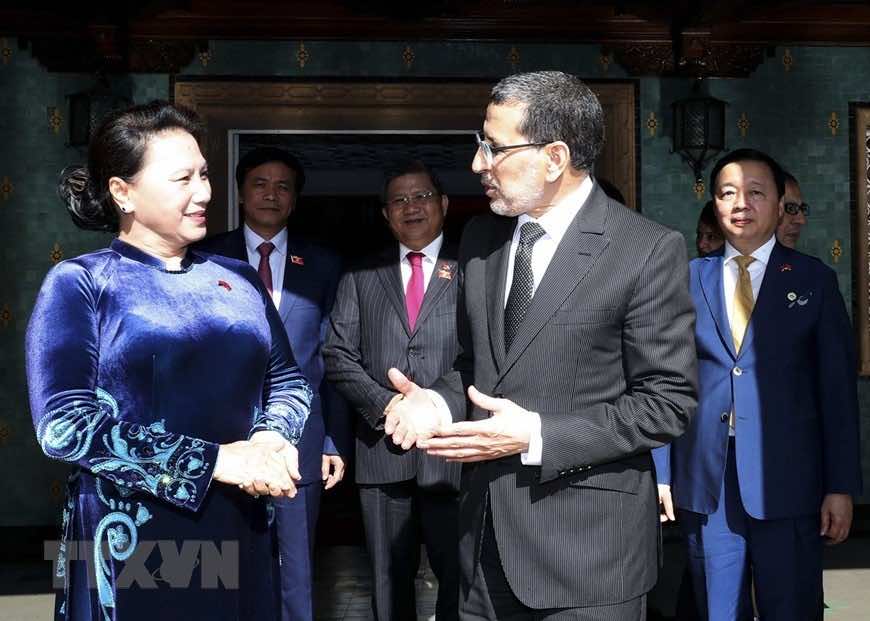
The two countries have enjoyed healthy and positive bilateral relations ever since, with delegation visits happening between the two, such as the Prime Minister Phan Van Khai visiting Morocco in 2004 and Moroccan Prime Minister Abbas El Fassi’s visit to Vietnam in 2008, meetings which opened the doors to many cooperation agreements.

Abbas El Fassi visited the President of the National Assembly in Vietnam, Nguyên Phu Trong, in 2008 (Photo Credit: Trong Duc – VNA)
The two countries have signed visa exemptions for some of their passport holders, as well as trade and investment agreements, and they have cooperated in many fields like economy, culture, and technology.
The cooperation between the two does not stop on the bilateral level, as the two work together in the context of several international and regional organizations.
Morocco notably supported, for example, Vietnam for the position of a non-permanent member of several UN committees and councils in the 2020-21 term.
Morocco was also made an observer member of the AIPA in its 41st General Assembly, which was notably chaired by Vietnam.
Vietnam and Morocco celebrated six decades of relations earlier this year, stressing the importance of opening up more avenues for even more cooperation in the future, as Morocco and Vietnam’s relation has a solid base for future development.
This will be made easier with the African Free Trade Agreement being signed in 2021, with 54 of 55 states participating, which could mean Morocco will become a gateway for Vietnamese products to find their way in other African markets, due to its strategic geographical position.
The same can be said for Vietnam. In the Southeast Asia region, Vietnam is one of the countries experiencing rapid economic growth, and is quickly carving out a position for itself in the larger region and the world, which could be a valuable opportunity for Morocco to cooperate more with the region, economically and politically.
These ties and cooperation also show up in the educational sector. Both countries offer scholarships to their students every year to study in the other, with some Vietnamese students heading to Mohammed V University in Rabat, and Moroccans studying in Hanoi National University in Hanoi, the capital of Vietnam.
Morocco also became the first African and Arab country to become a member of the Southeast Asian Ministers of Education Organization (SEAMEO) earlier this year.
Morocco Gate, A Standing Symbol
In the Ba Vi district of Vietnamese capital, Hanoi, there stands a monument that was built in the 1950s as a symbol for the ties between the two populations. The monument is known as Morocco Gate.

Hanoi’s Morocco Gate re-opened in 2018 after undergoing major renovations (Photo credit: Alexandre Dang / Hanoi Blog)
Morocco Gate was built between 1956 and 1960 by the very same soldiers that stayed in Vietnam after defecting from the French army. The monument is perhaps the best symbol of the countries’ cultural relations, as it combines Vietnamese materials and processes with Moroccan motifs and architecture.
It is reported that the design of the gate was inspired by similar structures that can be found in Morocco, and specifically by the Bab Al Mansour Gate in Meknes, of Bab Boujloud in Fes.
Morocco Gate underwent major renovations in 2018, and was reopened to a crowd which included the Moroccan Ambassador to Vietnam. The renovation also included writing the “Morocco Gate” title on the monument, in Vietnamese, English, and in the Maghrebi Arabic script, representing further Moroccan influence on the design.
Morocco and Vietnam’s shared history goes back a long time, and has been steadily progressing and evolving with time to become what it is today. The future for the two countries looks to lead to more ties between the countries and more bilateral cooperation.


