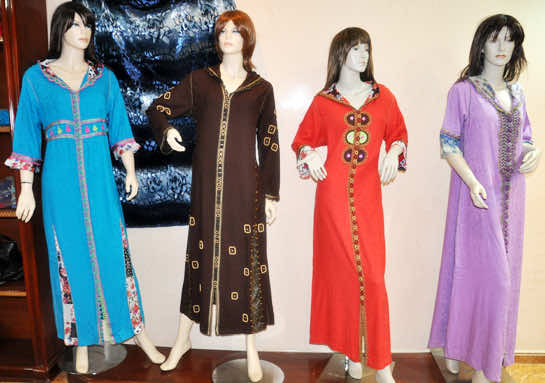
Casablanca – Apart from the Majestic Moroccan Caftan, Moroccan women are also typically known for wearing the Djellaba.
Though this traditional attire is also worn in other countries in the Maghreb and in some countries along the Mediterranean, the Moroccan Djellaba is the most famous internationally, for its faithfulness to its traditional features and its distinctive espousal of modernity.
Dejellaba’s appellation is claimed to come from the word jilbab, the name given to women’s religious dress in Islam. Jilbab is found in Qu’ran and refers mainly to traditionally long garments worn by Muslim women to cover the features of their beauty. It is sometimes used interchangeably to refer to Hijab, as long as it fulfills the Quranic demands for Muslism women’s religious screening.
Since there are no visual representations of the 7-century’s Jilbab, it is difficult to claim that contemporary Jilbab (or Moroccan traditional Djellaba) are similar to it. However, some anthropologist claim that today’s Jilbab dates back to the 19th century, since pictures of it show commonalities between the one worn at that time and the one worn today by Muslim women.
Moroccan Djellaba, akin to most other forms of Djellabas worn elsewhere, is traditionally a long-hooded, baggy robe with sleeves worn by women and young girls almost ubiquitously. It is usually made of cotton or wool, and traditionally features a baggy hood called “Kob.”
While today Moroccan women are the ones who predominantly wear this attire, Moroccan men are claimed to be the first to wear the Dejallaba, which was later on adopted by women during the time of independence (1956). Since that time, Moroccan women’s Djellaba has developed to gain more sophistication and multifariousness than men’s.
Modern Moroccan Djellaba is emphatically different from 20 century Dejellaba. The way it is now designed and worn is also clearly distinct. While most Moroccan women used to wear the scarf as an indispensable companion of the Djellaba in the past, Djellaba is worn today without the scarf. The scarf, to shake dust off misconceptions, is not to be always associated with religion, since not all women who wear scarfs forcibly do it out of religious adherence.
Unlike Kaftan and Takchita, Moroccan Djellaba is worn almost everywhere: at home, in the street, in workplaces, in the mosque, and so on. Traditional Djellaba is seldom worn during ceremonies, such as weddings for instance. Unless its sophistication and design match those of the Moroccan Kaftan, Dejallaba remains a day-to-day garment rather than an attire of special occasions.
Moroccan Djellaba is also no longer that simple traditional dress with very consistent and conservative design features. While the traditional Dejellaba of the 1960s remains intact and conserves its significance among Moroccan women, modern Djellaba has become so famous that it has become almost difficult to recognize one by a person not familiar with the mutations it has undergone.
Just like Moroccan Kaftan, Moroccan Jellaba has gain sophistication and is gradually finding its way to the most refined fashion shows and exhibitions. The Moroccan Djellaba today is bondless. You can find it in infinities of colors and designs. You may also sometimes mistake it for another sort of garment, as it has been borrowing some distinctive features from international attires, to grant it more heterogeneity.
You may notice that some Moroccan Dejallabas, particularly worn by younger women, do not feature hoods, which were some of the most recognizable features of the Dejallaba. This makes it harder for foreigners, for example, to indentify the garment. You may also notice that sleeves of some Djellabas are shorter. They almost have the length of those of T-shirts. Some Djellabas are also designed shorter, tighter and full of shapes and portraits.
The Moroccan Djellaba, like the Kaftan, has espoused the air of modernity to answer the demands of new generation of women, with new notions of beauty and elegance. Today’s Moroccan Djellaba is neither traditional nor modern—it’s both! It remains faithhtful to some of the defining features of the traditional Djellaba, yet injects a discernible contemporariness in it, in terms of colors, deigns and tissues.
With such conflation of the traditional and the contemporary now characterizing Moroccan Djellaba, the attire is increasingly sweeping the world and reaching the hearts of many women worldwide. Akin to its fellow Moroccan attire, the Kaftan, the Moroccan Djellaba now aspires to universality and international light. Hence, Moroccan contemporary fashion designers are now endeavoring to share the distinctiveness of this dress with the world, by adapting it to all tastes and preferences.
© Morocco World News. All Rights Reserved. This material may not be published, rewritten or redistributed