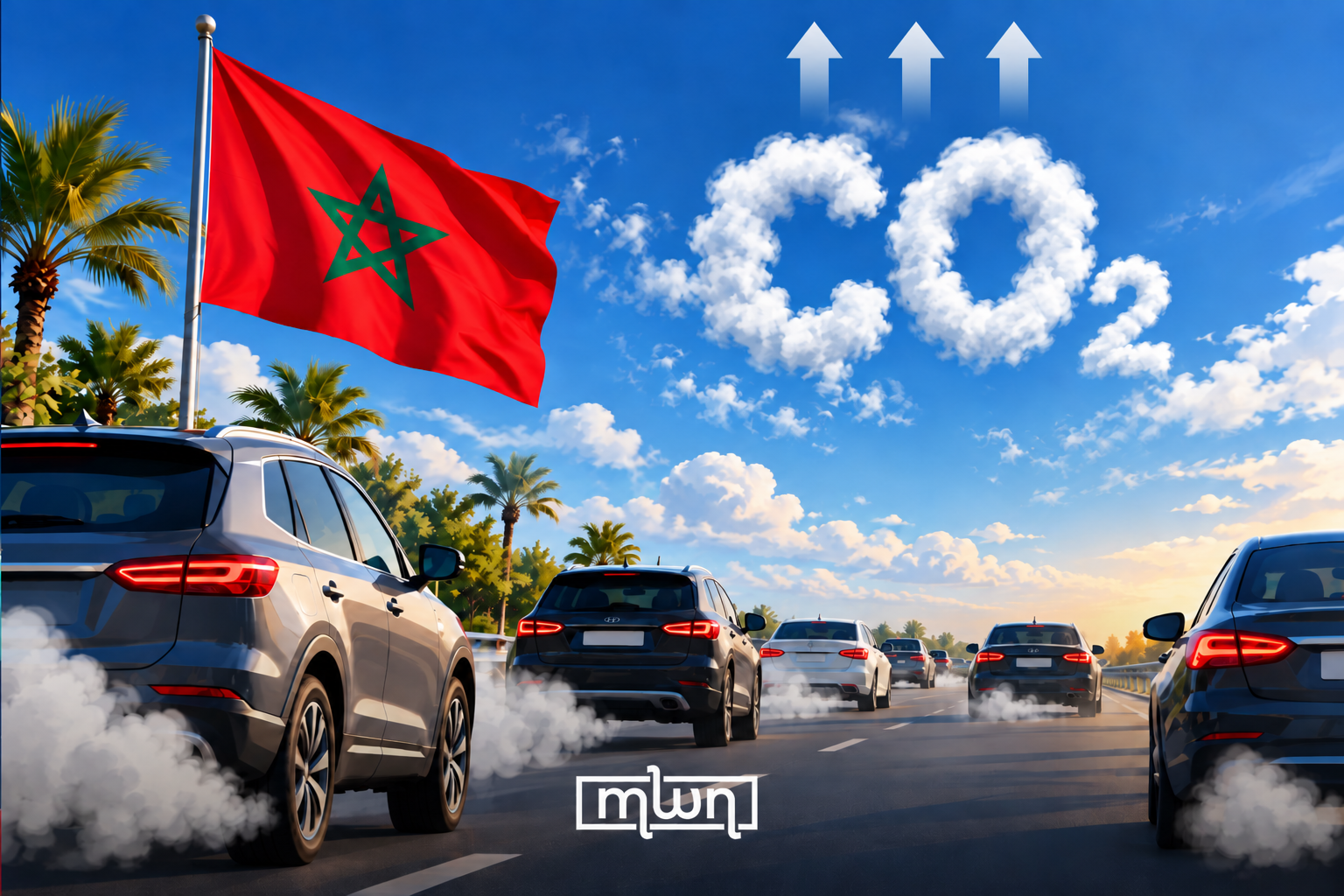
Marrakech – Morocco has not adopted mandatory fuel economy standards or fuel economy labeling for vehicles, a gap identified in a new reference study on the country’s shift toward low-carbon road transport.
The assessment was produced under the IMPROVE project, implemented in Morocco by the Deutsche Gesellschaft für Internationale Zusammenarbeit (GIZ) and funded through the International Climate Initiative of Germany’s environment ministry (BMUKN).
It was carried out in partnership with the Ministry of Transport and Logistics and the National Road Safety Agency (NARSA), with contributions from the Ministries of Economy and Finance and of Industry and Trade. The study maps the economic, environmental, and regulatory dimensions of the sector and pinpoints what is missing.
The study opens with the emissions data. In 2023, transport accounted for 28% of Morocco’s total CO₂ emissions and 36% of final energy consumption, and the sector remains more than 99% dependent on oil.
Road transport ranked as the second-largest source of CO₂ emissions in 2022, at 17.5% of the total. Passenger vehicles alone were responsible for 51% of greenhouse gas emissions from land transport that year.
Those figures come as the fleet keeps expanding. Between 2015 and 2023, registered vehicles rose from about 2.68 million to 4.47 million, an average annual increase of 6.5%. The motorization rate climbed from 55 to 88 vehicles per 1,000 inhabitants over the same period. In 2022, the average passenger car was 13 years old.
Morocco has meanwhile built a major automotive industry. In 2024, the sector represented 23% of industrial value added and supported 280,000 jobs across 230 suppliers. It generated MAD 154.49 billion ($15.45 billion) in exports in 2025, equal to 33% of the country’s total, making it the leading export sector.
Morocco produced more than 500,000 vehicles in 2025, reached a capacity of 1 million, and targets 2 million by 2030. It has been Africa’s largest producer of passenger vehicles since 2024 and the fourth-largest supplier by volume to the European Union.
The country is also positioning itself in electric mobility, reaching an EV production capacity of 100,000 units in 2025 and aiming to supply 400,000 to 500,000 EVs a year from the end of 2026.
Yet the study contrasts this industrial ambition with the state of domestic regulation. Despite its international commitments, it notes, Morocco has not implemented vehicle efficiency policies such as fuel-consumption labeling, a bonus-malus system, CO₂ emission standards, or a zero-emission vehicle (ZEV) mandate requiring manufacturers to supply a set quota of clean cars.
Existing measures fall short. The study describes them as either too narrow, such as the scrappage premium limited to taxis, or insufficient, such as the ban on importing used vehicles older than five years, which carries numerous exemptions.
Electric and hybrid vehicles benefit from a reduced import duty of 2.5% instead of 17.5% and exemptions from the luxury and annual taxes, but there is no purchase subsidy or conversion bonus for households or companies.
Morocco’s climate commitments are more ambitious than its current rules. Its 2025 Nationally Determined Contribution targets a 53% cut in total emissions by 2035 against a business-as-usual scenario, conditional on international support, with an unconditional target of 21.6%.
Transport is projected to contribute 9% of that effort, a potential reduction of 7.48 million tonnes of CO₂-equivalent between 2026 and 2035, through 13 measures that include a bonus-malus system and CO₂ standards.
To close the gap, the study sets out priority actions: deploy a system to improve vehicle and fuel-consumption data, introduce the bonus-malus scheme, adopt CO₂ standards for new cars and vans, integrate efficiency labeling, and expand charging infrastructure.
The Ministry of Transport and Logistics has publicly stated its intention to introduce a bonus-malus system and is working on its design, though the report cautions that success will depend on early coordination with the Ministry of Economy and Finance.