 Join on WhatsApp
 Join on Telegram
Rabat- “Art grows from joy and sorrow; but mostly from sorrow. It grows from human lives.“ Edvard Munch.
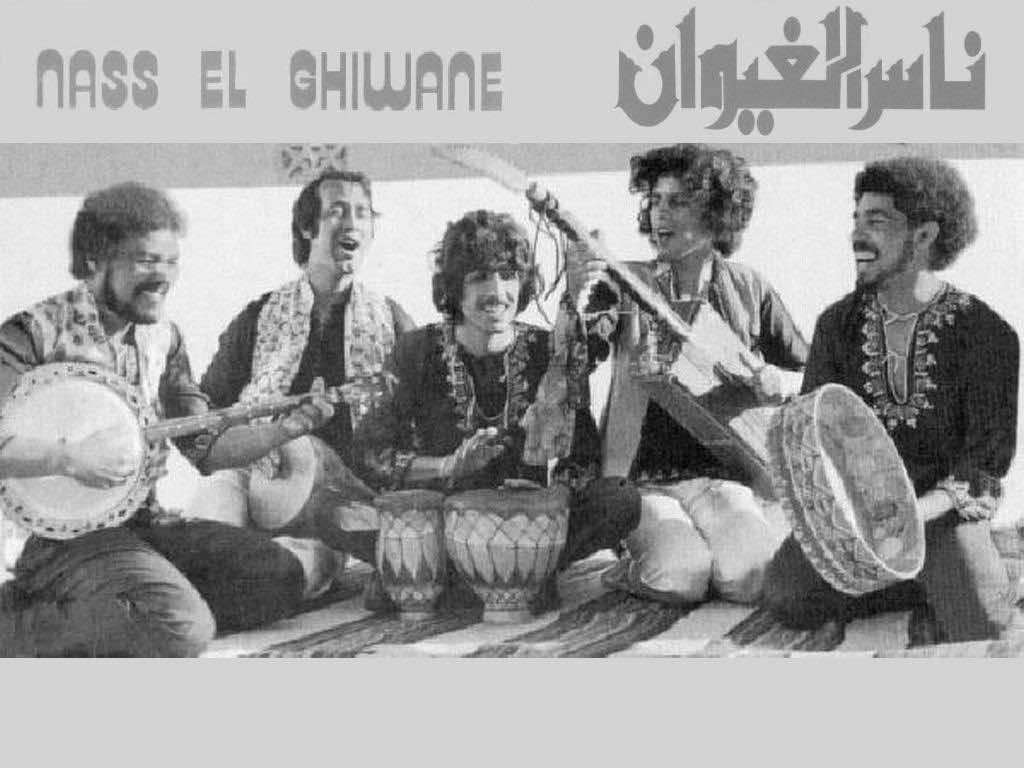
Suffering has been associated with art for so long. Humanity has endured a great many experiences and has generated creative ways to showcase its suffering through art. Every person has an artist sleeping inside who wakes up only when its vision is bleak and the horizon hides its colors. Though some contemporary artists contradict this statement and seem to be most productive only when they are happy, this is not the case with the Moroccan music band Nass El Ghiwane.
The 60s and 70s represented a significant transitional point in history. People’s political awareness started to grow and many voices emerged to shape reality in creative ways. Nass El Ghiwane stood out by putting on unprecedented performances in which they tackled issues that touched the core of the Moroccan society.
Boujmia Hagour, Laarbi Batma, and Omar Siyed, three young men who came from simple families and lived in the poor neighborhood of Hay El Mohammadi in Casablanca, set the pillar for a band whose echo traveled across the globe. Their passion for music brought them together. First established in 1970, Nass El Ghiwane gained fame and built a reputation. More enthusiastic youth joined their journey: Abderahman Paco, Allal Yaala, Mulay Abd Laaziz Tahiri, and Mahmoud Saadi, though the last two quit the band very early.
In October 1974, the band lost its founder Boujmia. His presence in the band was short, but he set out the path for it to follow. His lyrics and the strong voice gave Malhun songs a different taste. In a poem that marks disbelief towards the death of Boujmia, entitled “Annadi ana” (I am calling), the band repeated:
“My brother passed away yesterday
His news arrived just today
My brother died of agony
Leaving behind his places and family
O no brother, you are still with us
Or is it me that cannot take the loss”
The band started to perform at Casablanca’s famous theatre Al-MasraH Al-Baladi. At that time, the artist, Tayeb Seddiki, known as the godfather of young talents, was amazed by this group of young men who were fascinated by their own language and popular art; Nass El Ghiwane was the first musical band that Seddiki described as “troubadours.” Moroccans recognized Nass El Ghiwane’s music to be the mirror of their everyday life. Few are the instances when you enter a Moroccan house without finding a tape, a CD or the lyrics of their songs written on a piece of paper.
The era of Batma, Siyed, Allal and Paco coincided with a revolutionary movement in the 60s and 70s that took on a satirical approach to society, mainly manifested in poetry, Zajal, criticism, and theater. The “phenomenon” of Nass El Ghiwane drew inspiration for its verses from Moroccan popular culture. The “Moroccan maternal heritage” and was always present in their well- versed poems.
The band contributed to the shaping of a conscious and politically aware generation. Their songs had stinging criticism of society and the spread of corruption within its institutions. The late Hassan II received them exclusively to perform before him their most political songs. This unexpected invitation came at a time when people “rolled their tongues seven times” before they could speak of politics in Morocco.
After Laarbi Batma’s death from cancer in 1997 and the withdrawal of Paco, Nass El Ghiwane could have perished and been forgotten, like any band that lost significant icons like these
However, Omar Siyed and a new member of the artistic Batma family continued to entertain Moroccans with authentic rhythms that Moroccans have memorized since they were kids. Nass El Ghiwan has become an icon of Moroccan music. It combined Gnawa music of “Paco”, Chaabi music of Chaouia “Batma,” and Amazigh music of “Omar Siyed,” creating a mosaic of cultural specificities fused together and formed into a harmonious breeze to which Moroccans fall submissively whenever it blows.
Nass El Ghiwane was not just a craze; it was a phenomenon that inspired many prominent writers, poets, and film makers who chose to honor their writing careers with at least one work devoted to the legend of Nass El Ghiwane, including Ahmed El Maanaoui (“Transes”), Ahmed Sayeh, Mohammed Bennis, D.Caux, T.Fuson, and Taher Benjeloun, among many others.
Nass El Ghiwane sung for love, hope, peace, victory and failure, beauty, the body, the land, and the country. Their songs will be a constant reminder of authenticity and an immortal link to Moroccan roots.
They even sang about cats:
My kitten
My kitten is little
Her name is Namira
Playing with her is such a joy
She follows me like my shadow
She shows off a skill
To haunt a mouse
She is beautiful
Her hair is long
The simplicity of their themes and the way in which they presented them was revolutionary. In addition to the religious songs, in which they praise the Prophet of Islam, they have inspired Moroccans to sing about a tray, “S-siniya,” as if it were a diamond. S-siniya’s cultural and social connotation in Morocco goes beyond the fact that it is a mere tool with which to serve food or drinks. When a family gathers around a tray on which tea is served, they perform a very sacred ritual in the Moroccan culture. It symbolizes unity, hospitality, generosity, and company. These are the principles that Nass El Ghiwane has tried to transmit in its songs.
Edited by Melissa Smyth
© Morocco World News. All Rights Reserved. This material may not be published, rewritten or redistributed