


 Join on WhatsApp
  Join on Telegram
 Rabat – Confusion of perceptions impairs the coherence of the perspectives of the educational system in Morocco.
“When you don’t need anyone else to push you deeper in your problems than yourself” a friend of mine likes to say “check if you aren’t Moroccan!” One may not like this thought, but my friend thinks that his seventy years of age forty of which at the service of the educational system in one way or another, and in public life, authorize him to sustain such a claim!
An argument I hear and read very often about the educational system in Morocco is that it used to be much better in the past and that it did “produce” geniuses. While the system may actually have “produced” some geniuses, it has never met one of its most critical objectives, namely, universal coverage, that is, education for all. Furthermore, the closer the system got to its quantitative objectives regarding initial enrollment, the highest the rates of dropping out soared especially among girls, in rural areas, in marginal neighborhoods and among the most vulnerable populations. In fact, the farther cohorts of pupils advance in the system, the thinner they become until, by the time they are supposed to finish college, they are way below ten percent. This quantitative situation, alone, beats the romantic vision that the system has, at some given time, been able to satisfy any of its declared objectives or needs of the population. This consideration, alone, makes talking about the other aspects of the system such as quality, relevance and cost efficiency meaningless.
It seems that we, Moroccans, either have a very short memory or we prefer to occult reality and turn our heads away from it. We also tend to personalize issues and focus on ourselves and on factors that serve our own personal interests. What one needs to hear when those argue that the educational system was better in the past than it is in the present is actually that they are better educated and trained than those who graduated after they did. These will also look back on their achievements and successes with satisfaction and let you understand that they are among the geniuses the system had “produced” when it was still of a good quality. Likewise, they will explain the current difficulties and failures of everything around them by the poor quality of the profiles of those who have been trained after they had left school. An interesting test anyone can run is to ask individuals about when they think the “level” has dropped beyond reasonable acceptance. The probability is very high that they will set the timeline right after their own graduation.
Many will also argue that schools in remote and poor areas have “produced” better minds than those in rich urban neighborhoods. They will always have examples to give you, they will mention names of high raking army officers, brilliant surgeons and engineers and bright individuals who have managed to make it to the top of the administration. These will very probably be among the lucky tiny minority who made it through despite all social, economic and political odds and to fill the spots that the global agendas of the ruling class needed filled. They will tend to think of themselves as “geniuses” just like the members of their socio-cultural networks forgetting that these cases are droplets in the ocean of the urban rich and high middle class counterparts. Most will, however, tell you that when they went to school things were tough and syllabuses were neither appropriate to the needs of the nation nor were they sensitive to its identity and cultural heritage. The whole curriculum, they will argue, was geared to cater to maintaining the privileges of the few in major urban centers who continued serving and protecting the interests of the former colonial power at the expense of their countrymen’s and that they were undemocratic and disrespectful of the local populations. Inevitably, they will also tell you that the system was elitist, selective and exclusive.
Rational evaluation faculties are put on hold as soon as one is at the center of the process leaving it to passion and emotion to take over. The effect of natural relationships is thus downscaled and logic is relegated to lesser levels of the reasoning process. The paradox is that there is a consensus on operating a radical rupture with the “current’ educational system which most agree has ceased to be relevant, let alone efficient, at least immediately after one has graduated. The consensus covers such concepts as those of equal opportunity, compliance with the provisions of the constitution as regards human rights, gender issues, cultural plurality, modernity, relevance to the requirements of sustainable development, and inclusiveness, as well as those relating to attitudes such as responsibility, accountability, critical thinking, good citizenship, tolerance and entrepreneurship.
While hardly any party of the stakeholding community will challenge the broad formulation of any of these principles, very few will agree on what they involve in pedagogical terms, what they imply in terms of content and which consequences to expect from them in terms of cultural adjustments and social behaviors. The divergence in interpreting these principles and translating them into operational procedures is what causes the confusion which impairs the development of a coherent perspective for the Moroccan educational system. Agreeing on definitions might have been the link that was missed in the consensus building process of the current perspective!
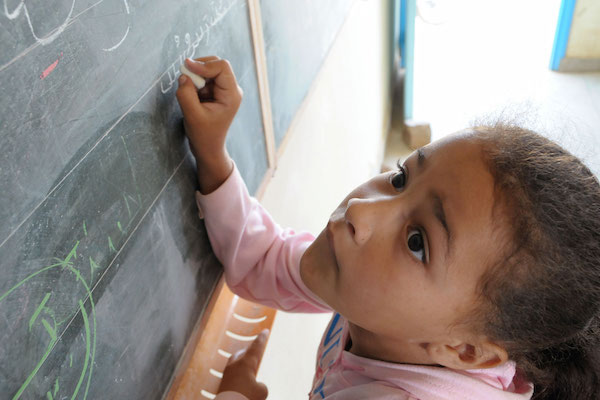
Photo credit: Unesco/Abdelhak Senna
© Morocco World News. All Rights Reserved. This material may not be published, rewritten or redistributed without permission
The views expressed in this article are the author’s own and do not necessarily reflect Morocco World News’ editorial policy


