


 Join on WhatsApp
 Join on Telegram
Rabat – The Middle East and North Africa has become associated, in international news, with wars, terrorism and sectarian tensions.
Amid this gloomy picture, few countries stand out as models for peace and stability. Morocco is one of them.
The kingdom has been hailed by international media as a beacon of peace and tolerance, and an example of a nation that is taking slow but steady steps toward democracy and economic development.
Morocco is seen as a country that chose a different path from its neighbors who are plunged either in violence or deep political and economic crises.
In an article published by “The Australian”, the news website’s foreign editor, Greg Sheridan, made an account of his visit to the kingdom and explained why it offers “an altogether different scene in the heart of the Arab world”.
“Of all the Arab states of North Africa and the Persian Gulf, none has a serious case for emerging from the Arab Spring in better shape than Morocco”, said Sheridan.
The experienced reporter substantiated his argument by saying that Morocco’s “economic growth rate is better than 4.5 per cent”, and that the kingdom “has had two democratic elections ultimately producing stable governments”.
In addition to that, Morocco “has free trade agreements with the US and Europe; its society is functioning; it is a stable military ally of the US; its last significant terrorist attack was in 2011 (in Marrakesh)”.
To understand how Morocco managed to preserve its peace and stability in this agitated part of the world, Sheridan asked Morocco’s foreign Minister, Nasser Bourita, about what made the kingdom different from other countries in the region.
“I think there were many reasons…Many observers from Australia or the West tend to think of the Arab world as a single bloc. But it’s not the case. Every country is different. Morocco is not Libya, which is not Yemen, which is not Saudi Arabia. Morocco was a state for more than 13 centuries,” said Bourita.
History, no matter how important, has to be strengthened by reforms in the present. If stagnation led to revolutions in other Arab countries, toppling regimes that reigned for decades, Morocco has been on the move in the years that preceded the “Arab Spring”.
“For Arab countries, the question was whether historical legitimacy was enough for the future. His Majesty brought a new social contract. He chose stability through reform”, said Morocco’s chief diplomat.
Bourita went on to explain that, “There were some (in the region) who believed stability could be achieved through the status quo, through freezing everything. Our stability was achieved through a new constitution, through transitional justice, through improvement in the status of women, through big projects for human development.”
Still, Morocco recognizes that being a stable country does not mean it is not affected by the surrounding turmoil. Extremism is a global phenomenon that saw Moroccan youth travel to Syria to join the ranks of terrorist organizations.
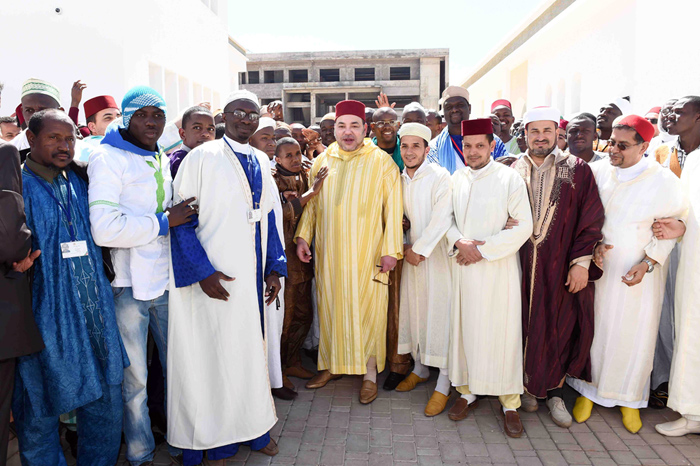
To counter such a threat, Morocco invested in educating imams and preachers, both from the country, Africa and Western Europe, to promote a true image of Islam as a religion of peace and tolerance.
The Mohammed VI Institute for the Training of Imams in Rabat is the spearhead of Morocco’s engagement in the fight against the extremist ideology. Greg Sheridan got to take a tour in the institute, learn about the program and talk to the institute’s director.
“One of the main objects of this institute is to correct the extremist reasoning and understanding of religion,” said Abdesselam Lazaar.
He added that, “The extremists misuse religious reasoning for extremist purposes. This institute corrects the reasoning of extremists. Then the extremists can talk only with weapons. One day the extremists will understand they have nowhere left to work because this institute has filled their space.”




