
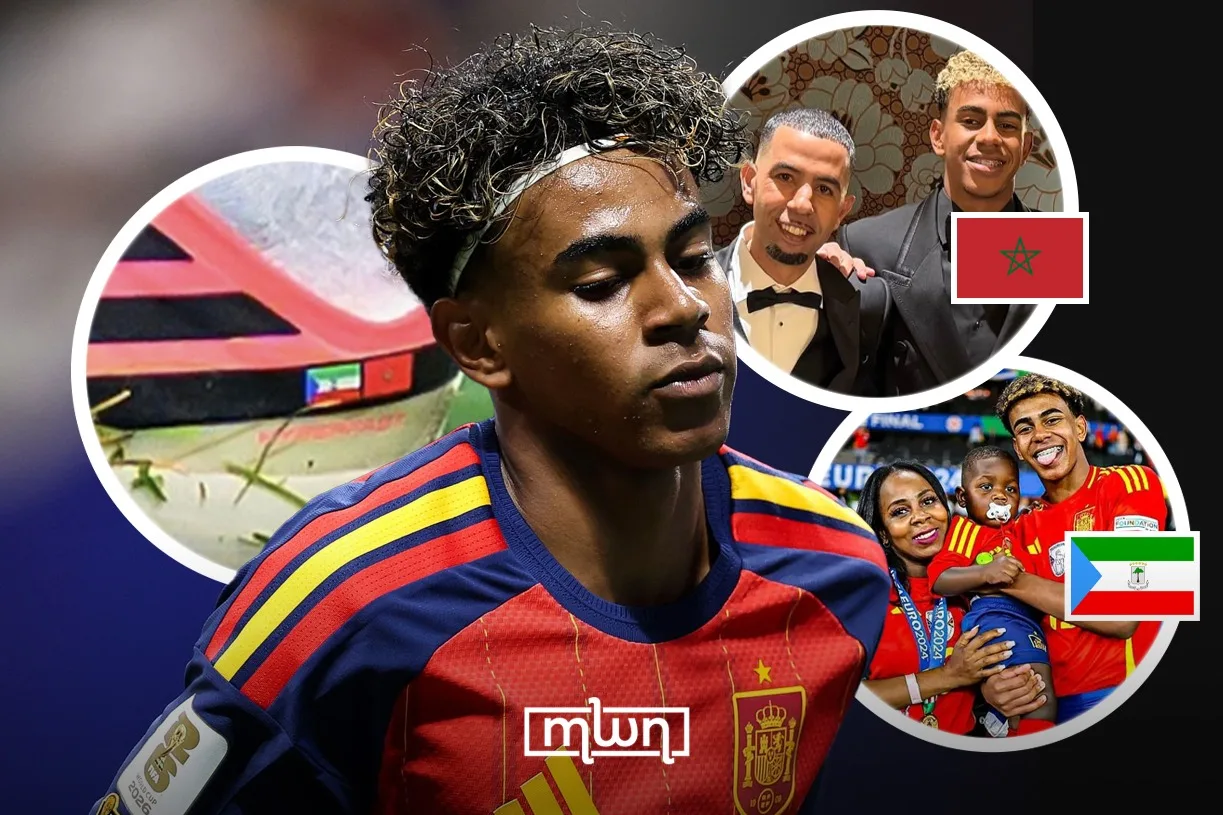
Casablanca — The plastic tips of football boots aren’t usually where one looks for a national crisis, but that is exactly what happened during the Euros and the 2026 FIFA World Cup, when Lamine Yamal stepped onto the pitch. On his shoes, the teenage phenom wore the tiny flags of Morocco and Equatorial Guinea, the birthplaces of his parents.
To some critics, this small tribute was a massive provocation. A recent opinion piece in El Español went as far as to argue that the young winger’s Spanish identity is tenuous, suggesting he plays for Spain purely for professional and financial advantage rather than a deep, emotional loyalty to the country.
The argument relies on a bizarrely toxic comparison. It contrasts Yamal with UFC fighter Ilia Topuria, who moved to Spain as a 15-year-old teenager and loudly adopts Spanish symbols. The critic claims Topuria is substantively Spanish because he chooses the culture, while Yamal’s loyalty remains split by blood and ancestry.
But this logic is fundamentally broken, and it sets a dangerous double standard for the children of immigrants.
The performative patriotism test
Why does a child of immigrants have to perform hyper-nationalism just to be accepted as a true citizen? Yamal grew up in Rocafonda, a working-class neighborhood in Mataró. He is a total product of Spanish public spaces, Spanish neighborhoods, and the Barcelona football academy. He has lived his whole life in Spain.
Yet, because he refuses to erase his family history, his right to represent the nation is questioned.
Dual-national kids face immense pressure from multiple sides when choosing which country to represent. The idea that he chose Spain simply for a paycheck is incredibly cynical, and his performance on the field destroys that narrative.
An athlete does not play with that level of intensity for a squad they are merely using for transactional benefit. During Euro 2024, Yamal was the creative engine of the team, racking up a tournament-high four assists, tying the all-time Euros record, and scoring a stunning semi-final goal against France on the way to winning the title and the Young Player of the Tournament award.
Wearing the Moroccan and Equatorial Guinean flags on his shoes is not a rejection of the shirt he wears; it is a thank-you to the parents who raised him and the origins that shaped his family.
His professional commitment is backed by 26 appearances, 6 goals, and 12 assists for the senior team by the age of 18.
Yamal fulfills his legal and professional duties perfectly on the pitch. His boots are personal property, and his identity is personal domain.
This constant scrutiny is nothing new for minority players in Spanish football. Yamal’s teammate and close friend, Nico Williams, has faced targeted stadium abuse domestically despite starring for the national team, while his brother, Iñaki Williams, had to take fans to court over racist monkey chants, proving that no matter how much talent these athletes bring to the pitch, a vocal segment of supporters remains obsessed with an impossible cultural purity test.
A transactional relationship
The real hypocrisy here lies in how the public treats minority athletes. When Yamal scores a brilliant winning goal, the entire country claims him as a national hero. The bars celebrate, the commentators scream his name, and his Spanish passport is suddenly a source of pride for everyone.
But the moment he steps off the pitch and shows a multi-faceted identity, those same critics gatekeep his citizenship.
If he is Spanish enough to sweat, run, and win titles for the national team, he is Spanish enough to decide what symbols he wears on his own gear.
A modern, strong democracy shouldn’t be terrified of a football boot. A country is strong when its citizenship is based on a legal pact of shared rights and duties, not an outdated ethnic purity test.
Spain is changing, and its population is becoming more diverse, with a record 299,732 foreign residents acquiring Spanish citizenship in 2025 alone, led by Moroccans as the number one country of origin with 42,114 naturalizations, according to the Instituto Nacional de Estadística.
Yamal is not an anomaly; he is part of a modern, pluralistic reality.
Trying to police a teenager’s footwear doesn’t protect Spanish culture. It just shows a deep insecurity about what it actually means to belong.
Morocco World News is also on X — check out our latest posts now! Get MWN on iOS and Android for instant access to breaking news.