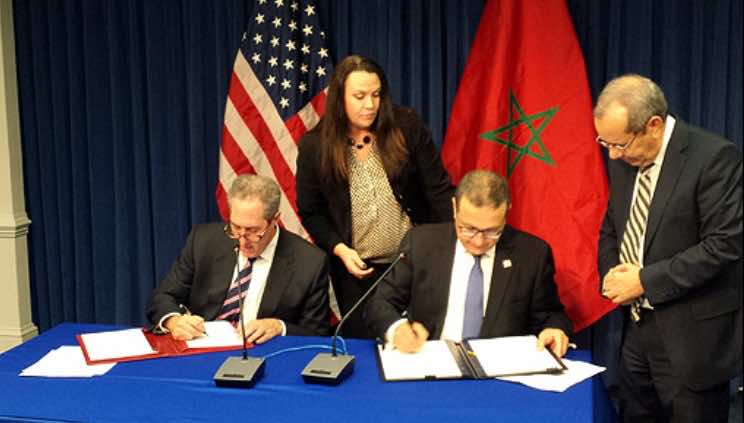
Rabat – In the twelve years since its implementation, the US-Morocco Free Trade Agreement (FTA) has dramatically exceeded the predictions initially set by the United States International Trade Commission (ITA).
The success story of the US-Morocco FTA was relayed by the Moroccan American Center for Policy (MACP) in its latest report “Exceeding Expectations: The US-Morocco FTA”, chronicling the origins and impact of the deal concluded in 2004 and implemented a year after.
On January 1, 2017, the US-Morocco FTA began its 12th year “enforcing liberalized commercial exchange between two historic allies,” states the report, adding that the FTA has “surpassed moderate expectations for its economic impact, and has been a success story for both sides.”
The report gives a thorough analysis of how Morocco became the US’s number one free-trade partner in Africa and evaluates its economic and political impact compared to expectations, while evaluating avenues for improving the FTA and general US-Morocco economic cooperation.
Throughout the last 12 years, the ITA expected US imports from Morocco to increase by USD 198.6 million. However, US exports reached this number by 2007, just two years after the agreement was implemented. “Through mostly sustained improvement up to 2016, US exports to Morocco have actually increased by about $1.4 billion, amounting to a 286 percent boost,” states the report.
The US-Morocco agreement was part of a wave of bilateral FTAs signed by the US between 2004 and 2010, but “Morocco’s success stands out among this group,” states the report.
“In the first two years following implementation, US exports to Morocco shot up by 118 percent, nearly double the percentage of the next most successful country over a similar time period. Moroccan exports to the US grew by 18 percent as total bilateral trade grew by 68 percent—the highest among this group of FTA partners,” the report further explains.
Not only the FTA helped generate economic benefits for both parties, one of the US’s primary goals was to use the FTA as a vehicle to promote bilateral relations as well as Morocco’s reform trajectory. Since its enactment, US-Morocco relations have supported this assumption by continuing to advance in several areas, particularly in development and security.
The report assuages the concerns of those opposed to the FTA, as Morocco has maintained a clear trajectory of reform to improve its labor environment. Before the 2004 FTA, Morocco had undertaken reforms improving conditions regarding child labor, overtime pay, minimum wage, and worker safety, and was a signatory to seven of the eight core conventions of the International Labor Organization.
The United States International Trade Commission’ report also stressed Morocco’s strong commitment to reform and improving workers’ rights, before and after the FTA was implemented, lauding Morocco’s National Human Rights Council (CNDH) as a force in spurring reform and identifying areas for improvement.