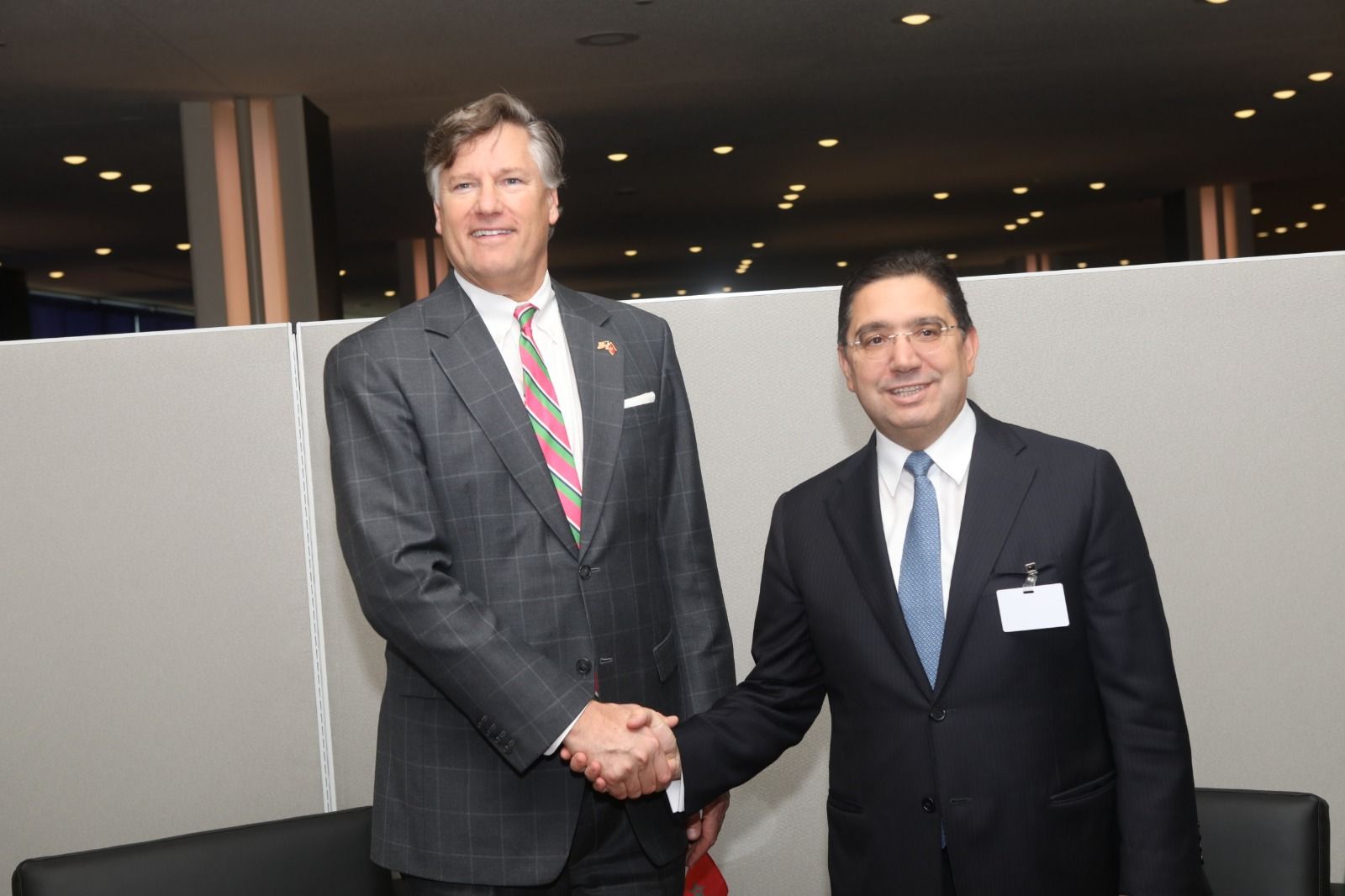
Marrakech – The United States has reaffirmed its commitment to developing the Western Sahara region under Moroccan sovereignty. Deputy Secretary of State Christopher Landau made the remarks Friday in New York, following talks with Foreign Minister Nasser Bourita on the sidelines of the 81st UN General Assembly.
Landau told reporters that Washington and Rabat had “reaffirmed the centuries-old friendship” between the two countries, along with “our shared vision for the development of the Sahara region and for strengthened cooperation under Morocco’s sovereignty over this territory.”
He added that the United States is eager to work with Morocco “and the other parties concerned to resolve this conflict once and for all.” The dispute has run over 50 years, and Landau argued that “this status quo cannot be maintained.”
He also confirmed that the “great, longstanding friendship” between Rabat and Washington “will continue in the future,” with relations at their best level ever.
The exchange followed an earlier meeting in New York. On Wednesday, Bourita held talks with Massad Boulos, President Donald Trump’s special adviser for Arab and African affairs.
Boulos called the discussion important, pointing to “long-standing U.S.-Morocco partnership and shared regional priorities.” He affirmed Washington’s commitment to “deepening our cooperation and working together to advance peace, security, and prosperity across the region.”
The meetings come as the UN Security Council prepares to review the MINURSO mandate next month, before it expires on October 31. A week earlier, Washington had reaffirmed the Moroccan character of the Sahara in a joint statement with Morocco and Israel.
Boulos’s outreach also followed his September 13 visit to Algiers, where he met President Abdelmadjid Tebboune, following a September 9 call with him.
Washington’s position dates to December 2020, when Trump recognized Moroccan sovereignty over the entire territory and backed the 2007 Autonomy Plan as the only basis for a settlement. In April 2025, Secretary of State Marco Rubio reaffirmed that decision.
Landau urged American firms to invest across Morocco, including the Sahara, in September 2025, and declared in Rabat in April 2026, in language that left no room for ambiguity, that “the United States recognizes Morocco’s sovereignty over the Sahara.”
The framework hardened with Security Council Resolution 2797, adopted on October 31, 2025. The US-drafted text instructed the political process to proceed “taking as basis Morocco’s Autonomy Proposal,” called genuine autonomy the “most feasible outcome,” and extended MINURSO until October 31, 2026.
The resolution passed with 11 votes in favor, none against and three abstentions – China, Russia, and Pakistan – while Algeria did not participate in the vote.
Landau’s stress on development ties the diplomacy to Morocco’s investment in its southern provinces. Rabat launched its New Development Model in 2015 with an initial MAD 77 billion ($7.7 billion), funding the Dakhla Atlantic Port, the Tiznit-Dakhla expressway, desalination, and renewable energy.
In 2025, it selected investors for six green hydrogen projects worth a projected MAD 319 billion ($31.9 billion).
The 1,055-kilometer expressway was recently named the “Donald J. Trump Highway” by royal decision conveyed to the US president on July 2. Trump publicly thanked King Mohammed VI on July 26, calling it a “Great Honor” and saying he hoped to travel its full length “hopefully soon.”
The Polisario Front and its Algerian sponsors continue to cling to a separatist demand that the international community has steadily abandoned. Both rejected Resolution 2797, isolating themselves further from a diplomatic process now firmly anchored in Morocco’s Autonomy Plan.
Their obstruction sustains a manufactured conflict that has stalled the region’s development for over 50 years, while the momentum on sovereignty, investment, and international recognition moves decisively against them.