 Join on WhatsApp
 Join on Telegram
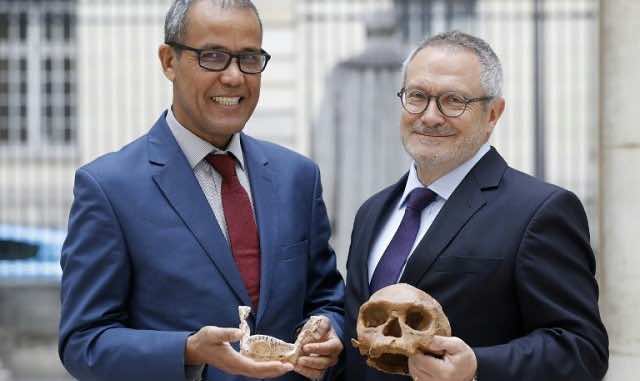
Rabat – The recent discovery of the oldest-known remains of homo sapiens in Morocco has drastically altered the modern understanding of human evolutionary history. But less known is the important role that Moroccan scientists played in the discovery.
In an interview with Morocco World News, Abdelouahed Ben-Ncer, research professor at the Moroccan National Institute of Sciences of Archaeology and Heritage (INSAP), explains how the team he co-directed made the breakthrough possible.
How was the discovery made possible, and how much time did it require of your team?
The discovery is a fruit of a collaboration between the National Institute of Sciences of Archaeology and Heritage and Max Planck Institute for Evolutionary Anthropology.
Researchers have been studying the fossils since they were found in 2004. But to uncover such history-altering discovery to the scientific community and the public does not happen over night. It requires a rigorous process of scrutiny and study.
At this point, the accuracy of the results of the finding are almost unquestionable, making it possible for making the big reveal. The program has chosen the journal Nature to publish the findings of its 13 years of hard work on June 7.
To what extent did Moroccan scientists and researchers participate in the study of the Homo Sapien fossils?
To great extents! During the examination of the fossils, expertise from at least 10 domains was required to generate the kind and history of the fossils, including paleontology, zooarchaeology, lithic analysis as well as geology, and Moroccan scientists have participated in all of these fields, along other foreign scientists.
The discovery of human remains at Jbel Irhoud has been described as ground breaking. Why?
The program’s researchers have found Homo Sapien fossils identified as being from the early members of Homo Sapiens that date back to 300,000 years ago, wiping off the credibility of previous data that had shown that our ancestors evolved 200,000 years ago.
This implies that 100,000 years of the presence of our species on earth was unexplored until the fossils at Jbel Irhoud were extracted and examined. The fact alone makes the discovery a scientific “earthquake.” It has rocked our knowledge on the very beginnings of the time our ancestors spent on earth.
Adding to that, the discovery also indicates that the oldest of the only extant human species fossils evolved in Africa and it was extracted from Jbel Irhoud, Morocco.
Is this the first discovery made in Jbel Irhoud, or is it one of many?
Jbel Irhoud was discovered by coincidence in the early 60s. Since then, a substantial number of fossils were discovered in the site, which has driven Jbel Irhoud to become an international site for archeological discoveries.
However, with time, its status and name withered, and that is because it lacked a momentum element in archeological science, historization.
This is not to say that archeologists who studied the site in the 60s lacked talent or knowledge, rather the historization methods during the time weren’t as advanced as they are now, which allowed for the program’s researchers to adequately categorize the fossils found in Jbel Irhoud on the basis of accurate historization.
Will the newly-discovered fossils be exhibited in Morocco or elsewhere?
Since the very beginnings of Homo Sapiens, these fossils have never left Morocco, nor will they in the future. All of the fossils extracted from Jbel Irhoud, under the collaboration between Morocco and Germany, are to stay in the land in which they were discovered.
As to their exhibition, some aspects of the fossils are still being studied to further enrich the results of the discovery.
What are the current measures taken by Morocco to preserve its archeological heritage?
Law number 2280 in the Moroccan juridical law provides for the protection of archeological and historical features located on Moroccan lands. It criminalizes acts of vandalism or “treasure hunting.” It also urges all Moroccans to protect the integrity of their national heritage.
I personally emphasize on the protection of the archeological treasures in Morocco. There could some people, driven by curiosity, who would want to visit the site, I advise them to respect the integrity of Jbel Irhoud because without the richness it provides, we wouldn’t have been able to make such a history-[altering] discovery.