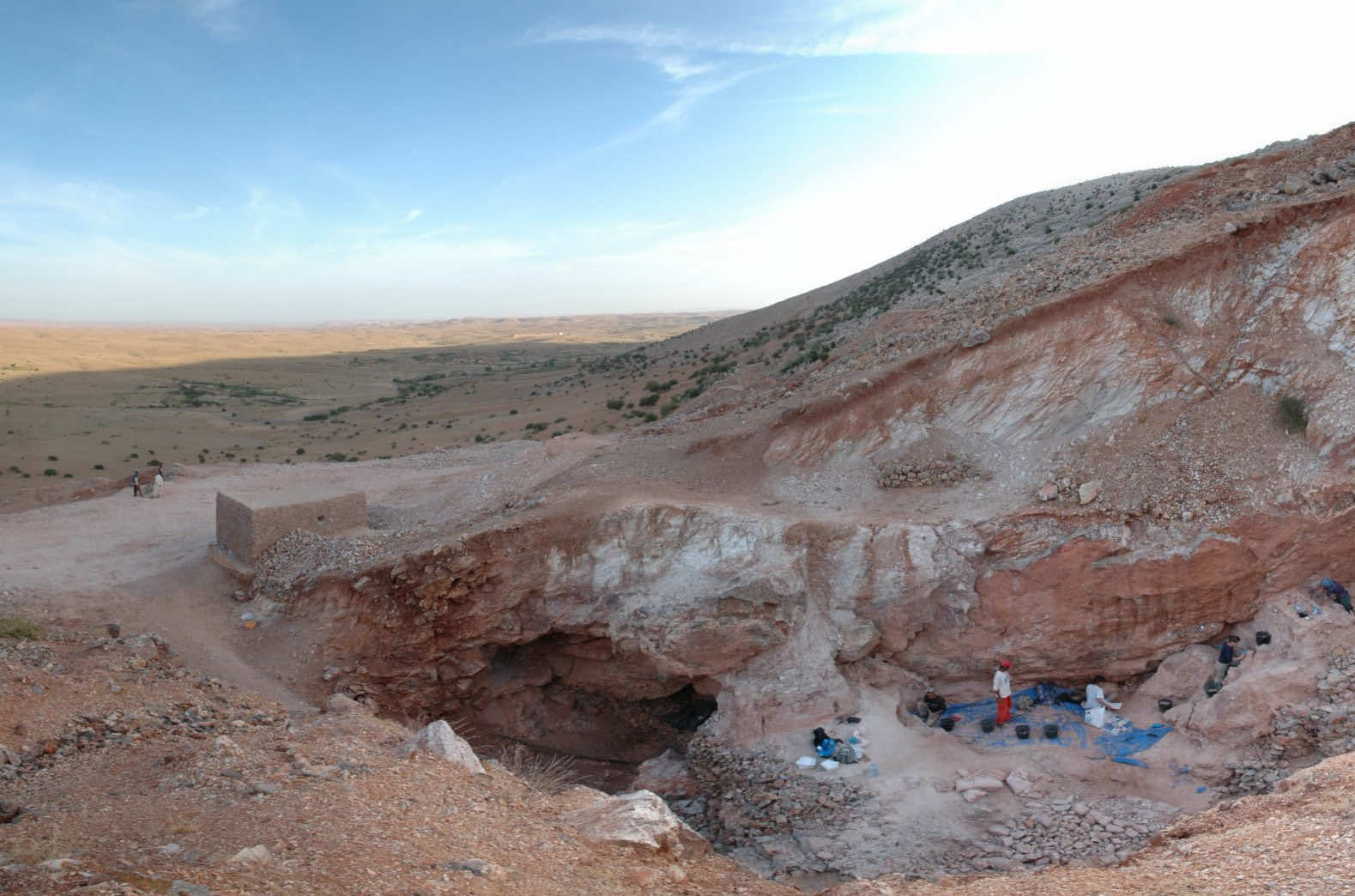
Rabat – The Ministry of Culture and Communication aims to make Jbel Irhoud an international archaeological and historical site, said Mohamed Laâraj, Minister of Culture and Communication, in the city of Youssoufia on Friday.
Jbel Irhoud was discovered by coincidence in the early 1960s. Since then, a substantial number of fossils have been discovered in the site, driving Jbel Irhoud to attract archaeological expeditions from around the world.
It was in the site that the recent discovery of the oldest-known remains of homo sapiens was made, drastically altering the modern understanding of human evolutionary history.
The discovery of the oldest Homo sapiens in JbelIrhoudwasa “real achievement,” said Laarj.
“Currently, the ministry is working to classify Jbel Irhoud among the national and world historical sites, given its certain archaeological value for the whole of humanity,” said the minister in a statement to the Maghreb Arab Press (MAP) during a visit to Jbel Irhoud.
The region likely contains future archaeological discoveries that could make an international impact, added Laarj.
The minister pointed out that several international institutions and foundations have taken a great interest in the site.
The recent discovery of Homo Sapien fossils was described by international media outlets as an major breakthrough.
The program’s researchers found Homo Sapien fossils identified as being from the early members of Homo Sapiens that date back to 300,000 years ago, updating previous data that had shown that our ancestors evolved 200,000 years ago, Abdelouahed Ben-Ncer, research professor at the Moroccan National Institute of Sciences of Archaeology and Heritage and co-director of the discovery, told Morocco World News in a previous interview.
“This implies that 100,000 years of the presence of our species on earth was unexplored until the fossils at Jbel Irhoud were extracted and examined. The fact alone makes the discovery a scientific earthquake. It has rocked our knowledge on the very beginnings of the time our ancestors spent on earth,” said Ben Ncer.
The discovery also indicated that the oldest of the only extant human species fossils evolved in Africa.