
 Join on WhatsApp
 Join on Telegram
By exerting strong pressure on their Israeli allies and with the help of certain Arab countries, the Americans have succeeded in bringing Hamas and Israel closer together, leading to the recent signing of a ceasefire agreement, but not a definitive peace agreement. In this region of the world, peace seems difficult to achieve, as the views of each side differ greatly, and the only language Tel Aviv likes to use is that of weapons and force to silence the Palestinians’desire for their own state. Trump, who wanted to conquer Canada and the seagull, has a plan for Gaza to satisfy his desires for greatness and conquest.
Every year, the UN General Assembly session marks the start of the international political season, just as the political season begins at the national level. In New York, all the heads of State and delegation leaders meet, greet each other, exchange warm embraces, pat each other on the back, and then hug each other in a show of more or less sincere friendship. Everyone is there to defend their priorities and forge or strengthen alliances.
This year, the United States and Israel chose to block the Palestinian delegation from participating in the session by refusing to grant them entry visas. This made it easier to ensure that they did not spoil the party. This left the field open for two thunderous speeches that complemented each other, those of the US President and the Israeli Prime Minister. The former launched a series of attacks and provocations against the UN, climate activists and his European allies, warning them of the dangers of immigration and glorifying his own achievements as head of State. The other proudly listed, before the eyes of the world, his assassinations of Palestinian, Lebanese, Iranian and Houthi leaders.
After delivering his speech before an almost empty General Assembly, where only the echo of his own voice and the scattered applause of a few supporters of his cause could be heard, the Israeli then travelled to Washington to meet with his American counterpart. This was an opportunity for both of them to announce the initiative they had been working on closely to bring peace to Gaza and realize their futuristic project there. Israel, which is not keen on the UN and multilateralism, did not want to reveal the contents of the new agreement there and preferred to unveil the project in the capital Washington, far from the eyes of international delegations.
It was President Trump himself who unveiled this plan, negotiated with Israel before it was submitted to the Palestinians, including Hamas, and the influential Arab countries in the region. There is no need here to dwell on the manner, method and process used to formulate this plan outside the UN bodies, and without the involvement of the parties concerned, starting with the Palestinians themselves, who had no say in the matter. At first glance, and if we refer to the Israeli’s comments, it is a take-it-or-leave-it proposal: either Hamas accepts the plan as it stands, or Israel will finish the job in the strongest possible way.
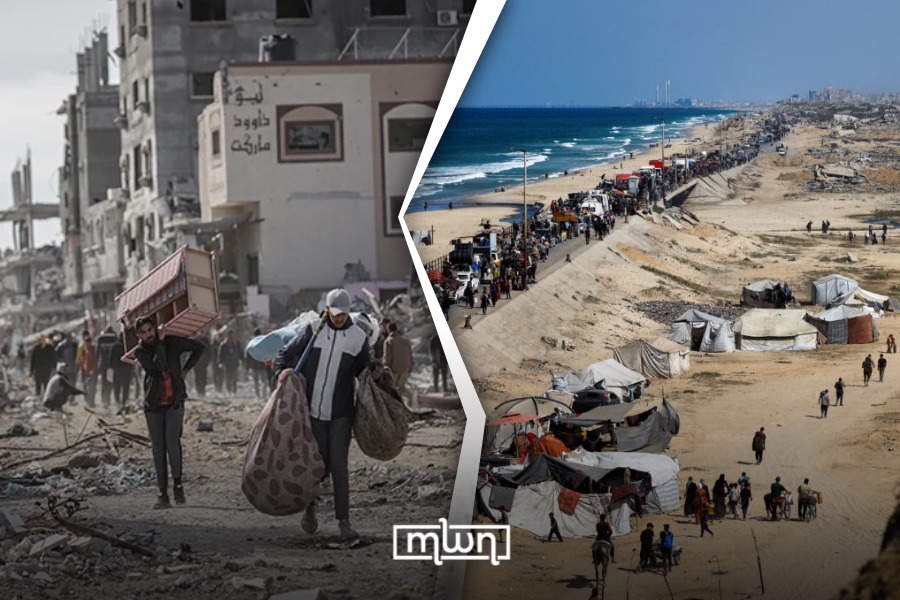
This project, as communicated to the press, can be summarized in twenty points, the essence of which is to make Gaza a deracialized zone, free from terrorism, which will no longer pose a threat to its neighbors, which we can guess to be Israel. Gaza will therefore be rebuilt for the benefit of its inhabitants, who have already suffered too much, according to the document. If both sides, Hamas and Israel, accept this plan, the war will end immediately and Israeli forces will withdraw to an agreed line, in preparation for the release of hostages on both sides.
Once the hostage issue has been resolved, Hamas members who agree to abide by the agreement must surrender their weapons. They may be granted amnesty and the right to travel to another country if they wish to go into exile. Only after the agreement has been accepted will food aid be provided to Gaza, immediately as stipulated in the note, including the rehabilitation of infrastructure and the delivery of equipment to remove debris and open roads. The distribution and entry of aid would take place without interference from either side, and via UN agencies, the UN appearing for the first time in the document.
Only after these preliminaries does the plan mention the institution that will manage Gaza during an interim period lasting five years. This transitional body will be composed of international experts and qualified Palestinians. It will bear the gentle name of the Peace Committee, whose self-appointed chairman is none other than President Trump himself, who will be supported by other heads of state, but under the tutelage of former UK Prime Minister Tony Blair. This body will establish the framework and manage the financing of Gaza’s reconstruction until the Palestinian Authority reforms itself and regains control of Gaza in a safe and effective manner.
Furthermore, this American plan devotes a large part to the economic development of Gaza, as announced by Trump last February, with the aim of turning the region into the Mediterranean Riviera. It will bring together a panel of experts who have contributed to the birth of certain flourishing modern cities in the Middle East, according to the document. We are informed that real estate projects have already been developed for this purpose by international groups and will soon be examined. In this context, a special zone would be established with preferential customs duties and an access rate to be negotiated with participating countries.
Only after discussing the good deals does the document turn its attention to the Palestinian population of Gaza. They will not be forced to leave, it says, but those who want to leave will be free to do so, and to return when they wish. This is more humane, as the plan offers them the opportunity to build a better Gaza for themselves and their children. As for Hamas members, they will play no role in governance, either directly or indirectly, and all their military installations should be destroyed under the supervision of independent monitors.
Even bolder. Dismantling Hamas will not be enough on its own, and a guarantee will have to be provided by regional partners, i.e. the Arabs, to ensure that Hamas and other factions respect their obligations and that the new Gaza Strip no longer poses a threat to its neighbors, i.e. Israel. The United States will therefore work with its Arab and international partners to develop an International Stability Force (ISF). This force will train and provide support to a Palestinian police force that will liaise with Egypt and Jordan, which have extensive experience in this field, according to the document.
According to Washington, the FIS will provide a long-term security solution. It will be required to collaborate with Egypt and Israel to help secure border areas in conjunction with the newly created Palestinian police force in Gaza. As the FIS establishes control and stability in Gaza, the Israeli army will withdraw on the basis of standards, stages and deadlines linked to demilitarization. This would be agreed between the following actors: the Israeli army, the FIS, the guarantors and the United States, with the aim of making Gaza a secure region that no longer poses a threat to its neighbors, i.e. to Israel.
Only after these preconditions have been met, and not before, will the Israeli army withdraw from Gaza and hand it over to the FIS, according to an agreement that has yet to be concluded with the transitional authority. It is generally in this kind of conditioning of the agreement to another future agreement that Israel has become accustomed to procrastinating in order to wear down its opponents with endless negotiations and wear them out. We recall the Oslo Accords signed in 1993 between the Palestinians and Israelis, and the multitude of other agreements that followed, which were endless and yielded no concrete results in helping the region escape the vicious cycle of confrontation.
As the redeployment of the International Stability Force progresses and the Palestinian Authority’s reform programme is faithfully implemented, the conditions could finally be in place to open a credible path to self-determination and the creation of a Palestinian state, the document says. It is at this point that the United States could recognize this state as the aspiration of the Palestinian people. Washington could then help establish a dialogue between Palestine and Israel to agree on a political horizon for a peaceful and prosperous existence.
Throughout the document, no reference is made to UN resolutions on this issue. Once again, this organization has been deliberately marginalized in the design of this approach and in the final settlement of this issue. In view of this failure, it is legitimate to question the ultimate objective of this offer. Will it strengthen the prospect of a truly independent and unified Palestinian state in the future? Or is it an attempt to shape Gaza into the region’s Riviera, as the US President himself has openly suggested, thereby fulfilling the dream of one day seeing a Palestinian state?
It is highly likely that by investing heavily and changing the composition of the population in Gaza in the future, both the United States and Israel could be tempted to establish an autonomous entity there in order to separate it permanently from the rest of Palestine, to which it has no territorial ties. The creation of a Palestinian state there appears to be a distant and vague prospect. Alongside this risk, the presence of former UK Prime Minister Tony Blair to lead the process also raises legitimate questions and a real ethical problem.
His role in the regime change in Iraq in 2003 alongside the Americans, outside of any Security Council resolution and under false allegations of weapons of mass destruction, seriously damaged his image and that of his country. His deafening silence following the announcement of the recognition of the State of Palestine by his country, the United Kingdom, whose government is led by his own Labor Party, did not go unnoticed. But that is another story, to which we will certainly return.