By Ahlam Ben Saga and Amal El Attaq
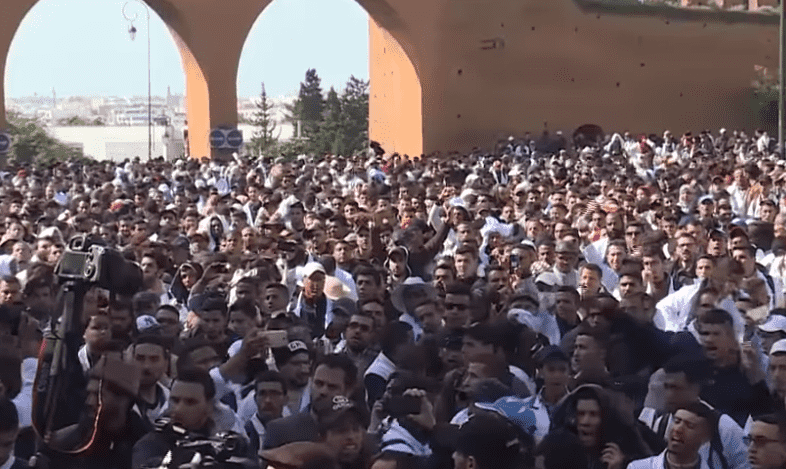
Rabat – When protesting contractual teachers started to approach the Royal Palace of Rabat, the King’s official residence, today, security forces used water cannons to disperse them.
Members of the Moroccan auxiliary forces also manhandled the protesters to prevent them from reaching the palace and the headquarters of the Ministry of Education, leaving a few protestors with injuries.
Chanting slogans such as “Death or Humiliation” and carrying banners such as “I’m a Teacher, I earn 400€ a month,” hundreds of teachers rallied near Bab Rouah, several hundred meters from Parliament in the capital city. They renewed their calls to be integrated into the public sector of employment that they say have “fallen on deaf ears.”
Wearing orange jumpsuits, teachers receiving the government’s ninth pay grade were on their third day of protesting. The protesters, who call themselves “teachers of jail cell number 9,” also stated that the ninth pay grade is “a shame.”
The march, organized by the Moroccan National Coordination of Teachers (CNPCC) “forced into contractual teaching,” rose against the signing of a contract extension for contractual teachers hired in 2016, 2017, and 2018.
Read Also: Moroccans Greet Anniversary of 20 February Movement with General Strike
The teachers chanted slogans calling for “their right to be promoted to the tenth pay grade” and “exceptional promotion with financial reimbursements backdated to 2013 unconditionally.”
The protesting teachers are accusing the government of “discriminating between teachers” in Morocco through the contracts. Contractual teachers do not benefit from rights granted by an employment law to permanent teachers.
Contractual teachers also do not have healthcare coverage and a pension fund. Their salaries come from the educational academies with whom they are contracted for a certain period of time.
Teachers came to Rabat from various cities in Morocco—Tenghir, Azilal, Taroudant, Agadir, Tiznit, and Chishawah—to participate in the march.
The protest started on Monday, February 18, and is scheduled to last until the end of the week.
Morocco has experienced a continual series of protests recently.
Several trade unions in Rabat are leading a separate protest today, which marks the eighth anniversary of the 20 February Movement, to denounce the government’s “disregard” for their needs, “poor” social dialogue negotiations, problems in education and healthcare, and the deterioration of workers’ situation.
The 20 February movement that began in spring 2011 and continued until spring 2012, witnessed the participation of thousands of Moroccans in different cities, but mainly in Rabat, demanding a new constitution; an end to corruption; a change in government; and better housing, employment, and living conditions.