


 Join on WhatsApp
  Join on Telegram
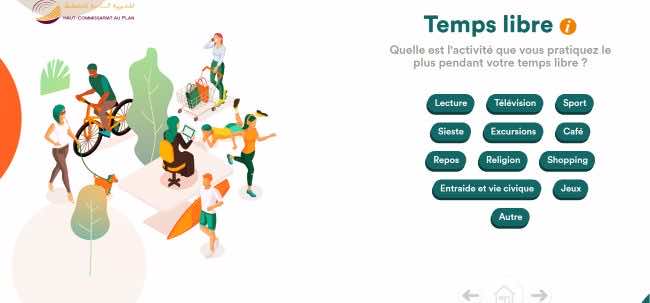
 Frankfurt – The High Commission for Planning (HCP) in Morocco has launched an interactive tool on its website called “How Are Moroccans Organizing Their Time?” Users can compare how they spend their time with other groups of Moroccans based on age and sex.
Using data from two studies of Moroccans aged 15 and up in 2012, the interactive website shows how much time Moroccans spend on leisure, work, domestic work, and physiological needs.
After first asking users their sex and age, the website asks questions like “How many hours do you normally sleep in a day?” If your answer is fewer than eight hours, you are in the minority; 60% of Moroccans sleep eight or more hours per day.
Mind the gender gap
Men are less likely to sleep eight or more hours, and fewer than half of men aged 35-60 get a full eight hours. Interestingly, men are more likely to spend over an hour on “personal care” than women, although the margin is small: 25% of men and 22% of women.
Seven-thirty a.m., 1 p.m., and 9 p.m. are the times of day most frequently given to eating.
Between mealtimes, men are more likely than women to be working full time and less likely than women to be doing domestic work. Only 35% of working women spend 6 or more hours on work daily. Working women, however, spend on average just under 4 hours doing domestic work each day.
The statistics for men showed a different story; 60% of men said they do not do domestic work like cooking, housework, and shopping. However, only 5% of women said the same.
Men also spend less time on domestic work: 80% of men spend less than one hour, 18% spend 1-5 hours, and 2% spend more than 5 hours.
In contrast only 13% of women spend less than one hour on housework, 45% spend 1-5 hours, and 43% spend more than 5 hours.
The most common leisure activity Moroccans engage in is watching television. The average person spends 2 hours and 39 minutes in front of the screen daily.
Other than in the categories of television and conversation, men spent more time than women on leisure activities: sitting at cafes, reading, sports, napping, civic life, shopping, and religion.
Read also: Morocco’s HCP Highlights Deepening Gap Between Job Market and Number of Graduates
HCP drew its information from a “Household Time Use Survey” and “Employment Survey” in 2012.


