 Join on WhatsApp
 Join on Telegram
Marrakech – “You can ignore reality, but you cannot ignore the consequences of ignoring reality,” Ayn Rand famously said. Today, the Polisario Front – that fossilized remnant of Cold War-era proxy warfare – is learning this lesson in the most publicly humiliating fashion imaginable, through the very mouths of its own leaders.
“In war, truth is the first casualty,” wrote Aeschylus over two millennia ago; yet few modern geopolitical fabrications affirm this more ruthlessly than the Polisario’s fifty-year charade. At its heart, Polisario’s unspooling war on Moroccan territorial integrity is a conflict manufactured by Algeria, sustained by Cold War inertia, and now disintegrating under the unforgiving weight of its own contradictions.
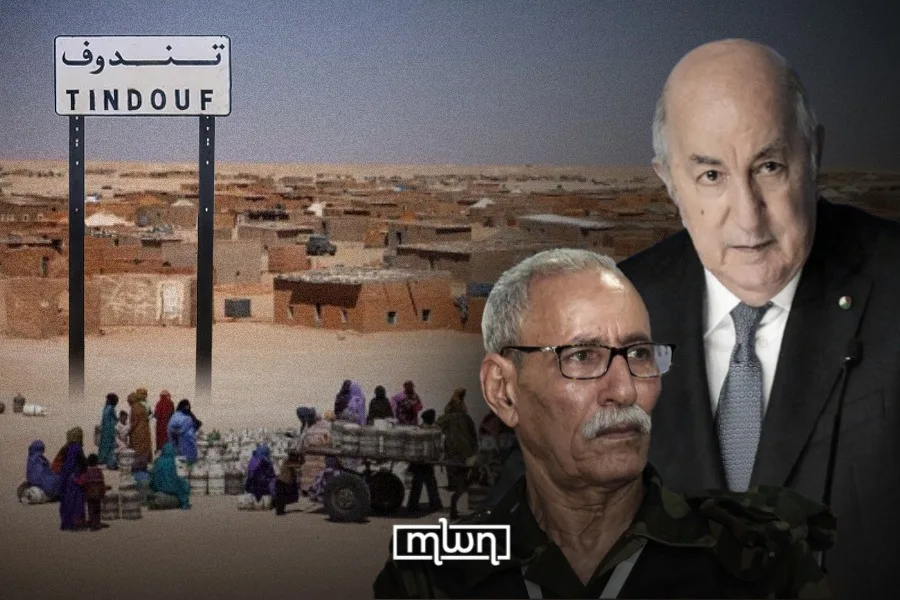
El País’s Luis de Vega, reporting this week from the windswept camps of Tindouf, delivered what reads less like a dispatch and more like an obituary or coroner’s report. The headline alone would have been heresy in Polisario circles a decade ago: the separatists are distancing themselves from armed struggle and offering Rabat a partnership grounded in peace and cooperation.
The entity that built its entire mythological scaffolding on the sacred promise of liberating the Sahara by force is now, hat in hand, visibly diminished and rhetorically disarmed, pitching itself as Morocco’s cooperative neighbor.
The details are devastating. Brahim Ghali, presiding over a military parade commemorating the 50th anniversary of his phantom republic, told the gathering that the Sahrawi people would be “not a source of threat but a partner willing to pursue peace and cooperation” with Morocco. This is from a man who spent his formative years commanding guerrilla operations against the Royal Armed Forces (FAR). There is no way this transformation can be seen as a diplomatic evolution; it can only be understood as unconditional capitulation presented under the threadbare garments of statesmanship.
‘We cannot make independence the only option’
But the true seismic fracture came from pseudo-foreign minister Mohamed Yeslem Beisat, the Polisario’s chief negotiator. Speaking to El País and other Spanish reporters in Auserd – not the Moroccan city, but its wretched namesake, a desolate camp squatting amid the godforsaken encampments of Tindouf – Beisat uttered the words that effectively disembowel the separatist cause from within: “We cannot make independence the only option.” Let the enormity of that admission register.
For half a century, independence was not merely an option for the Polisario – it was the option, the theological absolute, the non-negotiable covenant upon which every refugee’s suffering was rationalized, and every Algerian petrodollar was laundered into legitimacy. Now, their own chief diplomat has publicly dismantled this doctrinal fixation with the resigned air of a man folding a losing hand at a table he can no longer afford to sit at.
Beisat went further, telling El País that autonomy “as an option presented to the Sahrawi people can be discussed and accepted.” The caveat – that it must not be “dictated” or “obligatory” – is diplomatic garnish, the rhetorical equivalent of haggling over the font on a surrender document whose terms have already been signed. The substance is irreversible: autonomy under Moroccan sovereignty now sits squarely on the Polisario’s own negotiating menu, placed there not by Rabat’s coercion but by the gravitational collapse of every alternative. And indeed, it is the only alternative – unless the preferred one is to condemn yet another generation to rotting in the hamada, stateless, voteless, and forgotten.
El País noted that the Polisario leadership now discusses autonomy “with more ease than years past” while simultaneously abandoning armed confrontation as a viable path. This is a striking reversal from the 2020 escalation, when Ghali briefly resurrected hostilities in a desperate bid to recapture international attention. That gambit failed spectacularly, achieving nothing beyond confirming Morocco’s overwhelming military superiority and the Polisario’s strategic impotence.
El Español’s Álvaro Escalonilla, reporting from the same camps, sharpened the picture further. Veteran Polisario leader Bachir Mustafa Sayed conceded that the Americans are demanding accelerated progress by April or May. Three rounds of negotiations – two in Washington, one at the US embassy in Madrid – have already unfolded since UN Security Council Resolution 2797. That landmark text that, for the first time in the conflict’s tortured history, swept every competing formula off the table and enshrined Morocco’s Autonomy Plan as the sole credible architecture for a lasting political settlement. The Polisario was not consulted on the resolution’s language. It was notified.
The irony here is almost too exquisite to bear. Beisat praised Washington’s role, calling the United States “one of the few powers that can compel Morocco to negotiate.” This is the same administration that, in 2020, recognized Moroccan sovereignty over the Sahara – a decision the Polisario once condemned as an illegitimate act of imperial overreach. Yesterday’s villain has been rehabilitated into today’s indispensable broker, it seems, when the alternative is geopolitical oblivion.
One is reminded of the great al-Ghazali, who in the eleventh century wrote “Tahāfut al-Falasifa” – The Incoherence of the Philosophers – only for the Andalusian polymath Ibn Rushd to respond a century later with “Tahāfut al-Tahāfut” – The Incoherence of the Incoherence. The Polisario needs no such rebuttal; their positions refute themselves, each contradiction devouring the last like a serpent swallowing its own tail. Their entire position has become precisely that: an incoherence built upon an incoherence – condemning the US then praising it, existing for independence then abandoning it, demanding democracy while presiding over a one-party apparatus that has never held a contested election.
The puppet and the puppeteer
Yet even as the Polisario shuffles toward the negotiating table, the fundamental absurdity of the entire exercise remains unaddressed. Why negotiate with the marionette when the puppeteer sits in the next room? Algeria – which bankrolls the camps, arms the cadres, dictates the red lines, and provides the territorial base from which this entire fiction operates – remains the indispensable variable that no serious diplomatic framework can afford to ignore.
Morocco has never refused dialogue; it has merely insisted, with implacable logic, that all parties sit at the table, Algiers foremost among them. In the grammar of proxy warfare, one does not settle terms with the ventriloquist’s dummy.
And yet, even toward Algeria, Morocco’s posture has been one of relentless magnanimity. King Mohammed VI, in his address following Resolution 2797’s adoption, extended a direct, personal appeal to President Tebboune: “I call upon my brother to launch together a sincere, brotherly dialogue between Morocco and Algeria, in order to overcome differences and build new relations based on trust, fraternal bonds, and good neighborliness.”
This was not the language of a victor dictating terms – it was the language of a sovereign extending an olive branch to a neighbor whose hostility Morocco has absorbed with strategic patience for decades. The King reiterated his commitment to reviving the Maghreb Union, a vision of regional integration that Algiers’ Sahara obsession has single-handedly sabotaged.
The hostages of Tindouf
El País documented what it estimated as approximately 175,000 refugees in the camps – a figure the Polisario and the UN Refugee Agency (UNHCR) have long inflated as a diplomatic weapon.
Independent observers and Moroccan authorities have consistently argued that the actual number of genuine Sahrawis is significantly lower, with the population artificially swollen by Algerian, Mauritanian, Malian, and Nigerien nationals funneled into the camps to manufacture demographic weight. These are not citizens of a republic; they are human collateral in a geopolitical wager their Algerian wardens are now quietly losing.
El País captured their stories with inadvertent poignancy – the optometrist trained in Castro’s Cuba, the elderly shopkeeper who “believes independence is in God’s hands,” the young ophthalmology worker repeatedly denied a Spanish visa, the children kicking a ball barefoot across stones.
These are real Moroccans – not the statistical padding of Algerian census engineering – whose lives have been suspended in amber for fifty years, held hostage not by Rabat but by the intransigence of their own leadership and the cynical geopolitics of Algiers.
It was to these very people that King Mohammed VI directed perhaps the most consequential passage of his October address: “I hereby make a sincere appeal to our brothers in the Tindouf camps to seize this historic opportunity in order to reunite with their families, and take advantage of the Autonomy Initiative.”
He pledged, as King and guarantor of citizens’ rights, that “all Moroccans are equal, and that there is no difference between those returning from the Tindouf camps and their brothers and sisters within the homeland.” That is not a negotiating posture, but a homecoming invitation, extended with the full constitutional authority of the Moroccan state.
The arithmetic of abandonment
The diplomatic hemorrhage afflicting the phantom republic has become a torrent. Mali – Algeria’s neighbor – withdrew recognition on April 10. Bolivia suspended it in February. Panama, Ecuador, Peru, and a lengthening cavalcade of Latin American and African states have recalibrated in recent years.
From a Cold War peak of over 80 recognitions, the so-called Sahrawi Arab Democratic Republic (SADR) now clings to roughly 29 – a rump coalition of the geopolitically marginal, the ideologically fossilized, and the diplomatically inert. That is what fifty years of Algerian treasury-bleeding has purchased: a support base that would struggle to fill a mid-sized committee room. As Churchill once quipped, “However beautiful the strategy, you should occasionally look at the results.”
On the African continent – the one arena where the SADR maintains institutional life support through its anomalous African Union membership – barely a third of member states still recognize the entity, most of them clustered in the orbit of South Africa, a nation whose own post-apartheid foreign policy was forged in the furnace of liberation theology and has never fully shed its reflexive solidarity with any cause that wraps itself in the lexicon of self-determination, however fraudulent. The rest of the continent has awakened, and it is voting with its feet toward Rabat.
Meanwhile, two-thirds of UN member states now consider Morocco’s Autonomy Initiative the only framework for resolution. The United States and the European Union have all endorsed Rabat’s economic sovereignty over the southern provinces. Apparently, the tectonic plates have shifted, and they have shifted irreversibly.
What El País documented in Tindouf this week was not a jubilee. It was a wake attended by mourners who have not yet been told the patient has died. The Polisario’s leaders now speak the language of compromise because the vocabulary of defiance has been bankrupted by five decades of barren results. Morocco’s Autonomy Plan is no longer one option among many – it is the only architecture left standing, endorsed by the world’s most consequential powers and enshrined in the formal machinery of the United Nations.
As Rabat prepares to submit an updated, detailed Autonomy Initiative to the UN – as the King announced – the question is no longer whether the Sahara conflict will end on Morocco’s terms. It is whether Algeria will have the strategic wisdom to stop subsidizing a fantasy, and whether the hostages of Tindouf will finally be allowed to come home. “The truth,” as George Orwell wrote, “is incontrovertible. Malice may attack it, ignorance may deride it, but in the end, there it is.”
Read also: Algeria Hijacks Pope Leo’s Visit to Peddle a Separatist Cause No One Is Buying