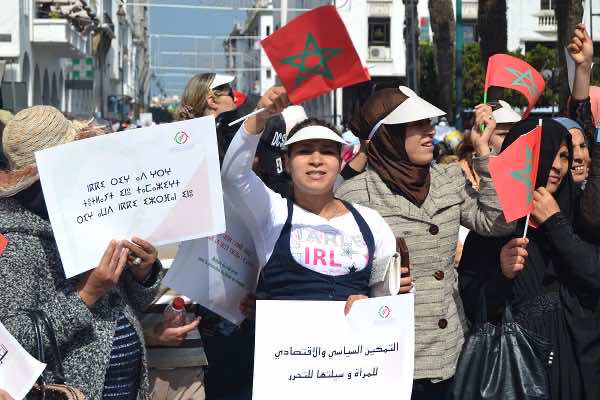
Rabat – A Moroccan MP believes that Morocco has made noticeable advances on gender issues, especially gender equality, in recent years. The MP cited the number of political reforms initiated since the change of constitution in 2011, saying that while there is still much to improve, what has been achieved is “commendable.”
Allal Amraoui, an MP from the Istiqlal (Independence) Party, made his remarks at a recent conference in Lisbon, Portugal. Amraoui, who sits on the Moroccan House of Representatives’ foreign affairs and national defense committee, led the Moroccan delegation at the Lisbon conference, where he put forth the well-established idea that Morocco is a regional exception or trendsetter on multiple fronts.
Discussing gender relations in “contemporary Morocco,” the Istiqlal MP seemed to take pride in the “notable advances” that have been made in relation with the King’s insistence on inclusiveness and equality as pillars of the much-reported new development model.
Amraoui illustrated his central thesis—that Moroccan women have made notable gains in recent years—by providing examples of legislative amendments and political reforms witnessed in the past eight years.
He said that legislative texts such as the family code, the penal code, labor law, regulations on nationality and naturalization, as well as the electoral code have all gone through some modifications to make them more reflective of, or compatible with, emerging social trends and political realities in “today’s Morocco.”
Amraoui’s main points underline the broad agreement surrounding Mohammed VI’s Morocco. In recent years and months, both Moroccan and international observers have made the case that Morocco has vastly changed under the current King.
Writing in late July on the occasion of the two-decade anniversary of King Mohammed VI’s ascension to the throne, one Moroccan columnist argued that political reforms and development projects—mainly state-of-the-art infrastructure, advances on human rights and gender equality, investing in reducing social inequalities and socio-economic disparities—have become the distinguishing marks of Mohammed VI’s Morocco.
“As it would not be possible to make an exhaustive assessment, let’s simply say that Morocco in 2019 has absolutely nothing in common with the Morocco of 1999,” the columnist said. This, he went on, has been possible because of the political will and availability of a King who “listens to his people.”
Writing in the same week, in commemoration of the Throne Day, Moroccan journalist Zineb Ibnouzahir, whose columns have a distinctly feminist feel, conceded that, in 20 years under Mohammed VI, Morocco has considerably improved the status of its women.
“In the past 20 years,” she wrote, “[Moroccan women] have made some gains.” She cited the “right not to be repudiated, to ask for divorce;” “the right to transfer our nationality to our children;” and “the right to be treated as an adult and autonomous being, not an eternal minor in need of [male] tutelage…”
Still a long way to go
While the overall sentiment in such assessments is pertinent, verifiable even, recent weeks have seen a resurgence of demands for Moroccan society to fully embrace its changing socio-political realities.
In the wake of a scandal involving Hajar Raissouni, a female journalist who was jailed (she has since been granted royal pardon) for “illegal sex” and abortion, Moroccan human rights activists took to the streets in waves to denounce what they saw as the social and political hegemony of Moroccan conservatives, including some religious and cultural puritans, who they said want the country to remain “stuck in the middle ages.”
“I think that Moroccans, mostly the youth and women, have had enough. For their sake, we will not give up,” said Sonia Terrab, one of the forerunners of individual freedoms activists in the wake of the “illegal sex” and abortion scandal.
Meanwhile, recent reports have suggested that gendered violence continues to be part of the daily life of many Moroccan women.
The underlying assumption is that the country’s intrinsically patriarchal cultural codes and mores are an impediment to female freedom and unencumbered expression of femininity in public space. As a result, one recent study concluded, even when the law is on their side, Moroccan women still feel subsumed by a culture that demands that they be silent and docile.
Stephanie Willman Bordat, an international human rights lawyer, recently told Morocco World News that recent reforms have not sufficiently dealt with Morocco’s lingering issue of sex-based violence.
While there have been changes and a noticeable political will to go forward, to secure women’s rights, most of the legal reforms have been either vague or not effectively implemented, Bordat argued. She took the example of Law 103-13 on combating violence against women.
For Bordat, while Law 103-13 is a welcome change to Morocco’s relatively toxic legal atmosphere for women, it has not lived up to the expectations of women and women’s rights activists. The law “is really extremely short and it did not address any of the issues related to gender-based violence that Moroccan women and NGOs have been advocating for ten years,” she said.