 Join on WhatsApp
 Join on Telegram
Rabat – A survey published by the BBC in June reported that 6% of the Lebanese population find homosexuality acceptable. This rank falls on one extreme side of the scale, opposite an Algerian acceptance rate of 26%.
The difference may come as a surprising statistic since Lebanon is known as one of the Arab world’s most progressive countries for its LGBT community.
Georges Azzi of the Arab Foundation for Freedoms and Equality commented on Lebanon’s relative openness to the LGBT community within the Arab world: “What has helped make the difference is a culturally diverse society, a mostly independent media and the relative ease of registering nongovernmental organizations.”
Legality versus reality
Article 534 of Lebanon’s criminal code implicitly prohibits homosexuality as homosexual acts are usually classified under “any sexual intercourse contrary to the order of nature.” Punishment can include up to one year in prison. The law, originally enacted by French colonizers, is often cited to prosecute cases against LGBT individuals.
However, legal interpretations of “unnatural/indecent acts” are changing. In a landmark move in late March, a military judge declined to prosecute a sodomy case against four military personnel. Lebanese judges have also recently ruled that Article 534 did not apply to some cases regarding consensual same-sex acts and/or acts involving transgender individuals.
In a groundbreaking 2018 case, one district court dismissed charges under Article 534. “The appeals court judge denounced the law’s discriminatory intrusion in people’s private lives and declared that homosexuality is not ‘unnatural,’” Human Rights Watch reported.
The Lebanese legal system is not based on precedents, which allows for more fluid interpretation by individual judges. At the same time, it means that these recent cases will not necessarily result in similar rulings down the line. Even given such progressive rulings, Helem, Lebanon’s first registered LGBT group, reported a 2018 increase in arrests under Article 534.
These new cases are still a big step for Lebanon’s LGBT rights movement. However, the community itself continues to face hostilities. One Amnesty International researcher wrote of “social media pages that call for transwomen to be prosecuted and calling on the state to arrest them, torture them and simply remove them from the public view.”
Gay men and transgender women have spoken out on abuse from police and other security officials. Some reported being raped with an iron rod or beaten with electric cables.
Lebanese police are known to perform anal examinations on men to prove or force “confessions” of homosexual acts. The government has spoken out against these examinations but has yet to enforce a blanket ban.
Read also: Spanish LGBT Association Calls for Decriminalizing Homosexuality in Morocco
A conflicting landscape for LGBT rights
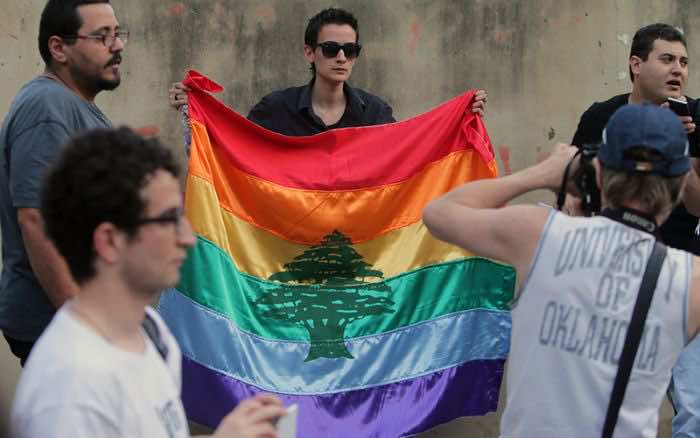
Lebanon made headlines as the first Arab country to celebrate pride week. As activists looked forward to the opportunity, the government canceled the groundbreaking celebration’s opening event. Authorities cited a need to protect participants, who faced hostile threats. Subsequent pride week events have continuously faced cancelation.
Security officers also tried to shut down a September 2018 conference on LGBT rights in Beirut. The attempted shutdown came in response to a call from the Muslim Scholars Association. They had asked for the organizers’ arrests and conference cancellation, citing a legal clause on “incitement to immorality.”
The government crackdowns present a debate on response to hostile threats. Authorities say the actions serve “to ensure the protection of the audience as radical religious groups have threatened to attack if the event goes ahead,” according to an Amnesty International publication. However, “instead of holding those making threats accountable, security forces have taken the threat as a given and imposed the ban.”
Targeting the threatened, rather than the aggressors, sends a clear message.
International involvement
In February, Human Rights Watch submitted a complaint to UN rights officials about the crackdowns. The organization claims that government forces violate international rights law and basic freedoms in shutting down such gatherings.
Lebanon is a signatory to the International Bill of Rights, and HRW called on this commitment. “Government disruptions of peaceful human rights activities violate the rights to freedom of assembly and association, expression, and non-discrimination. We are particularly concerned to see such back-tracking in a country that has witnessed progress in the courts toward respecting the rights of LGBT people.”
The international community also casts a critical eye on British funding for Lebanon’s Internal Security Forces. The UK government started funding the ISF in 2008 to address national security concerns and to promote human rights. To date, they have contributed almost $11.7 million dollars to the ISF.
British officials helped draft a Lebanese code of conduct to protect human rights in 2012. Since then, reports of ISF rights abuses and torture have continued to abound.
In response to the concerns, a British Foreign Office spokesperson explained, “Much of our work with the Lebanese Internal Security Forces is focused on promoting and improving human rights—only by working with them can we bring about the changes we would like to see.”
Some oppose the financing and call on the British to revisit their policy. “The funds should be restricted and conditioned if human rights violations continue,” said George Ghali, programs manager at Lebanese rights organization ALEF. “The UK should use the funding as a pressure tool to influence human rights-friendly policies. Whenever funding has been restricted or conditioned to human rights change, the Lebanese comply.”
Read also: Video: LGBT Activists Talk Openly About Life in Morocco
Slow progress is still progress
One LGBT individual spoke to the New York Times about his life in Lebanon: “You live in your own bubble, which is a safe one. I’m surrounded by gay and gay-friendly people and I live in Beirut, the capital.”
However, he said that changes outside of the capital. “As soon as you get out of Beirut, the situation changes. In my daily life I’m very comfortable. I’m not scared, but I’m cautious.”
From “liberal” Beirut to rural Lebanon, the country’s growing LGBT movement still faces an uphill battle.