


 Join on WhatsApp
  Join on Telegram
 Rabat – Morocco is currently in discussions on taxation and a customs union with the European Union (EU), announced the Moroccan Minister of Economy, Finance, and Administrative Reform, Mohamed Benchaaboun.
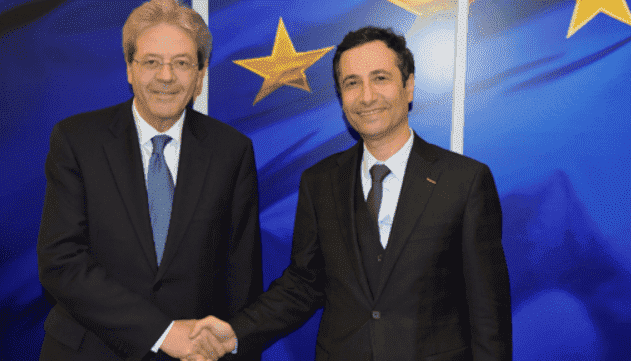
Benchaaboun made the announcement on Monday, February 10, after his meeting with the European Commissioner for the Economy, Paolo Gentiloni, at the EU’s headquarters in Brussels, Belgium.
Morocco is also looking to strengthen its partnership with the EU, added the minister.
The meeting focused on topics of mutual interest falling within the remit of the two senior economists, such as economic and monetary policy, Benchaaboun told the press.
The Moroccan minister cited “subjects of importance for Morocco in its relations with the EU,” including regulations of origin.
According to the minister, several rules need to be reviewed in order for Morocco to export more to the EU.
“There is also the issue of taxation. The EU will make important decisions in the coming days regarding its relations with Morocco,” announced Benchaaboun.
“We have obviously discussed the partnership as a whole and the means to strengthen it to the advantage of both parties,” he added.
The two officials agreed to examine the Morocco-EU partnership further in the coming days, in order to “build a relationship of trust” and “make the [Moroccan and European] economies benefit from it.”
The meeting between Benchaaboun and Gentiloni is the first since the European officer’s appointment as a member of the new European executive commission on December 1, 2019.
The Moroccan ambassador to the EU, Ahmed Rahhou, along with other senior officials and economic experts representing Morocco and the EU, attended the meeting.
The EU did not change import regulations
The meeting comes only a few days after several media speculated a change in the EU’s regulations on Moroccan exports.
On Thursday, February 6, the EU denied rumors that it planned to ban Morocco from exporting products from the southern region of Western Sahara to European states.
The EU’s position on the labeling of Moroccan products has not changed, affirmed the EU’s spokesperson Peter Stano.
Western Sahara “is covered by the EU-Morocco agreement in the agricultural field that entered into force in July 2019,” said Stano.
The EU’s stance on the Western Sahara conflict has not changed either, ensured the spokesperson, noting that the EU “fully supports” the UN-led process.
Growing economic partnership
The meeting is also the latest in a series of meetings between Moroccan and EU representatives to strengthen bilateral partnerships.
On January 29, Morocco’s Minister of Foreign Affairs, Nasser Bourita, flew to Brussels to meet with the EU’s high representative for external affairs and security policy, Josep Borrell.
During the meeting, Borrell revealed that Morocco is one of the largest-growing trade partners for European countries.
In 2017, around 64.6% of Moroccan exports went to the EU and 56.5% of Moroccan imports came from Europe, with trade value reaching €37.4 billion, presented the official.
“The EU’s imports from Morocco are dominated by machinery and transport equipment (€6 billion), agricultural products (€3.4 billion), and textiles and clothing (€2.9 billion),” said a joint statement.


