Rabat – Long before African referees became regular names in major international tournaments, Said Belqola had already written his place in football history.
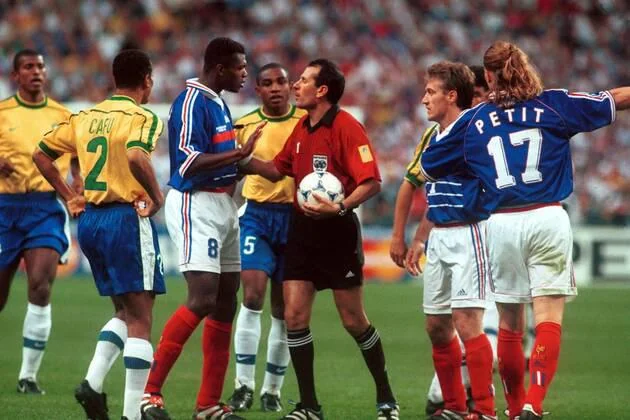
The Moroccan referee is best remembered for officiating the 1998 FIFA World Cup final between Brazil and France at the Stade de France in Saint-Denis.
That night made him the first African referee to take charge of a World Cup final, a landmark achievement for Moroccan, African, and Arab football.
Belqola’s story was not only about one match. It was about a referee who rose from Moroccan football to the highest level of the global game, earning the trust of FIFA at a time when African officials were still fighting for wider recognition on the world stage.
From tiflet to international football
Said Belqola was born on August 30, 1956, in Tiflet, Morocco. Away from football, he worked as a customs officer in Fez, balancing his professional life with his development as a referee.
His refereeing career began domestically before he was added to the FIFA international list in 1993.
That appointment opened the door for him to officiate major matches outside Morocco and build a reputation as one of Africa’s most reliable officials.
By the late 1990s, Belqola had become one of the leading referees on the continent. His calm authority, physical presence, and ability to manage high-pressure matches helped him earn major appointments in African and international competitions.
Rise through african football
Before the 1998 World Cup, Belqola had already gained important experience at the Africa Cup of Nations.
He officiated at both the 1996 and 1998 AFCON tournaments, taking charge of two matches in each edition. His biggest continental appointment came in the 1998 AFCON final between Egypt and South Africa, a match that confirmed his status among Africa’s elite referees.
That experience mattered. A referee trusted with an AFCON final had already shown he could handle pressure, emotion, and high-stakes football. It also helped strengthen his case for a major role at the World Cup later that same year.
The 1998 World Cup breakthrough
Belqola’s defining tournament came at the 1998 FIFA World Cup in France.
Before the final, he officiated two group-stage matches: Germany against the United States and Argentina against Croatia.
Both were important tests involving major football nations, and his performances helped him remain in contention for the biggest appointment of the tournament.
Then came the historic call. FIFA selected Belqola to referee the final between Brazil and France on July 12, 1998.
The match itself became one of the most famous finals in World Cup history. France defeated Brazil 3-0, with Zinedine Zidane scoring twice and Emmanuel Petit adding the third goal in stoppage time.
Marcel Desailly was sent off in the second half, making Belqola’s match management even more important on a night watched by millions around the world.
For Morocco, the appointment was a moment of enormous pride. For Africa, it was a breakthrough. Belqola showed that referees from the continent could handle the highest-pressure match in world football.
His biggest matches
Belqola’s most important matches include the 1998 World Cup final between Brazil and France, the 1998 AFCON final between Egypt and South Africa, and his two World Cup group-stage matches in France: Germany against the United States and Argentina against Croatia.
He also officiated France against England at the Tournoi de France in 1997, another high-profile match that added to his international reputation before the World Cup.
According to WorldReferee’s database, Belqola officiated 28 recorded international matches across 14 competitions, issuing 106 yellow cards, 10 red cards, and awarding five penalties.
Why Belqola Was Different
Belqola’s strength was his authority without unnecessary drama.
He had the presence needed to control emotional matches, but he did not try to become the story. That is one of the most important qualities for a top referee. In major finals, the best officials manage the tension, protect the rhythm of the match, and make difficult decisions without losing control.
His 1998 World Cup final performance showed exactly that. The match included huge pressure, global stars, and a red card, yet Belqola remained composed throughout.
He also represented a generation of African referees who had to prove themselves in a football world dominated by European and South American officials. His appointment to the final was not only a personal success. It opened a door for future African referees.
Legacy and passing
Sadly, Belqola did not live long after his historic achievement. He died in Rabat on June 15, 2002, after a battle with cancer. He was 45 years old and was later buried in his hometown of Tiflet.
His passing came only four years after the biggest moment of his career, but his legacy remains powerful.
In 2013, the International Federation of Football History & Statistics ranked Belqola among the best referees of the previous 25 years, further underlining the respect he earned in the game.
A Moroccan name in World Cup history
Said Belqola remains a landmark figure in Moroccan football history.
Players usually receive most of the attention, but Belqola proved that referees can also carry a nation’s name onto the biggest stage.
By taking charge of the 1998 World Cup final, he gave Morocco and Africa a moment that still stands today.
More than two decades later, his achievement remains historic: the Moroccan official from Tiflet became the first African referee to control the biggest football match.
That alone makes Said Belqola one of the most important referees the continent has ever produced.