


 Join on WhatsApp
  Join on Telegram
 Rabat – With national polls showing her popularity peaking (48%) in France’s increasingly anti-Islam political landscape, Marine Le Pen is proposing a “Hijab ban” in France. At a time of unprecedented fear and anxiety in France, Le Pen’s openly Islamophobic party appears to be riding the wave of public angst.
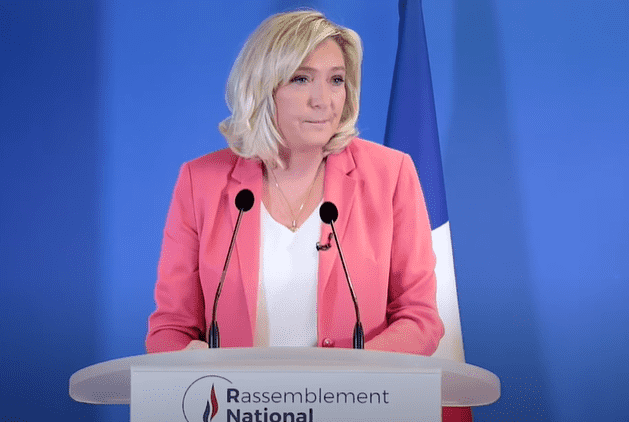
Marine Le Pen proposed the controversial hijab ban in a bill she described in a speech on Friday as expressing her special interest in matters of “national self-defense” She called the Muslim headdress an “Islamist item of clothing” that is inimical to French culture and values.
She told the press attending her speech that the ban would be part of a new law which would ban undefined “Islamist ideologies.”
Despite the ban being in direct conflict with France’s defense of the right to freedom of religion, she justified the ban as a response to what she described as a “totalitarian and murderous” Islam.
The French electorate appears more receptive than ever of the National Rally’s xenophobic and fear-driven message. The party’s overtly Islamophobic narrative appears to be hitting a nerve in the midst of a public health crisis and an atmosphere of fear after the beheading of French teacher Samuel Paty and the gruesome attack on a church in Nice.
Read also: France Dismantles Network Hiring Moroccan Seasonal Workers Irregularly
The far-right politician is now the favored candidate of 48% of the French electorate, according to recent polls. Neck-and-neck with Macron, it appears that Le Pen is betting on the unconstitutional Hijab ban as a way to push her into the lead.
The political calculation is a damning sign of France’s growing intolerance towards its 3.7 million Muslim citizens, the largest Muslim population in Europe. Despite making up 5.8% of the country’s total population, the religious minority has become the target of public fears and frustrations.
Similar to the political machinations of Dutch extremist Geert Wilders, Le Pen is pushing for ever more extreme measures to gain attention and help push her hateful messages to the mainstream. Le Pen’s proposed hijab ban is neither realistic nor constitutional, yet the populist candidate clearly sees value in promoting the intolerant idea.
During the 2017 French elections, Macron and Le Pen appeared closely tied until the second round of voting which Macron won convincingly.
Ever since, however, Islamophobia in France appears to have grown as a political tool in the campaigns of politicians across the political spectrum. France’s next presidential elections, due to commence in 2022, are set to provide yet another confrontation with simmering French intolerance and its effect on national politics.


