 Join on WhatsApp
 Join on Telegram
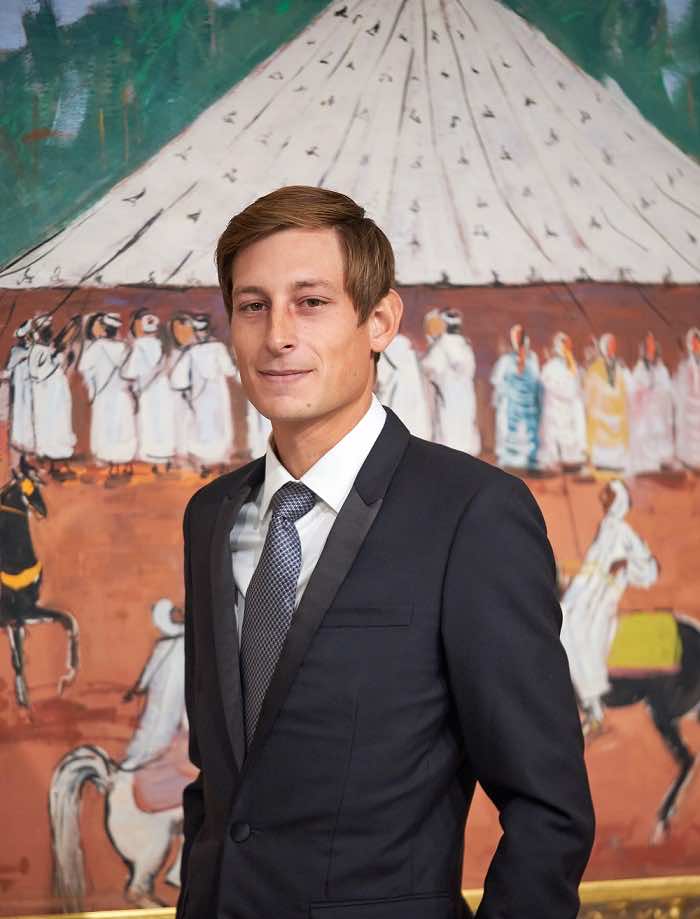
Miami – In an exclusive interview with Morocco World News, Brian Bexter El Glaoui reveals his progress towards detailing the life and artistic journey of his late grandfather, Hassan El Glaoui.
El Glaoui’s paintings, praised throughout the kingdom for their unique style and emphasis on Moroccan culture and history, are still making international headlines and landing high bids at famous art auctions.
Considered one of Morocco’s most valued artists, Hassan El Glaoui’s biography is one that tells of a rich history with the kingdom.
Born in December 1924 to Hadj Thami El Mezouari El Glaoui, the last Pasha of Marrakech, Hassan El Glaoui witnessed defining moments in Moroccan history while surrounded by powerful and charismatic figures. His father had consolidated power during turbulent times in Morocco and led a wealthy life––allowing him to frequently visit Europe and take part in elite European society.
Hassan El Glaoui’s foray into art
In 1943, General Conrad Goodyear, founder of the Museum of Modern Art in New York (MoMA), and Prime Minister Winston Churchill visited the Pasha in Marrakech and noticed the talent in El Glaoui’s art. Churchill approached the reluctant Pasha about allowing his son to pursue a career in art without necessarily having to neglect the desired administrative vision he had for him.
Standing as a prime example of a well-respected statesman and painter, Churchill’s intervention encouraged Thami El Glaoui to allow his son to embark on the journey––an intervention many have dubbed as the crucial element in establishing El Glaoui’s career path.
Undoubtedly, this meeting of fine arts and political relations profoundly influenced the young artist and would persist as the driving force in exposing Moroccan history on the international art market in the years that followed.
Hassan El Glaoui left for Paris in 1952 where he studied at Ecole des Beaux-Arts under Emilie Charmy and Jean Souverbie until his return to Morocco in mid-1964.
The following years witnessed a wave of El Glaoui’s individual and joint exhibitions both in Morocco and internationally. From meetings in Marrakech, to a joint exhibition of El Glaoui and Churchill’s works held in London in 2012 at the Leighton House, El Glaoui shed a unique light on Moroccan history with every brush stroke.
He also established several galleries around the globe, namely Wildenstein and Hammer Galleries in New York and Galerie Andre Weill and Petrides in Paris.
Hassan El Glaoui’s works continue to bring Morocco to an international audience
El Glaoui’s passing in 2018 by no means reduced the public’s interest in his paintings. The Salt of My Earth, a retrospective exhibition of over 100 of his paintings and sketches, took place in 2019 at the Mohammed VI Museum of Modern and Contemporary Art in Rabat, for popular appraisal.
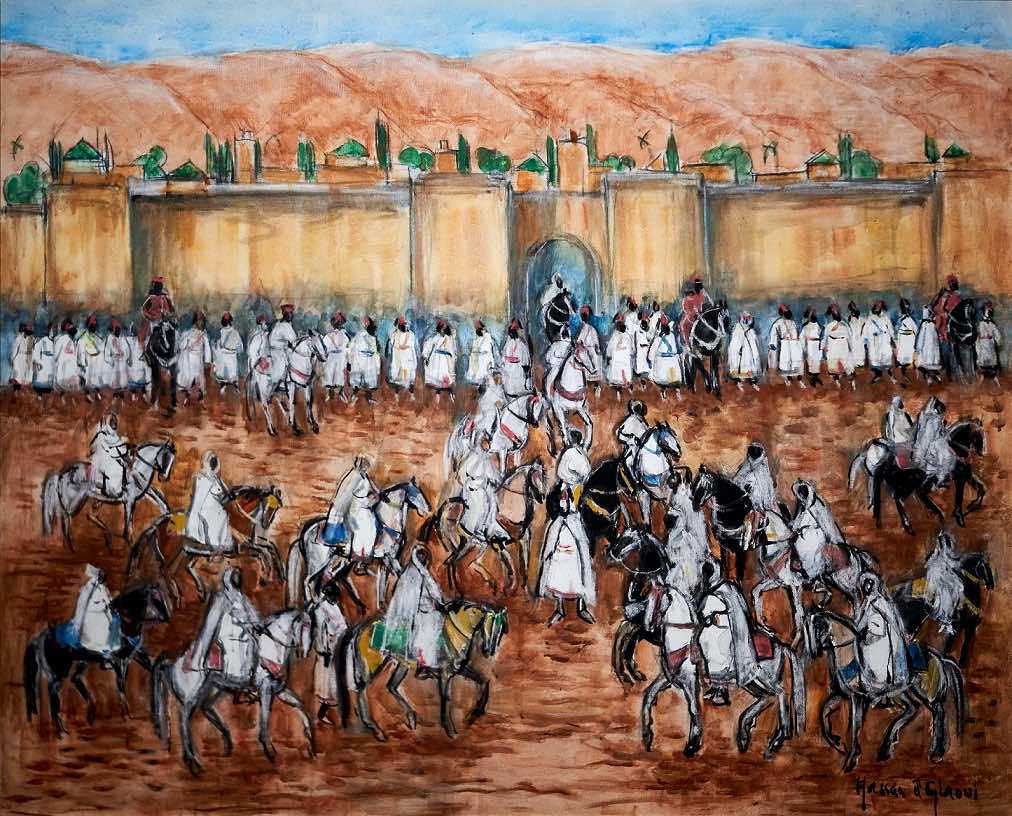
Although his work depicted a variety of themes, the painter became especially known on an international level for his portrayal of Moroccan customs. A popular subject of his paintings was the depiction of horses, distinctly horse-riders participating in the tradition of “Tbourida.” Recognized in the West as “Fantasia performances,” these dynamic and riveting events entailed riders in traditional attire simultaneously firing muzzle-loaded muskets.
As his grandson, Brian Bexter, described, “In this way, Hassan El Glaoui’s pieces not only paid tribute to our family and entire country but also captured the attention of Western audiences with their dynamism and particularity.”
How Hassan Glaoui captured Morocco in art
He added, “The late artists’ work incorporated an unparalleled blend of archaic traditions with modern painting attributions he picked up in his years studying and painting abroad. Hassan El Glaoui frequently illustrated scenes that resonated with him when he was far from his homeland. In fact, he would illustrate to his foreign companions how the distinct landscape and clear skies in Morocco were peerless.”
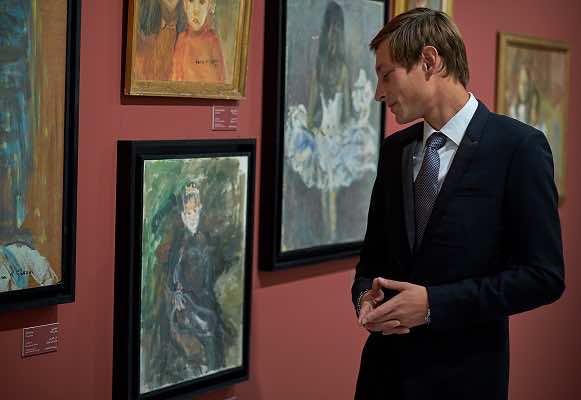
His paintings, “and not only his Fantasia-related pieces but his landscapes and portraits that many did not know of,” specified Brian Bexter, allowed global spectators an insight into how his work strenuously captivated the unparalleled essence of a kingdom and its people.
Today his grandson, Brian Bexter, an expert in art piece authentication, is preserving El Glaoui’s justly celebrated oeuvres and documenting his personal journey not solely as an artist but also as a father, husband, and son of the last Pasha of Marrakech.
The upcoming Hassan El Glaoui biography
“My grandfather was a pioneer. There is really no other way to describe his legacy and the impact he has had on the international art scene, in the sense of shedding light on Moroccan history. He highlighted the ‘coexistence’ of Morocco’s customs in foreign realms through his art which, in fact, is a form of storytelling and El Glaoui told Moroccan history through an artistic lens.”
Brian Bexter has set out to retrieve archived documents and accounts of his late grandfather in hopes of tracing back his memories and life experiences before creating the biography of the artist. The pandemic undoubtedly made his investigation more challenging as the filing of archives transitioned to digital platforms, yet Brian was keen to reach out to individuals and institutions who had been affiliated with his late grandfather.
Having had the unique opportunity to assist the late artist in his work, pose for his portraits, and witness his extraordinary skills while growing by his side, Brian is driven to write a biography in his name.
The biography, he specified, aims not solely to entail accounts related to the late artist’s exhibited oeuvres but also personal matters that formed his identity––ranging from his marital experiences to his victimization of racism as a darker-skinned figure among European society.
Preserving Moroccan history through artistic expression
The act of documenting these intangible memories and producing a way of sharing them with loved ones for generations to come is one way of preserving not just a legacy but also history, he explained.
“Moroccan history is one that is rich and precious to not only the native eye but also the international audience and just as Churchill saw the potential in my late grandfather’s work, I believe more approaches ought to be taken by our own audience,” he told MWN. “Showcasing Moroccan history through art is of utmost importance in preserving our culture through these changing times.”

Brian endorses philanthropists who engage in such matters and proclaims the need to further invest in young artists who capture the essence and history of Morocco through art––paying tribute to the kingdom’s rich culture and expanding its presence on the international art stage.