Rabat – As Morocco rapidly develops, the growing middle-class is leading to a growing number of families owning cars. Amid this changing situation, the country’s unofficial parking guards are creating a difficult situation that appears to require government intervention.
Inequality in Morocco has created an unregulated informal industry of unskilled workers acting as parking guards in exchange for a few dirhams from more affluent car owners seeking to park their vehicle.
Public outrage over parking lot attendants has been making headlines for years. Back in 2019, hashtags went viral on social media calling out predatory behaviors becoming common practice in Morocco’s largest cities. Once again this year, the issue was brought up on various media outlets, after yet another viral Facebook campaign.
After a call to boycott parking attendants and calling people to call out bad behavior when an unpleasant encounter occurs, citizens were encouraged to file complaints on the Chikaya.ma and CasablancaCity.ma platforms.
As public outrage intensified, Deputy Minister of Interior Noureddine Boutayeb clarified the legal framework of the profession during a parliament session on Tuesday. He told the gathered press that“the exploitation of public spaces as parking facilities, falls within the framework of the temporary occupation of public domain, which is subject to a set of laws and regulations”
Many netizens however, see the sector as lawless.
A Facebook group named “Boycott Moul Gilet,” created for documenting unpleasant encounters with parking attendants, now has over 88,000 members. The rapid popularity of the group perfectly illustrates both the need for intervention on the matter, and the degree of anger among many citizens.
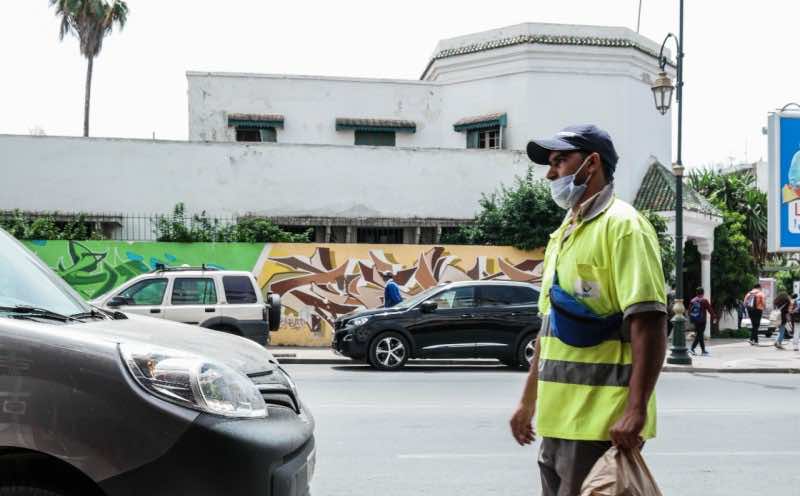
In recent weeks, the group shared several unfortunate parking encounters, denouncing the anarchy of the guards and the illegal practices that have become commonplace. The complaints range from guards imposing unreasonably high prices. In Dar Bouazza and Ain Diab, affluent coastal localities in Grand Casablanca, parking prices are around 20 and 10 MAD, respectively.
A quick scroll through the Facebook group also reveals that the high cost is far from being the only concern incensing many citizens. Some guards also regularly resort to aggression when a person refuses to pay the imposed fee. Many people have also complained about having to pay at every stop, even if it’s only for a few seconds, or while someone is still in the parked vehicle.
Most of these problems are only exacerbated by the proliferation of illegal, non official guards. People can simply buy a yellow vest, pick a street or neighborhood and take over as a parking guard, while imposing their chosen fee on residents.
Some city councils have attempted to set up mechanisms to inspire a better management of parking facilities for vehicles on public roads, either through the creation of specialized public bodies or through private contractors.
A number of such mechanisms have already been introduced in some major cities such as Fez and Marrakech, making the sector somewhat regulated and limiting disputes between the people involved in the profession and their clients.
But the Fez experiment proved to be a failure, and uncovered the disconnect between city officials and the citizens they are meant to serve.
Fes Parkings
“The organization and management of vehicle facilities on public roads and squares is a competence vested in the heads of collective councils, and managed on the local levels of the ministry of interior’s administrative proxies,” Deputy Interior Minister Boutayeb said. This statement appears to leave local officials with the choice to employ whatever measure they see fit to deal with the parking management of each city.
Residents of the city of Fez are among the most affected by the lawlessness of parking attendants.
Citizens regularly struggle to park their vehicles without the all too familiar verbal-sometimes physical altercation with parking guards. One member of the popular facebook group “Boycott Fes Parkings” spoke to MWN about how he was not allowed to park in front of his own home, and was forced to pay a parking fee despite the area being a residential street.
The local government sought to resolve this issue through “FES PARKINGS”, a local development company. The initiative is under direct direction of the commune of Fez and the supervising Ministry, with city hall holding a majority stake in the company.
The regional initiative could have been an opportunity to operate and organize the guards and attendants in structured groups, and make them subject to applicable labor laws. But instead it was met with disapproval from many locals, as the set prices were too high. Fes Parking relied on an hourly fee of 2 MAD per vehicle, in a city where residents have gotten used to paying the same amount for an unlimited period of time.
Hicham Zerhouni, a member of the “Boycott Fes Parkings” Facebook group, reminds the followers of the page and the city’s residents that “the failure of city officials to manage the parking crisis needs to be remembered during the election month, especially by those planning to boycott elections or sell their votes”