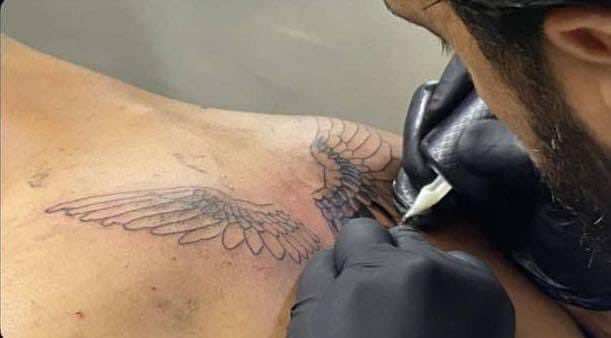
Rabat – Tattoos are considered among the oldest art forms known to man. A tattoo artist makes a living from their art. While there are a few tattoo salons across Morocco in cities like Rabat, Casablanca, Marrakech, and Tangier, tattoos are not widely accepted in Moroccan society yet.
Tattoos date back to ancient times. Ethnic groups had them for diverse reasons. Amazigh women used to have traditional tattoos mainly on their faces, feet, arms. It was considered a symbolic rite of passage for young women, and throughout their lives. They used to create the ink themselves as an integral part of their culture, even though they happen to forcefully tattoo some women. Just like in the Hawaiian tradition, Amazigh tattoos differ from the Western forms of tattooing, as it is the tattoo artist that determines the design.
While Amazigh tattoos were widely accepted in society, the practice started disappearing due to multiple factors. On one hand, the practice started disappearing because of the French occupation of Morocco, and the influence of Islamization in the country. On the other hand, globalization and its related social and cultural changes made traditional Amazigh tattoos unappealing and uncool to a modernity-hungry Moroccan society. This marked a turning point in the perception of tattoos. Society started shaming Amazigh women for being tattooed, reaching a point where some women have started getting their tattoos removed today.
Tattoos in the Arab World, a practice asserting itself
In the Quran, Islam’s holy book, there is no mention of tattoos being condemned. The Islamic tradition, however, prohibits this practice through hadith. According to hadith Sahih al-Bukhari, “The Prophet cursed the one who does tattoos and the one who has a tattoo done.” Tattoos are considered to be a sin as they alter the body, changing God’s creation.
Zahmoul Fawez also known as Fawez Wachem is a Tunisian tattoo artist. In 2016, he opened the Tunisian National Tattoo School, the first tattooing school in North Africa and the Maghreb. The school offers training for body art, which is impressive as it is rather challenging to get a tattoo school acknowledged by a Muslim state. The owner of N Body Art, a prominent tattooing and piercing shop in Rabat, had the chance to visit Fawez’s school. According to him, however, we are far from reaching this level in Morocco – at least for now.
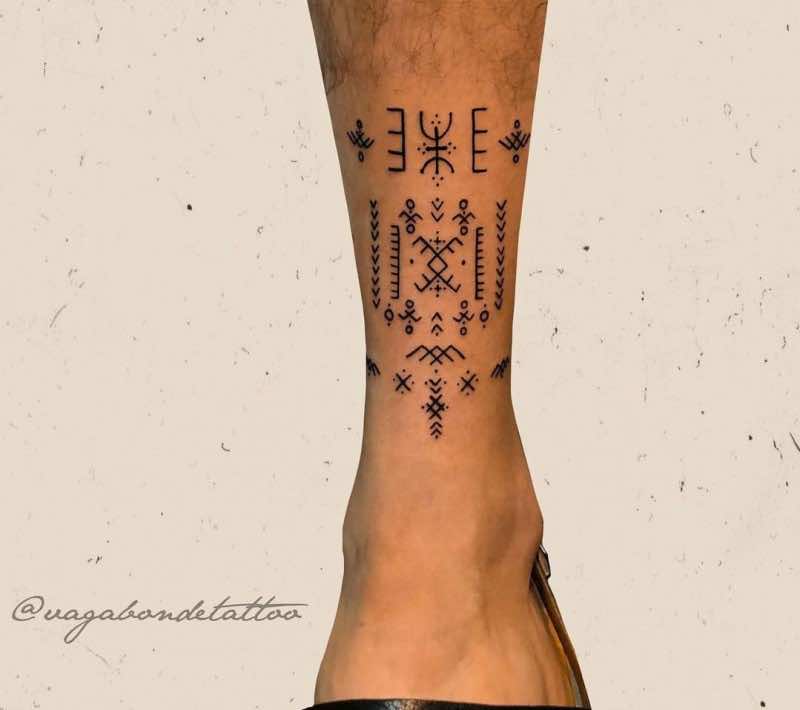
Berber Tattoo done by Vagabonde Tattoos. photo credit: @vagabondetattoo on Instagram
For instance, there is no mention of tattoo shops in the Moroccan law, and so they register as “beauty salons.” Some tattoo salons often get raided by the police to check their policies and regulations or make sure they maintain proper hygiene. This is so because tattoos are considered a form of body care, according to Vagabonde Tattoo, a Marrakech-based tattoo artist.
In anthropology, any action has a meaning. Thus, the process of getting a tattoo provides a sense of belonging to an individual that affirms their identity through their skin. The trace of Amazigh tattoos as well as modern tattoos today in Morocco shows a certain cultural resistance. There is a shift from the principle to the norm: tattoos are prohibited, but the cultural dynamics assure that the practice still exists. Change takes time because it involves a paradigm shift, according to anthropologist and researcher Farid El Asri.
Being a tattoo artist in Morocco is challenging
From being encouraged to being frowned upon, tattooing has evolved into a formal profession. Young entrepreneurs decide to open their own tattoo salon to promote this practice of body art in Morocco. These Moroccan youths have developed a sense of entrepreneurship to make a living from their passion.
Being a tattoo artist is more than just drawing on someone’s skin. It implies providing their shop with the right tattoo equipment, a clean work area, and ensuring proper hygiene. They have to sterilize everything and be careful not to spread any infection since tattooing affects the skin and blood. They also need to educate customers about proper aftercare.
Some tattoo artists learn through an apprenticeship, while others are self-taught like Nabil from the N Body Art who talks about the “learn by doing method” as he learned on the internet and through YouTube videos. Both tattoo artists I talked to agree that one of the most challenging aspects of their work is access to the right equipment. It is hard to find the right tools, and importing needles is impossible because of customs clearance processes.
In an environment where tattoos are frowned upon, being a professional artist will be either sink or swim. According to the tattoo artists I talked with, their peers do not judge them for their job and even support them. But they still wish their work was perceived as art by society. Vagabonde Tattoo says that their profession is usually frowned upon as people associate tattoos with scarification and thugs, which leads them into thinking that being a tattoo artist is a useless or risky job in Morocco.
A real passion behind a flourishing business
Over time, their customer base has diversified and the artists’ opportunities relatively broadened. Vagabonde Tattoo described the experience as magical as they enjoy the interaction with their customers who are of all ages and backgrounds.
Lately, it has become a trend to get traditional Amazigh symbols as tattoos. Some Amazigh women get their tattoos removed to adapt to today’s society. Vagabonde Tattoo specializes in Berber tattoos. But she says that most of her customers are Europeans, as the majority of Moroccans seek modernity. The elderly women are the sole original remainders of this part of Morocco’s culture. We pay tribute to our heritage so that the tradition of tattoos among the Amazigh community lives on.
Tattoos are often assimilated to prisoners and thugs. Thus, there is no tattoo culture in Morocco. For many, getting a tattoo is inconceivable, if not taboo. Despite the strict mindset, our society transforms and things change.
In order to value the tattoo artists’ craft better, it would help to start perceiving them as professional artists. Nabil from the N Body Art thinks that Morocco is actually in need of this kind of art style and that they should get the same advantages and rights as other artists.
Echoing the same sentiments as Nabil, Vagabonde Tattoo believes that it is a challenge to appreciate tattoo artists at their fair value as it is deep-rooted in society – especially among older Moroccans – that tattoos are bad and should be frowned upon. It would be a good start if tattooing was talked about even more in the newspapers, on TV, or radio shows.
Moroccan tattoo artists make do with what they have, managing to achieve their dream to make a living from their love for ink. But the lingering social taboos and stereotypes about tattoos indicate that Moroccan society is still relatively far from normalizing tattooing as an acceptable form of art.