 Join on WhatsApp
 Join on Telegram
Rabat – Riots over the incarceration of former President Jacob Zuma are spreading across South Africa, fuelled by decades of growing inequality and poverty.
What started off as protests along ethnic lines, mainly by Zulu protesters demonstrating against the arrest of prominent Zulu politician and former president Zuma. The jailing of Zuma, after being convicted on contempt of court, sparked protests that evolved into riots and looting in predominantly Zulu provinces of KwaZulu-Natal and Gauteng.
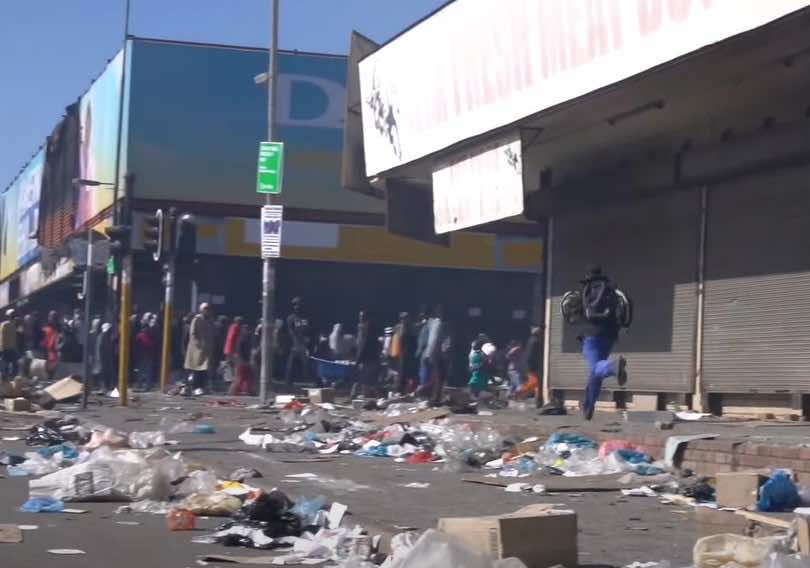
What started as protests in support of Zuma quickly morphed into outbreaks of looting and violence as South Africa faces its ‘ticking time-’bomb’ relating to the country’s vast inequality. As the riots have moved beyond ethnic lines, protests and violence have engulfed other provinces, including the country’s metropole, Johannesburg and port city of Durban.
While at first protesters had gathered to protest the jailing of the former Zulu president, grinding inequality and poverty have become the main grievances for the ongoing unrest.
South Africa’s Minister of Police, Bheki Cele, stated the government “cannot allow anyone to make a mockery of our democratic state, and we have instructed the law enforcement agencies to double their efforts to stop the violence and to increase deployment on the ground.”
Government response
Footage of shops and malls being looted have been circulating worldwide as South Africa’s police have failed to cope with the massive scale of public unrest. The South African government has deployed the military on the streets of the rainbow nation.
South African President Cyril Ramaphosa, in a public address to the nation warned that “the path of violence, of looting and anarchy leads only to more violence and devastation as well as suffering.” Opposition parties such as the left-wing Economic Freedom Fighters (EFF) party failed to show political unity in the face of chaos on the streets.
EFF spokesperson Vuyani Pambo told local television channel SABC News that the government’s deployment of the military as an “admission of a lack of political leadership.” Pambo described Ramaphosa as the “so-called president” before stating that the country’s longtime ruling party, the African National Congress (ANC) “has failed, and must admit that it has failed.”
Renewed unrest in South Africa is perceived by many as a result of decades of growing inequality and poverty under the leadership of the ANC, South Africa’s largest political party. The ANC has ruled since the country’s first free elections that saw ANC-candidate, Nelson Mandela, become president of the post-Apartheid state.
Yet the current crisis is fueled by decades of further widening inequality, continued ethnic divisions,marginalization and corruption, issues not easily resolved, especially in the face of ongoing chaos.
With riots and looting having left convenience stores and markets empty, many in KwaZulu-Natal and Gauteng have few places left to buy their basic living products and food. As protests spread beyond traditional Zulu provinces, South African politicians appear to have little unity to offer a restless population.