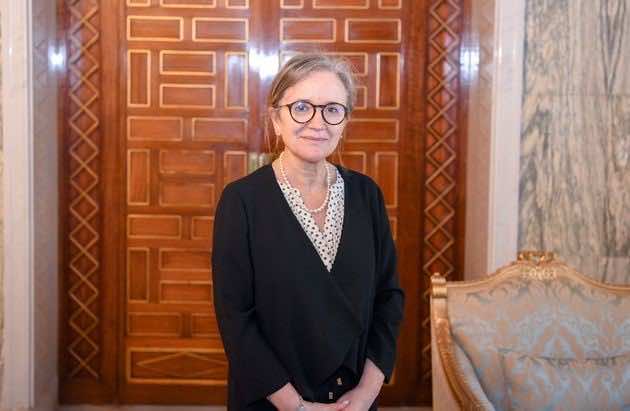
Rabat – Tunisian President Kais Saied has appointed Najla Bouden Romdhane as the country’s new prime minister and instructed her to quickly form a government to end Tunisia’s months-long constitutional crisis.
The appointment of Romdhane, the first woman in the history of Tunisia to hold the position of head of government, comes two months after President Saied triggered a constitutional crisis by dismissing former PM Hichem Mechichi and freezing the parliament.
In a recorded video statement published online, the president asked Romdhane to form her cabinet in the upcoming days, noting that “the government should respond to the demands and dignity of Tunisians in all fields, including health, transport, and education.”
He emphasized that the new government’s main mission would be to “put an end to the corruption and chaos that have spread throughout many state institutions.”
Despite having little experience in the political milieu of the country, Romdhane was appointed in 2011 as Director General for Quality at the Ministry of Education where she was also responsible for implementing World Bank projects.
Born in 1958 in the governorate of Kairouan in northern Tunisia, Romdhane is an engineer in geology and has worked as a project manager at the Ministry of Higher Education and Scientific Research in 2015.
In 2016, she served as Head of the Management Unit by Objectives and implemented a reform project to support the employability of higher education diplomas at the Ministry of Higher Education and Scientific Research.
Amid the ongoing political crisis in Tunisia, the country has been under domestic and foreign pressure after the president suspended parliament and seized most powers in July. While critics described the move as a dictatorial power grab or a “constitutional cup,” President Kais said he had to intervene to save the country from political paralysis.
113 members of the centrist Islamist Ennahda party, Tunisia’s largest political party, resigned last week amid a dire political crisis. On Sunday, pro-democracy activists gathered in Tunis to demand the reopening of parliament and the restoration of the democratic institutions that were established in Tunisia in 2011.
The appointment of a new PM and the formation of a government in the coming days is expected to end Tunisia’s months-long political uncertainty, but it remains to be seen whether the new authorities will do any better than the recently dismissed government in delivering the promises of the country’s much-lauded 2011 spring.