Rabat- Following the latest elections, Moroccans expect the new government to bring long-promised changes in terms of improving social protection programs, education, health, employment, and bolstering the national dialogue.
After an intense political campaign, 50.18% of voters turned out nationwide, with nearly 70 % of voters in Morocco’s southern provinces, making participation in 2021 elections far higher than that of 2016.
Moroccans expressed their displeasure with the Justice and Development Party’ (PJD) performance by voting instead for the National Rally of Independents (RNI), raising expectations around the new government.
Hopes and dreams
“When the Moroccan people go to vote in the election, they hope for real change. Later, we find that no big change happened,” Wissal, a 23-year-old student from Casablanca, told Morocco World News (MWN).
She added that although she stopped believing in elections, she made an exception this year and voted for the RNI, hoping for big changes to happen in Morocco.
“My hopes and dreams are first and foremost that the new government will reform the education system and adapt it to the job market… as well as the creation of employment opportunities for recently graduated students especially,” she explained.
Wissal expressed her fears about not getting the job she has always dreamed of because of high unemployment in Morocco. “These feelings overwhelm and paralyze my mind, but I’m still trying to be optimistic.”
According to a new study from the High Commission for Planning (HCP), Morocco’s unemployment rate has moved from 9.2% in 2019 to 11.9% in 2020. The study noted the total number of unemployed people climbed by 29% to 322,000 people.
While some are putting their hopes on the new government, others remain sceptical over the value of the elections. Hassan is 30, unemployed, and decided not to vote in the latest elections. He said emigration is “the only solution to fulfil his dreams and have a better life, even if that means putting his life at risk.”
Hassan related that the pandemic made his financial situation even worse, as the COVID-19 crisis led to the loss of thousands of job opportunities. “I used to work from time to time in different jobs. But now everything changed; I have been looking for a job for a long time, and couldn’t find any.”
Bigger challenges
If Moroccans have for years “endured the efforts of structural reforms of both economy and finance sectors, today they have the right to grow in ambition and have higher expectations,” Moroccan political analyst Adil Benhamza, told Morocco World News.
He explained that Morocco has achieved important development at the macroeconomic level, and the problem is currently related to the weakness of the reflection of this success regarding social and spatial justice.
According to Benhamza, Morocco’s choice of a new development model is a natural result of previous development and economic choices failure “in distributing the fruits of development equitably”.
Speaking about challenges that Akhannouch’s government will face, he related that the government has not revealed, so far, the funding sources of all its major projects.
“In order to make a judgment about what the current government intends to do, we must wait for the new finance bill to get a complete picture about the situation; any lack of funding would hinder the government’s ambitions.”
“We must not forget that Morocco, when dealing with the COVID-19 crisis, expressed the ambition to develop trade internationally as well as investing in our strategic location near the most important global markets, and that will need a lot of funding resources,” concluded the analyst.
The country’s economy suffered unfavorable conditions in 2020, resulting in a contraction of 6.3% as a loss of 432,000 jobs.
On the other hand, new data from Morocco’s High Commission of Planning (HCP) showed that Morocco’s national economy grew by 15.2% in the second quarter of 2021, as opposed to a drop of 14.2% during the same period in 2020.
Thus, many economic experts think the government should focus on counter-cyclical fiscal policy, by lowering public debt, reforming the pension and health systems and making them more sustainable, as well as creating a more business-friendly environment.
The governmental program
Amid the election campaign, Aziz Akhannouch, head of the National Rally of Independents, announced the provision of one million jobs if he would win the prime ministership, which some see as being difficult to achieve, but not impossible.
The first concrete test of the new government’s ability or readiness to deliver on the promises detailed in its action plan will be related to the new finance bill of the upcoming year. The bill will be discussed on Friday. According to government regulations, the ministers have until October 20 to agree on a fiscal bill for 2022.
Regarding the guiding principles of the governmental program, the new Head of Government emphasized the ten commitments of his government during the 2021-2026 period, such as his party’s promise to reevaluate salaries and pensions.
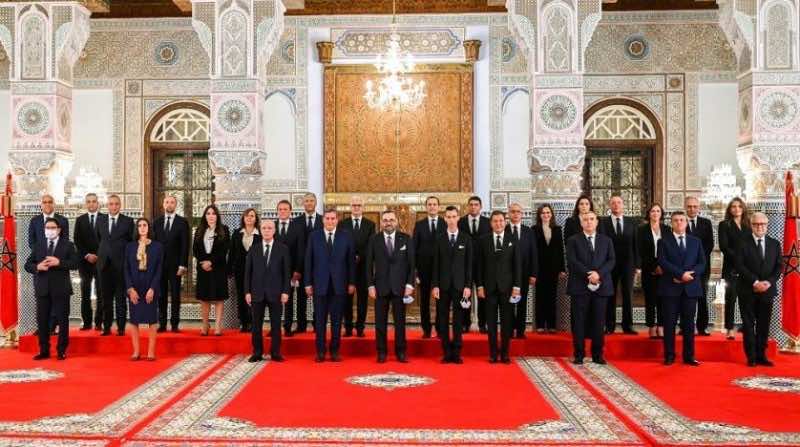
Akhannouch described his cabinet’s priorities on Monday, during a plenary session held by both houses of the Moroccan parliament. The incoming government aims to focus on strengthening of state-provided social services, a mass employment strategy, good governance in public management, as well as the establishment of a strong cooperative relationship between the executive and legislative bodies.
According to Akhannouch, the governmental agenda provides realistic and ambitious responses to get out of the COVID-19 crisis and project into the future with determination and consistency. The new coalition government in Morocco includes the National Rally of Independents (RNI), the Authenticity and Modernity Party (PAM), and the Istiqlal Party.
On Friday October 8, King Mohammed VI said that “the development model opens up vast prospects for the work of the government”, urging it to complete the implementation of the major projects underway.
In his speech marking the opening of the Moroccan parliament’s first legislative year of the 11th legislature, the King added that “despite the positive environment, we should remain realistic and continue to work in a responsible manner.”
The development model, which encompasses economic, social, and environmental aspects, is a long-term inclusive and participatory framework that “sets out new standards and opens up vast horizons for everyone.”