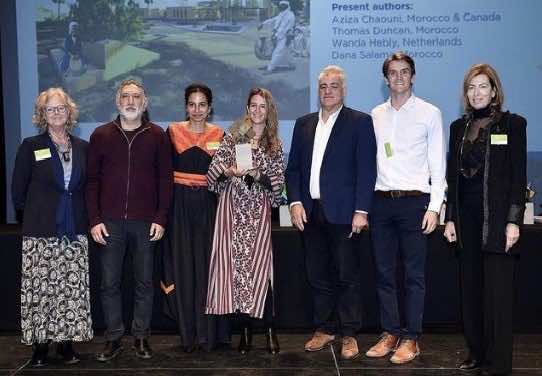
Fez – The 6th edition of the International Holcim Awards, which was held on November 13 in Venice, Italy, honored the work of Moroccan architect Aziza Chaouni, highlighting her sustainability-minded and socially responsible project on climate migration.
The Moroccan architect earned both the Global Holcim Awards Bronze prize and the Acknowledgement Prize for her project “Cultural Interlude.” The project draws a self-sustaining music school and ecotourism center that aims to preserve the tribal cultural heritage in an oasis located in the town of M’Hamid El Ghizlane, in Zagora province.
Such local features are seemingly endangered due to the global trend of urban migration that see the oasis lose both its inhabitants and its tribal heritage, including tribal music, local architecture, and traditional agricultural practices.
“The project is located in the Sahara desert, on the edge of an arid oasis that lacks water resources, so it could only be sustainable,” Chaouni said in LafargeHolcim press release, indicating that the project will generate its own energy and make use of every drop of water collected.
The project incorporates traditional construction with sophisticated technologies, such as solar chimneys and rainwater harvesting for both domestic and irrigation purposes.
The Global Holcim Awards jury acknowledged Chaouni’s commendable dedication to addressing the problem of climate change-induced tribal displacement by providing a solution that allows people to stay rooted in their hometowns and maintain their traditions.
The prizes were handed over by Jose Antonio Primo, CEO of LafargeHolcim Morocco, during the awards ceremony.
Chaouni is also the co-founder of the Bureau of Ecological Architecture and Systems of Tomorrow (EAST) with Takako Tajima, a renowned landscape architect based in Southern California. Tajima has won many prizes, including The Architectural League Prize from the Architecture League of New York in 2009.
Bureau EAST’s “River remediation and urban development scheme” in Fez, Chaouni’s hometown, won the 2009 Global Holcim Award Gold for creating a chain of recovery projects and for addressing the economic and social life of the city together with the ecology of the river.