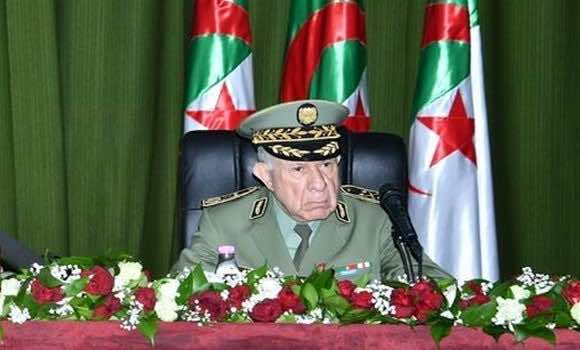
Rabat – Controversial anti-Morocco remarks by Said Chengriha, the chief of staff of Algeria’s military, recently made him the center of focus of a number of media reports, with many describing the 76-year-old army general as the mastermind of Algeria’s growing rift with Morocco.
In a special video report aired last week on November 5, German news outlet Deutsche Welle (DW) referred to Chengriha as “the orchestrator of the cold war with Morocco.”
Quoting both Algerian and foreign observers who have watched the 76-year-old general’s career and his rise to the forefront of Algeria’s political scene in late 2019, the report emphasized that Chengriha, and not President Abdelmadjid Tebboune, is the “real leader” of Algeria.
Before taking office as the chief of the Algerian army, Chengriha worked as deputy commander of special operations in the 1990s, DW recalled.
The report cited the general’s involvement in the death of hundreds of anti-establishment critics between 1992 and 1994, describing him as one of the symbols of Algeria’s “black decade,” a reference to the Algerian civil war between December 1991 and February 2002.
Often described as a “brutal” and “bloodthirsty” leader, one of Chengriha’s tasks after being appointed as the chief of staff of the Algerian People’s National Army was to stifle the anti-establishment protest movement known as the Hirak.
But also central to the Algerian general’s public persona and well-cultivated nationalist aura is his immediately apparent and deep-seated mistrust – and even hatred- of Morocco, which he likes to describe as Algeria’s “classical enemy.”
Throughout his military career and especially since becoming the most powerful figure of the Algerian politico-military establishment, Chengriha has long been known for his readiness to confront or blame Morocco, according to DW.
In one of his latest remarks against Morocco, General Chengriha accused the North African country of conspiring with Israel and a handful of “terrorist organizations” in Algeria to destabilize the Algerian regime while undermining the country’s security and interests.
Most significantly, as the de facto leader of Algeria’s High Security Council, General Chengriha’s traditional Morocco-blaming was critical in Algeria’s decision – despite evidence to the contrary– that Morocco was the perpetrator of the tragic forest fires that hit northern Algeria in August of this year.
President Tebboune, another longtime representative of the Algerian establishment, has of course long espoused his country’s traditional Morocco-bashing rhetoric.
But the Algerian president’s speeches and interviews in recent weeks show a shift from his usual rhetorical flirtation with conflict to an apparent determination to actually drag Morocco into an open confrontation.
During his presidential campaign and just days following his election as Algeria’s president in late 2019, Tebboune’s anti-Morocco discourse was mild and even came with scant suggestions of a possible rapprochement between Rabat and Algiers.
This led many observers to hope that his election could inspire a new dawn in Morocco-Algeria elections. And even if Tebboune does not radically alter the face of Morocco-Algeria rivalry for the better, more cautious analysts conceded, he would at least keep any military escalations at bay.
But such analyses have been turned upside down by recent developments, as Tebboune’s office continues to air unproven accusations and unambiguous threats targeting Morocco.
The latest accusation is the claim that Moroccan military members attacked two Algerian truckers and their local guide while they headed to northern Mauritania.
MINURSO, the peacekeeping operation in Western Sahara, is still investigating the claims, but denied the attack was in Mauritania. Instead, the UN confirmed the incident took place in a buffer zone, a restricted area in Western Sahara.
The UN did not, however, mention how the Algerian nationals died. Meanwhile, a source from Morocco’s military denied any attacks on the Algerian nationals, emphasizing that the two truckers and their guide were actually killed in a landmine explosion in a restricted zone.
That the explosion took place in a restricted, sensitive area comes with two possible readings: Either that the three killed were not simple truckers, or that Algiers appears to be ready to deliberately send civilian truckers to restricted zones in the hopes of dragging Morocco into the military escalation from which Rabat has so far distanced itself.
Morocco continues to insist that it does not want to go to war with Algeria and that it will not be dragged into an all-out military confrontation with its eastern neighbor. This more measured, wiser approach has traditionally been applauded in diplomatic circles.
As Algeria’s unflagging campaign of accusations, allegations, and war threats continues, however, it remains to be seen whether Morocco’s opting for restraint will be effective this time around.