










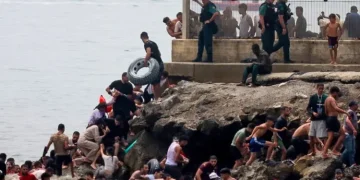

























































Rabat – Morocco’s security services are reinforcing control at the border with Ceuta to avoid another mass irregular migration attempt seven months after waves of irregular migrants crossed to the Spanish enclave.
Spanish news agency EFE reports that Morocco reinforced security in the region on Friday afternoon.
Police sources informed the Spanish news outlet that the decision was made as a result of a series of messages that have been circulating on the internet in relation to a relaxation of security measures at the border crossing.
In May, a mass irregular migration entry to Ceuta caused frustration among Spanish government officials and deepened the then simmering diplomatic crisis between Rabat and Madrid amid tensions over Spain’s sheltering of Polisario leader Brahim Ghali.
Hailing from Fnideq in northern Morocco, thousands of migrants lined up to swim their way to the Spanish enclave. The Spanish Ministry of Interior estimated the number of Moroccans who entered Ceuta in May at more than 10,000, including minors.
Most of the migrants were later returned to Morocco, prompting many NGOs to accuse Spain of violating migrants’ rights by collectively deporting them in total disregard of international conventions on the treatment of migrants, including asylum seekers and unaccompanied minors.
In the meantime, as tensions deepened with Morocco, the Spanish government resorted to accusing the Moroccan government of deliberately relaxing its border security to allow waves of migrants to flood into Ceuta.
Madrid claimed its tension with Rabat originated from Morocco’s “weaponization” of mass migration to “blackmail” Spain. However, the diplomatic rift between both countries had emerged a month before the Ceuta migration crisis, with Morocco repeatedly requesting justifications from Spain after the Spanish government allowed Polisario leader Brahim Ghali to enter its territory in April.
Ghali had traveled to Spain for hospitalization, angering Morocco and prompting the Moroccan government to declare that the Spanish government was no longer a reliable partner.
There have been signs of a reconciliation in recent months, with Spain taking noticeable steps toward restoring relations with Morocco.
Morocco has also welcomed Madrid’s calls for turning the page of the Ghali affair and last May’s feud over the Ceuta miigration crisis. Recent statements from both governments paint a shared determination to salvage their “essential” and “strategic” cooperation after months of unprecedented tensions.
However, the fact that Morocco’s ambassador to Spain has still not traveled back to Madrid to resume work has led many observers in both Spain and Morocco to take the view that the two countries have not completely settled their divergences on some major questions.