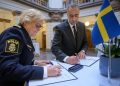

Morocco’s foreign minister, Nasser Bourita, has confirmed that Morocco and the Visegard countries are committed to strengthening their bilateral relations as they look to address shared challenges.
Bourita made the statements in an interview with Hungarian channel Hir TV, in which the Moroccan top diplomat highlighted the key talking points of the first ministerial meeting between the V4 group and Morocco held on 6-7 December in Budapest.
“Bilateral relations with the four Visegrad countries” will serve as “a solid foundation of trust,” Bourita said, adding that this trust “offers the opportunity to take our relationship up a notch and have this V4+Morocco format.”
The Visegrad Group consists of four Central European countries: Poland, Hungary, Slovakia, and Czechia.
Despite all four countries being members of the EU and NATO, the group sees itself as a cultural and political alliance aimed at promoting socio-political and economic integration, as well as defense and energy cooperation, among its members.
The Morocco-V4 meeting comes amid a context of fragility and turbulence in world affairs, with countries looking for solid and reliable partners, Bourita explained.
For Morocco, he argued, joining the V4 group helps to “face security challenges, in addition to the many challenges imposed by the pandemic.” He noted that other opportunities are “open particularly on the economic development level.”
As a result, this meeting provides “the ideal opportunity to exploit our bilateral achievements to uncover the new prospects that this format offers,” Bourita said.
Read also: Moroccan FM Conveys Africa’s Determination to Become Credible Partner for V4 Group
The chief of Moroccan diplomacy underlined that what counts is the “trust and reliability of a partner,” regardless of neighborhood, which is no longer an important asset.”
During his visit to Hungary, Bourita held talks with the Hungarians minister of foreign affairs and trade, Peter Szijjarto, with an eye on developing a bilateral “genuine partnership” based on the two nations’ outstanding connections.
“The two countries have signed more agreements in the last five years than in the last decades,” he later said of the meeting in his interview with Hungarian television.
Pointing to the improving dynamics between Budapest and Rabat, he added that his meeting with Szijjarto was an opportunity to examine the implementation of these series of bilateral accords and look at ways to strengthen their collaboration.
Morocco being the third economic partner of Hungary in Africa, the discussion with Szijjarto revolved around boosting bilateral economic partnership and exchanging the best practices to manage the COVID-19 crisis, Bourita concluded.