
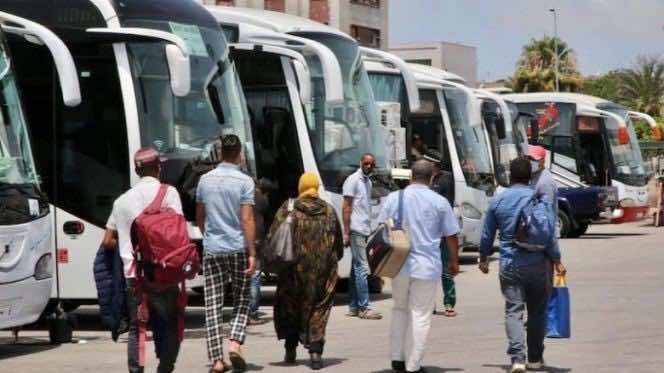
Rabat – The government on Wednesday launched a program to provide financial support for people such as couriers who drive for a living, to mitigate the effects of a rise in fuel prices.
The scheme, which was first announced earlier in March, will also help people including bus and taxi drivers, as well as people transporting goods.
Drivers can apply for government support by registering on Morocco’s online platform starting as of today, the government said in a press release.
They will benefit from the government support, which is specified according to three categories, starting from April 2022.
How much can drivers get?
Public transport professionals will benefit from a subsidy of MAD 2,200 ($226) for large taxis, MAD 1,600($164) for small taxis, MAD 1,800 ($184) for mixed transport vehicles in rural areas, MAD 7,000 ($719) for intercity buses, and MAD 6,200 ($637) for urban buses.
Regarding tourism transport, transit professionals will benefit from the financial support of MAD 2,800 for first-class buses, MAD 1,400 ($143) for second-class buses, and MAD 1,000 ($102) for third-class buses (TGR/TLC).
In addition, freight transport professionals will receive a support of MAD 1,000 ($102) for towing vehicles, MAD 2,600 ($267) for trucks with a gross vehicle weight (GVW) greater than 3.5 tons and less than 14 tons, MAD 3,400 ($349) dirhams for trucks with a GVW between 14 and 19 tons, MAD 4,000 ($411) for trucks with A GVW greater than 19 tons, and MAD 6,000 ($616) is allocated for road tractors.
The government aid also includes school and personnel transport. Personnel transport professionals on behalf of others will benefit from financial aid of MAD 1,200 ($123) for each vehicle, while MAD 1,000 ($102) is allocated for each school transport vehicle.
Moroccan drivers participated in a 5-day national strike which started on March 7 to protest against the rise in fuel prices, demanding a cap on fuel prices.
The government launched on March 17 a digital platform to facilitate tax payments to regional authorities in order to preserve the purchasing power of Moroccans amid the global rise in fuel prices.