 Join on WhatsApp
 Join on Telegram
Rabat – The Forsa program, a government investment scheme, has come under heavy fire recently for what critics deemed unnecessary and corrupt spending on the program’s advertising campaign.
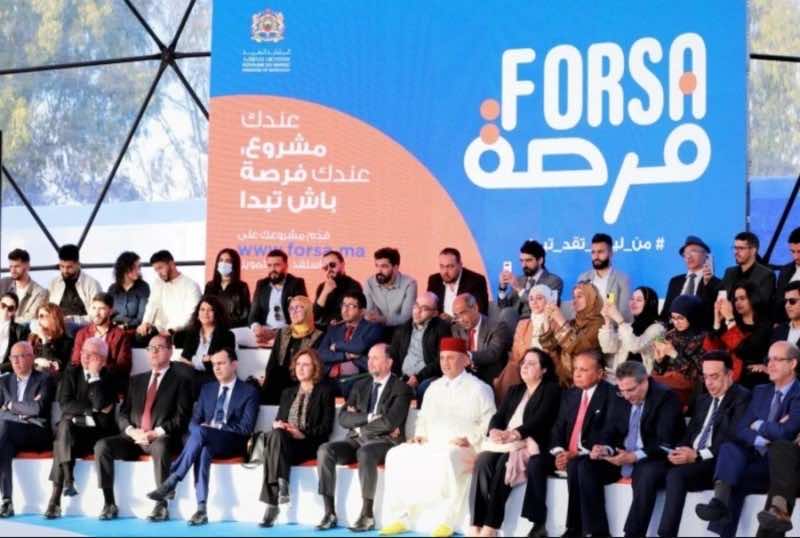
Government officials celebrated the launch of the program with a lavish party at a luxury Rabat hotel, as well as allocating a advertising budget for the project with upwards of MAD 23 million ($2.3 million), with an online campaign that used social media influencers.
But between the extravagant spending, the questions of the efficacy of such programs as a whole, and a debate around influencers’ place in society and the internet in general, Forsa doesn’t seem to be having the smooth start the government probably hoped for.
Read also: Government’s Forsa Program Sparks Controversy
Question of money
With the Forsa program as a whole costing over MAD 1 billion ($100 million), many were anticipating results that could justify the cost. But with the advertising alone costing MAD 23 million, questions have been raised about where the money is going.
A big criticism of the marketing budget is that the program does not, at the end of the day, offer a tangible product or a service that directly benefits consumers.
Academic and analyst Mohamed Bouden, along with other critics, contended that what the project really needs is not some massive marketing budget or online ad campaigns, but rather an institutional awareness campaign to get the idea of the project across to those who need it.
In fact, some critics have said that the campaign only served to cover up shortcomings in this institutional mechanism. If the government cannot manage the necessary resources to get the program out there, then surely hiring a few big online personalities can do the job.
But the spending mismanagement did not stop at the marketing campaign. Many have criticized handing off management of the project to the private sector.
The Moroccan Agency for Tourism Development (SMIT) is tasked with managing the project, but skeptics have questioned the firm’s ability to do so. Many don’t see what expertise SMIT has to bring to the table in a program focused on investing in upcoming business.
In addition, SMIT’s track record in similar projects was similarly called out, as many see that their performance has not measured up to expectations when they were handed other government projects.
The entire discussion has even led to corruption accusations, with parliament and government members being accused of spending the money for the sake of personal gain or connections instead of what’s best for the project.
Read also: Minister Ammor Faces Backlash over Accusations of Nepotism, Corruption
Hicham Al Mhajeri, a member of Parliament with the Party of Authenticity and Modernity (PAM), was one of the most vocal opponents, decrying poor management and saying that the overhead costs of the project should not be as much as they are.
“Should it really cost this much money and effort to pick five projects in each municipality?” he argued. “Something is not clicking.”
For Al Mhajeri, the budget is overblown for how many projects are getting chosen, and the money that is going into overhead management and marketing costs could be better spent on the investments themselves, or on other government programs.
The launch party of the program itself faced heavy criticism, with it taking place at a luxury hotel in Rabat with various influencers invited.
Questions arose around whether the celebration really needed to be that grand, and how much more unnecessary spending there is in the program itself and the government at large.
The influencer debate
As internet accessibility steadily increases in Morocco, we have started seeing the rise of online celebrities in the country. While the influencer debate is still a new one with more questions than answers due to the recency of the phenomenon, many have questioned why this project in particular needs to be associated with them.
One of the pillars of the Forsa advertising campaign seems to be the use of social media advertising and influence from online celebrities to get the name of the program out there.
Mustapha Fakak, known online by the alias “Swinga” boasts more than 600,000 subscribers on the video sharing website YouTube, with most of his uploads garnering at least tens of thousands of views.
Last week, reports emerged that the YouTuber – whose content encompasses a large range of educational topics about health, finance, and administrative information – received up to MAD 300,000 ($30,000) to produce a YouTube video introducing the Forsa program.
The figure invited controversy, due to the sheer amount and the skepticism of the government allegedly spending large sums like this one on social media influencers.
On a Facebook post, Swinga did however deny the leaks.
“I woke up to a mess about me in some papers, and a contract with my online alias that has me receiving 300 thousand Dirhams for a video about the Forsa program,” Swinga wrote. “The odd thing is that it is my first time seeing this contract in the articles.
“Just to clarify, the overseers of Forsa’s media campaign did reach out to me to make a video on the topic and explain the project, since I have a big following of young people, who are the target demographic,” the YouTuber said.
He then went on to break down the economics of producing such a video, arguing that even had he not been paid the alleged amount, some video projects might warrant it.
But beyond the economics of the deal, people are questioning the implications of the importance of influencers in today’s climate.
Bouden argued that these developments could suggest an environment where a few people who amass huge social media followings become arbiters of thought in society, saying that the outcome could be negative for the independent thought of the population.
He also added that beyond the Forsa program, the influencer community could have particularly adverse effects on children, who are more susceptible to such marketing tactics.
On the other hand, an increasingly online young generation argues that the situation has not differed from when media was controlled by a few big corporations, saying that the rise of influencers signifies a takeback of media discourse by the people.
Regardless of what this debate means for society at large however, skepticism is still prevalent over how these influencers can help the Forsa program reach the target audience of aspiring business owners.
What about the results?
The results of the program – although it has only just started – seem predictably disappointing so far.
Although more than 100,000 applications have come in for the program, the SMIT announced earlier this week that their call for applications of financial institutions was “unfruitful.”
The opening of bids was declared unsuccessful in 10 out of the 12 regions, with SMIT rejecting the only two financing firms to have applied.
This affirms the worries that people had about SMIT taking on the reins of the project, as local partners like incubators and financiers were to be vital in the practical mobilization of the program.
A total of 32 incubators have been also selected to help run the program on a more local level, after bids were opened for them.
Other critics of the program such as the Party of Justice and Development (PJD) decried the program’s unclear criteria for investments, warning that applications might get drowned with generic ideas that don’t bring much new to the table.
The wording of the advertisements themselves was also called into question by commenters, as many expressed similar worries about the program being drowned in irrelevant applications since the ads make it sound like an investment is all but guaranteed.
In fact, the program only provides 10,000 spots to entrepreneurs, who upon being selected will get MAD 100,000 ($10,000) each. The spots are distributed locally, meaning each municipality and administrative region has its own number of spots.
Indeed, despite several programs of this nature, Morocco remains behind the rest of its continent and region when it comes to the support of its startup companies.
With some of the highest internet connectivity rates in Africa, Morocco would seem to be a perfect ground for startups and new digital businesses to arise, but a hostile and bloated bureaucracy combined with a lack of fintech capabilities has impeded those abilities, according to reports.
And while funding reached an all-time high in 2021, it still pales in comparison to other countries in the region such as Egypt. Last year, Morocco recorded MAD 269 million ($29 million) in startup investments, while similar Egyptian companies raised $100 million.
When looking at other countries with burgeoning startup companies, early funding seems to be a key resource in ensuring the companies’ survival. If Morocco wishes to move towards a more internationalized and modern economy, this would seem to be one of the most pressing issues to deal with.
Programs like Forsa, if managed well, could be just the kind of kickstart that Morocco needs for its economy to join the startup revolution, but under the current circumstances and with the skepticism surrounding them, that doesn’t seem like a reality in the near future.
Read also: Morocco’s Startup Funding Reached All-Time High in 2021