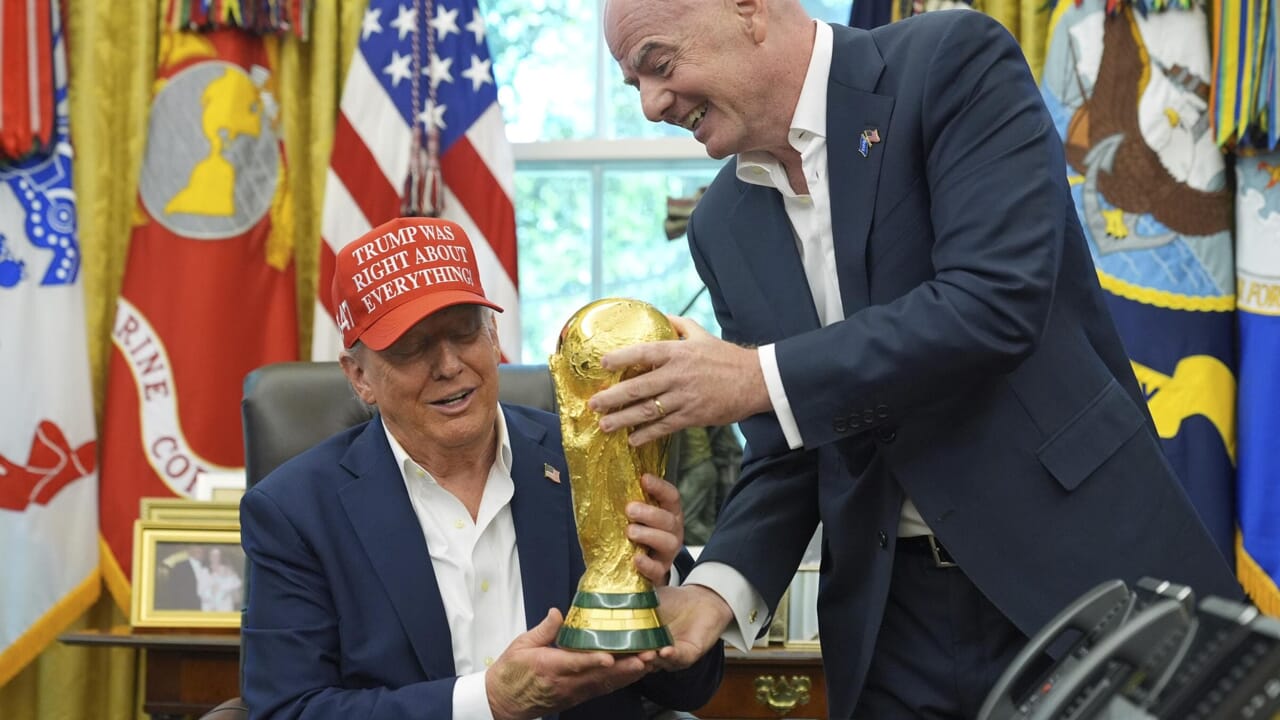
Rabat – US President Donald Trump has thanked FIFA after the governing body suspended Folarin Balogun’s one-game ban, allowing the United States striker to face Belgium in the World Cup round of 16.
“Thank you to FIFA for doing what was right, and reversing a great injustice!” Trump posted on Truth Social after the decision became public.
Balogun had received a straight red card during the United States’ 2-0 win over Bosnia and Herzegovina in the round of 32.
The red card came after a VAR review of his challenge on defender Tarik Muharemovic.
A red card normally brings an automatic one-match suspension.
But FIFA later confirmed that the implementation of Balogun’s suspension had been suspended for a one-year probationary period.
FIFA decision gives USMNT major boost
The decision means Balogun can play against Belgium in Seattle.
That is a major boost for the United States.
Balogun has been one of the team’s most important players during the tournament and has scored three goals in three starts.
US Soccer welcomed the decision and said it was pleased that Balogun was eligible for the match.
Christian Pulisic also said the decision gives the team a boost before the Belgium match.
Defender Chris Richards said several players first saw the news on social media and were not sure whether it was real.
“I thought it was AI,” Richards said, describing the surprise inside the squad.
Belgium questions the decision
Belgium reacted very differently.
The Royal Belgian Football Association said it was astonished by FIFA’s decision and was considering possible action.
The Belgian federation argued that the decision goes against the normal rules for red cards, which state that a player sent off is automatically suspended for the next match.
That is where the problem begins.
Even if FIFA had the legal power to suspend the punishment under Article 27 of its disciplinary code, the timing of the decision raises serious questions.
Balogun’s red card may have been harsh.
Many people, including US players and head coach Mauricio Pochettino, believed the challenge was accidental.
But there is a difference between correcting a harsh decision and changing the normal consequence of a red card just before a knockout match involving the host nation.
A decision that looks too convenient
FIFA’s explanation may be based on its disciplinary code, but the decision still creates a bad image.
A red card suspension was first treated as automatic and not open to appeal.
Then, days later, the same suspension was suspended, giving the United States back its leading forward before one of its biggest matches of the tournament.
That makes the decision difficult to defend from a fairness point of view.
The Guardian also reported that the White House lobbied FIFA to lift Balogun’s suspension. FIFA was approached for comment on that report.
Trump’s public message only added to the debate.
His post framed FIFA’s decision as justice for the United States, but for Belgium and many neutral observers, it may look like special treatment for a tournament co-host.
FIFA sets a risky precedent
FIFA has used Article 27 before, including in the case of Cristiano Ronaldo before the World Cup.
Still, using it in the middle of the tournament creates a more sensitive situation.
Other teams may now question why some red-card bans are applied immediately while others can be delayed.
That is dangerous for FIFA because consistency matters in knockout football.
The issue is not only whether Balogun should play.
The bigger issue is whether every team would receive the same treatment in the same situation.
For the United States, the decision brings relief and a major attacking option back into the team.
For Belgium, it brings frustration before a match that already carries high stakes.
For FIFA, it brings another debate over transparency, pressure and fair play at the World Cup.