
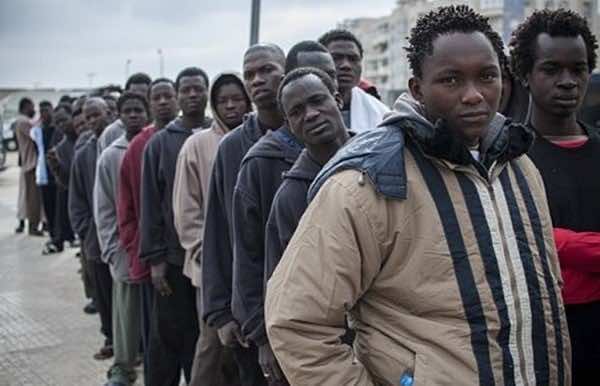
Rabat – Last week, reports of the kidnapping of 13-year-old Fatima Zahra by “a gang of Sub-Saharan migrants” in Casablanca stirred a wave of racist and hateful remarks towards sub-Saharan migrants, revealing the deeply rooted anti-Black racism within Moroccan culture.
A few days after the report ignited a storm of prejudiced and xenophobic comments on various social media platforms, Moroccan authorities were finally able to locate Fatima Zahra. The 13-year-old girl had gone missing on the night of Monday, May 9, according to her parents.
She was instantly reported to have been kidnapped by a group of sub-Saharan migrants and abducted to an abandoned cemetery in the Hay El Farah neighborhood in Casablanca.
The girl ran away from her family home on the same night following a dispute with her parents. She then met her 17-year-old neighbor who tried to convince her to return home. According to the teenage boy, the “gang of sub-Saharans” attacked him, robbed him of his belongings, and kidnapped Fatima Zahra.
With many news websites reporting this version of the event, many internet users were quick to grab the opportunity to make racist and discriminatory remarks against the sub-Saharan community in Morocco.
Reports of the incident had spread fast among Moroccan internet users who used the Arabic hashtag #Save_Fatima_Zahra to show solidarity with the victim. Many resorted to the stereotypical notion of black men as criminals, claiming that sub-Saharan migrants are used to robbing, kidnapping, rapping, and killing people.
The racialization of the case played a huge role in portraying sub-Saharan migrants as evil and dangerous criminals.
Other internet users showed solidarity with the missing girl but denounced the hateful and racist remarks directed toward sub-Saharans. People should not take the disappearance of the girl as an excuse for their racism and xenophobia, they argued.
Read also: Making Sense of Female Sub-Saharan Migrants’ ‘Vulnerability’ in Morocco
A few days after Fatima Zahra’s disappearance, Morocco’s General Directorate of National Security (DGSN) found her near the Oulad Ziane bus station in Casablanca. According to DGSN, the teenager spent the past few days in a gas station near Marrakech alongside a man, who was taken into police custody.
In a video posted on social media, Fatima Zahra’s parents thanked Moroccans for their support and solidarity and expressed their happiness and relief in finding their missing daughter. But they did not give further information on the details of the case.
The investigation is currently underway to determine what exactly happened on the night of Fatima Zahra’s disappearance and whether a group of sub-Saharan migrants was indeed involved in or linked to Fatima Zahra’s disappearance.
Pattern of Anti-Black Racism in Morocco
Even though Morocco is an ethnically and racially diverse country, many sub-Saharan migrants, including students, suffer from constant racism and discrimination, especially in light of such cases of criminal allegations.
Moussa N’Daw, a Senegalese former professional football player and former coach of Moroccan club AS Sale, was the victim of racist remarks during a football match between AS Sale and Racing de Casablanca on February 6, 2021. A former player and current employee at the Pere Jego Stadium made the racist comments 20 minutes into the match.
N’Daw expressed his disappointment, calling the incident “unacceptable.” The Moroccan National Professional Football League denounced the incident and considered it “unrelated to the principles of sportsmanship.”
In 2019, Moroccan transportation company CTM was met with a torrent of criticism after news emerged of its policy of preventing “undocumented Africans” from traveling onboard its buses.
CTM strongly denied what it described as unfounded accusations, saying in a carefully-worded statement that its “values and ethics go against any type of discrimination.”
As Morocco has become a hotspot for migrants trying to make the journey to reach Europe in search of a better future, such recurring racist incidents raise many demands for a change of attitudes towards undocumented sub-Saharan migrants in Morocco.
There has been no shortage of Africa-celebrating and pan-Africanism-fostering events and policies in Morocco since the country’s return to the African Union in January of 2017.
Over the past five years, one robust consensus among observers of African politics has been that King Mohammed VI’s unapologetically pan-African and Africa-embracing diplomacy has indeed reconciled Morocco with Africa.
Yet, cases like the CTM PR gaffe, N’Daw’s racial abuse, and the unabashed racialization of the kidnapped girl’s case are a chilling reminder that Moroccan society still has some considerable distance to travel when it comes to exorcizing its racialist past and fully accommodating the country’s growing sub-Saharan community.
Read also: French Restaurant Accused of Discrimination Against North Africans