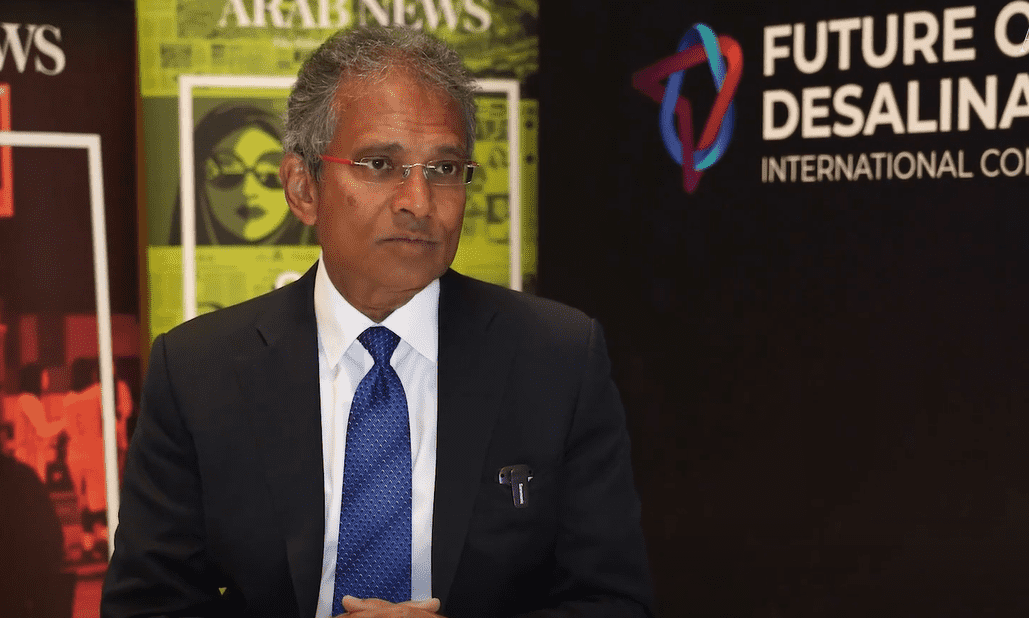
Rabat – ACWA Power, a Saudi developer and investor in power generation and desalinated water plants, has expressed interest in expanding its operations into Morocco over the upcoming years.
Speaking to Arab News on the sidelines of the Future of Desalination Conference in Riyadh, Paddy Padmanathan, CEO of ACWA Power, said: “We see opportunities emerging in Morocco and South Africa in the not too distant future.”
The need for water desalination projects has increased as countries across the Middle East and North Africa face an acute water crisis amid growing water demand caused by growing population and industrialization.
“The gap [between supply and demand] is widening,” says Padmanathan, noting that there will be a 30% increase in global water demand by 2030 and that such rising demand calls for more water desalination.
With an established portfolio in Saudi Arabia, the UAE, Bahrain, and Oman, ACWA Power, considered a leading global private developer of seawater desalination, eyes expansion to other countries that are relatively new to the desalination industry.
Read Also: Morocco Launches Tender for Water Desalination Plant Feasibility Study
This expansion strategy serves the company’s interest to meet the forecasted market growth, says the CEO, suggesting that this is expected to keep desalination costs low.
Low desalination costs appear to be vital today for the economies of countries located in water-stressed areas such as Morocco. The lack of precipitation, rising temperatures, and droughts defined the country’s situation over the past months and these phenomena are expected to be repeated next summer at higher rates given the acceleration of climate change.
Aware of water deficit challenges, Morocco has over the past years invested in desalination plants to improve the nationwide coverage of drinking water. In 2018, the Moroccan government launched the Chtouka Aitbaha plant in Agadir, Africa’s largest desalination plant, under a public-private partnership with an investment of approximately MAD 4.48 billion ($417 million). The plant became operational earlier this year in March.
Morocco has also committed to developing additional seawater desalination plants in Casablanca, Safi, and Jorf Lasfar. The Casablanca plant is set to produce around 300 million cubic meters of water per year. It is projected to be operational by the end of 2027. As for the Safi and Jorf Lasfar plants, Morocco’s National Office of Electricity and Drinking Water (ONEE) plans to boost their production capacity in the near future.
Besides securing the sustainable water supply to Moroccans across the country, the established and under-construction seawater desalination plants in Morocco sustain the country’s plans to become a leading global producer of green hydrogen, a carbon-free energy source produced from water.
While the desalination plants solve Morocco’s need for water, some observers have warned of the ecological impact of the water residues on the marine life along the Moroccan coastlines.