Join on WhatsApp
 Join on Telegram
Fez – The ninth Global Forum of the United Nations Alliance of Civilizations (UNAOC) opened in Fez on Tuesday, November 22.
A message from Morocco’s King Mohammed VI, delivered by Special Advisor to the King Andre Azoulay, opened the event, highlighting the historic and cultural landscape of Fez, describing its hosting of the forum as “a privilege.”
“The current context is marked by the resurgence of the very causes which led to the creation of the Alliance of Civilizations,” the message said. “Never before has our civilization been so exposed. Never before has living together come under threat on a daily basis.”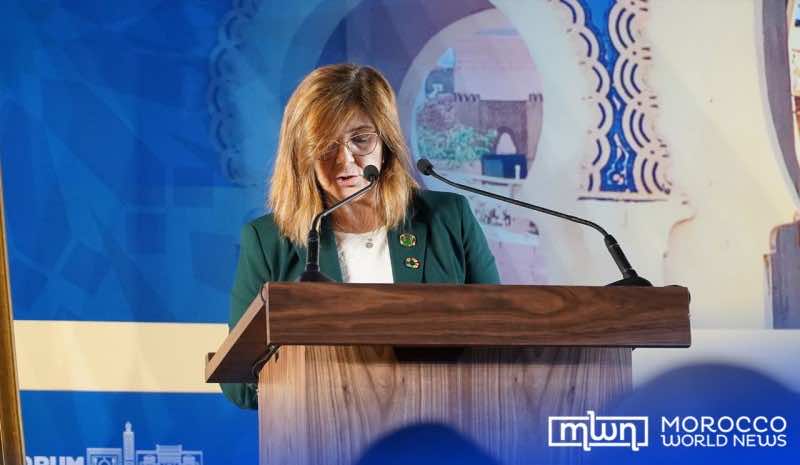
Secretary of State for International Cooperation Pilar Cancela Rodriguez
In this context, the King highlighted in his message the history of religious and cultural co-existence in Morocco between the Muslim and Jewish communities.
Clash of civilizations
High Representative for the UNAOC Miguel Angel Moratinos opened the event, highlighting the famous theory by political scientist Samuel Huntington, who posited that cultural and religious differences will be the main driving forces behind future international conflicts.
“We are not witnessing a clash of civilizations, what we are witnessing is a clash of interests and ignorance,” Moratinos said, dismissing the theory.
Samuel Huntington, a famous American political scientist, put the theory forward in his 1992 book “Clash of Civilizations,” saying that he believes cultural and religious differences would be the main driving force of conflicts in the post-Cold War era.
In this context, he added, the UNAOC’s role has become more crucial than ever in establishing global peace and intercultural understanding.
He stressed that the importance of standing together against common enemies is more important than ever, with humanity faced with crises such as the energy crisis and food shortages.
The COVID-19 pandemic, global climate change, and the current war in Ukraine have recently gathered to create an especially tense international context, affecting the quality of life and access to living necessities around the world, especially in developing countries.
“The real danger is that we are facing a new type of totalitarianism, a technological totalitarianism that wishes to totally control the behavior of natural human beings through political economic practices,” he added, saying that such practices aim to turn citizens into mere consumers.
The UN representative urged attendees to defend mutual respect and living together in the face of the current global crises.
Global gaps
UN Secretary General Antonio Guterres similarly talked about a bleak international context, highlighting especially domestic and global wealth gaps, as well as international conflicts such as the ongoing war in Ukraine.
“Trust – in political leadership and in one another – is crumbling,” Guterres said, adding that the lack of trust is leading to a crumbling of values around the world. “Human rights and the rule of law are either neglected – or attacked outright.”
The contrast between developed and developing countries was a focus of the UN chief’s speech, as he stressed the importance of helping vulnerable communities around the world to avoid further conflicts and secure the necessities of life.
The lingering global inequalities between the global north and south have been coming into focus more lately, especially as global crises like climate change and food insecurity continue to disproportionately affect regions like Africa and other developing nations.
The UN Chief highlighted the efforts of several activists and individual actors in developing nations, such as Uganda’s Magdalen Amony and India’s Elsa Marie D’Silva, who both run programs to help disadvantaged communities in their countries.
Global support
As international sponsors for the UNAOC, representatives from Spain and Turkiye also made remarks during the opening ceremony.
Foreign Minister of Turkiye Mevlut Cavusoglu put a spotlight on the prevalence and spread of discriminatory ideas such as Islamophobia and xenophobia.
Turkiye FM Mevlut Cavusoglu with Moroccan FM Nasser Bourita and High Representative for the UNAOC Miguel Angel Moratinos
The Turkish politician highlighted the efforts made by the UNAOC to combat international issues, and crises, and called for more action to be made to counter those issues.
“Not the ones speaking the same language, but the ones sharing the same feelings, understand each other,” Cavusoglu concluded.
Representing Spain, Secretary of State for International Cooperation Pilar Cancela Rodriguez highlighted the significance of hosting the event in Africa for the first time.
She said that as much as globalization and interconnectivity have made the world connected, hate and discrimination have found it easier to spread than ever.
“The Alliance of Civilizations is an important instrument to avoid these conflicts and also to facilitate the process of peace,” the Spanish politician said.
Rodriguez highlighted the importance of mobilization from youth around the world to promote peace and dialogue.
“Multiculturalism should not be seen as a threat,” she stressed.
The initiative founding the UNAOC was sponsored by Spanish Prime Minister Jose Luis Rodriguez Zapatero and Turkish Prime Minister Recep Teyep Erdogan in 2005, making the two countries the two main co-sponsors of the initiative.
Fez as a host
Morocco’s historic city of Fez is hosting the ninth edition of the global forum this year, under the theme “Towards an Alliance of Peace: Living Together as One Humanity.”
Contrasted by a renewed rise of the far-right and several geopolitical and humanitarian conflicts, the forum seeks to promote peace and solidarity in order to address global challenges like the COVID-19 pandemic and climate change.
The conference is set to have a special focus on Africa, “a continent that has not yet gained its rightful place when it comes to collective action and global mobilization,” Bourita said back in October.
The United Nations Educational, Scientific and Cultural Organization (UNESCO) marked the old medina of Fez as a world heritage site in 1981, citing its numerous historical sites such as Al Qarawiyyin University, the world’s oldest continuously operating university.
The city was chosen to host the forum “in view of its ancestral character and its spiritual symbolism,” Moratinos said earlier this year.