 Join on WhatsApp
 Join on Telegram
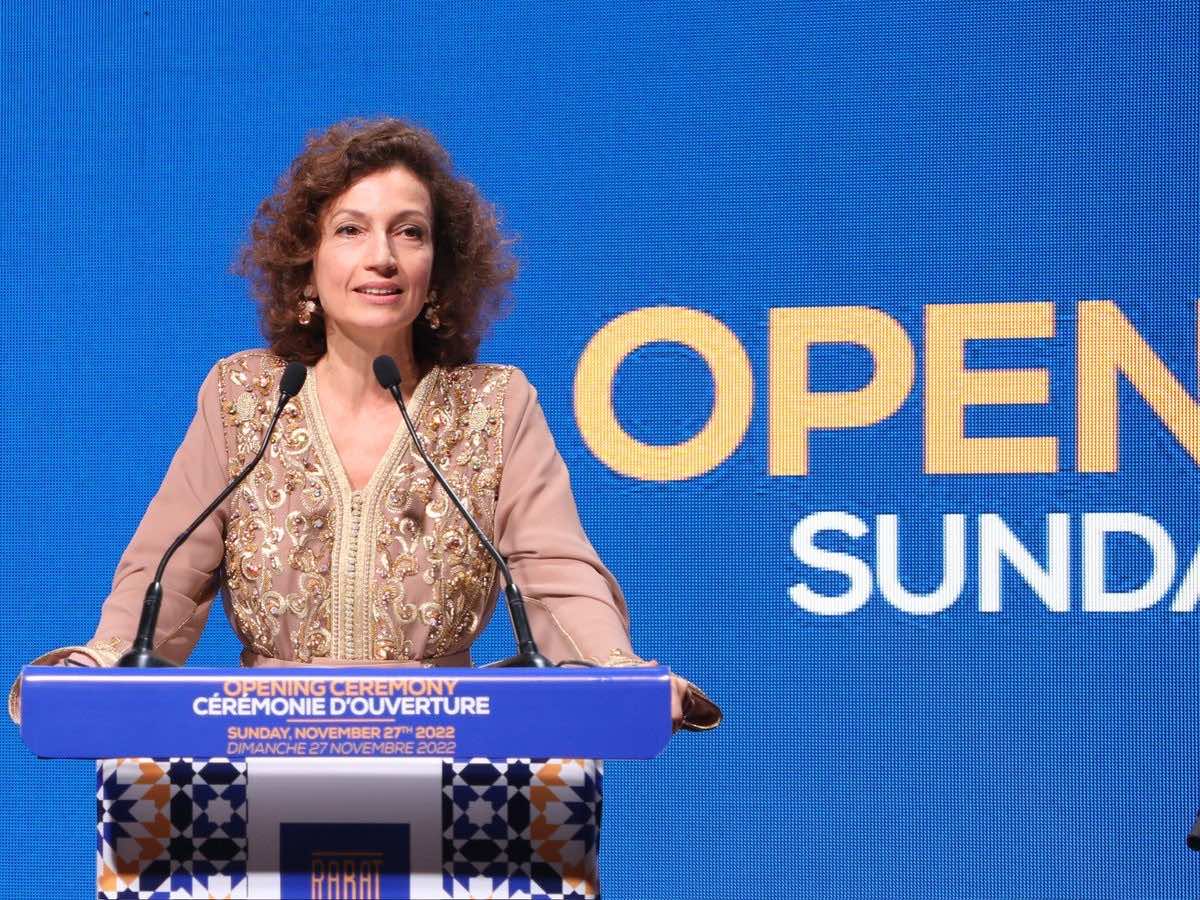
Rabat – Morocco’s success in safeguarding its cultural and historic heritage is largely thanks to the commitment of King Mohammed VI, UNESCO’s Director-General, Audrey Azoulay, said on Monday.
Azoulay expressed her “most sincere” thanks to King Mohammed VI for “his commitment to safeguarding culture,” and for his multilateral actions in promoting peace.
UNESCO’s Director made her remarks at the opening of the 17th session of UNESCO’s Intergovernmental Committee for the Safeguarding of the Intangible Cultural Heritage held in Rabat.
Noting UNESCO’s efforts to preserve the world’s heritage, Azoulay recalled the 2003 convention dedicated to intangible heritage.
UNESCO has “managed in less than two decades to give another dimension and reinvent the concept of heritage,” she said.
“When we talk about heritage now, we no longer think only of monuments or natural sites but also another fundamental heritage: that of traditions, festivals, gestures that are transmitted from generation to generation and which continue to exist in social practices,” she explained.
UNESCO’s DG further added that she is “proud” that the concept of heritage has evolved to represent more than tangible heritage.
The 2003 convention was ratified by 180 countries including Morocco.
The convention prompted many countries to adopt new legislations and public policies dedicated to preserving intangible heritage. These measures were “hardly imaginable before,” she said.
The 2003 UNESCO convention entered into force in 2006. The treaty aims to safeguard the intangible cultural heritage of communities, groups, and individuals.
Secretary General of the Government Mohamed Al Hajoui delivered a speech on behalf of King Mohammed VI.
In the speech, the King said that “Given the rapid changes affecting the world today, it has become necessary to highlight the intangible heritage of countries around the world, and to adopt measures for its preservation, namely by furthering the objectives set out in the Convention.”
Highlighting Morocco’s efforts to preserve its intangible heritage, the King explained that since Morocco ratifies the convention in July 2006, the country registered 11 elements on the UNESCO World Intangible Heritage, the latest of which is Tbourida, an equestrian performance registered last year.
A number of high-ranking officials were present at the event including Advisor to the King, Andre Azoulay, the Minister of Youth, Culture and Communication, Mohamed Mehdi Bensaid, and the Permanent Representative of Morocco to UNESCO, Samir Addahre.
Read Also: Morocco, UNESCO Promote Knowledge Transfer in Handicrafts Industry