
 Join on WhatsApp
 Join on Telegram
Washington DC – The leading French newspaper Le Monde published last week an op-ed signed by a group of journalists and academics who call for the holding of an international conference to find a solution to the Sahara dispute. At first glance, one could assume this initiative is very commendable and that its signatories have good intentions to help the Maghreb countries put an end to one of the most deleterious vestiges of French colonialism. Respectable scholars like Miguel Hernando de Larramendi or Bernabe Lopez Garcia are known for their admirable, even if ultimately unrewarded, efforts over decades to advocate rapprochement between Morocco and Algeria and the creation of the Greater Maghreb.
Historical untruths
However, the presence of certain academics and journalists known for their bias or even their visceral hatred of Morocco and the country’s monarchy poses a real problem. Considering their burning resentment, one wonders whether the ultimate goal of such a conference is a sincere gesture to resolve this territorial dispute, rather than a ruse to blunt the blossoming diplomatic momentum that Morocco has enjoyed over the past six years. Indeed, sustaining the past few year’s pro-Rabat momentum has been the adoption by the UN Security Council of a series of resolutions endorsing the Moroccan Autonomy Plan and the recognition of Algeria’s responsibility in the creation and prolongation of the Western Sahara dispute.
The second element that poses a problem is the signatories’ tendency, throughout their collective text, to equate Morocco with Algeria. Anyone with basic knowledge of this regional dispute knows that it was Algeria that created it from scratch even as Morocco was showing frequent gestures of good faith towards Algiers, reflecting Rabat’s commitment towards the creation of a united and prosperous Greater Maghreb.
In addition, it is also common knowledge that Morocco was first a victim of the criminal dismemberment of its territory by France, then of Algerian machinations driven by hegemonic ambitions in the region.
To thus insinuate that Morocco has always sought to obtain an absolute victory over Algeria is a historical untruth that discredits the presumed message of peace conveyed by the authors of this initiative.
Another example of Morocco’s attempt to edge closer to a greater Maghreb by creating an atmosphere of trust between Morocco and Algeria, was through the late King Hassan II who signed two agreements with Algerian President Houari Boumediene in 1972.
The first agreement was on the drawing of the borders between the two countries and the second was on the joint exploitation of the iron deposits in Garet Jbilat, south of Tindouf. Under the said agreement, Morocco simply gave up whole swathes of its territory that France had annexed to Algeria at a time when it believed that the latter would always remain under French sovereignty. In return for King Hassan II’s sacrifices, Boumediene pledged not to hinder Morocco’s efforts to recover the Sahara. On many occasions, the Algerian president reiterated his country’s commitment to recognize, or at least not challenge, Morocco’s sovereignty on the region.
For example, during the Arab summit held in Rabat in October 1974, the Algerian president said solemnly: “For me, there is no problem in the Sahara; Algeria considers that this affair is purely aMoroccan-Mauritanian issue, no more, no less.” This Algerian position was reiterated during then Foreign Affairs Minister Abdelaziz Bouteflika’s visit to Morocco in early July 1975. In the press release published at the end of the visit, Bouteflika confirmed that his country had no sights on the Sahara and welcomed “the mutual understanding between the two brotherly countries, Morocco and Mauritania, about the region.”
The hell of French ‘good intentions’
But these declarations of seemingly good intentions masked Boumediene’s true motive: to make his country the hegemonic power of the Maghreb. Since Morocco was the only obstacle standing in the way of his regional ambitions, Boumediene, who saw himself as the Bismarck of the Maghreb, believed that he could use the unresolved question of the Sahara to weaken Morocco and prevent it from achieving its territorial integrity.
Encouraged by petrodollars and the “Mecca of decolonization” aura Algeria enjoyed at the time among non-aligned countries and among Third-Worldist intellectuals and activists of the Western left (especially the Parisian elite), Boumediene wrongly thought that these machinations would bear fruit and that the dream of creating a puppet state in southern Morocco would materialize in the near future.
More than fifty years later, however, Morocco is now more than ever certain of its legitimate historical and legal rights over the Sahara, and increasingly determined to abort any attempt to undermine this right. It goes without saying that the region is still paying the price for the delusions of grandeur of an Algerian political-military class whose deep-rooted hatred of Morocco has prevented it from learning lessons from the history of this centuries-old kingdom and the resilience of its people.
The third issue with the collective op-ed’s execrable initiative for Morocco is its timing. It is obvious that France bears responsibility for the genesis of this conflict. It was France that eagerly carved up and dismembered Morocco when it was still an independent country.
French archives and a large number of books published in particular during the 19th century and early 20th century (including these brilliant essays on the deep genesis of the Sahara dispute) prove that this territory was an integral part of what was then called the Cherifian Empire. A brief perusal of the terms of the March 1895 agreement signed between Morocco and Great Britain, in which the latter solemnly recognized that this territory was indeed part and parcel of Morocco, is enough to understand that what is today known as Western Sahara is historically Moroccan.
If France really wanted to help the Maghreb countries create a solid regional bloc, it could have done so on two occasions: following the War of the Sands in 1963 and in 1975. In both cases, an international conference held in Paris would have contributed not only to finding a solution to this dispute, but even more so to avoiding the emergence of a conflict between Algiers and Rabat, whether in relation to the Sahara or with regard to the drawing of the borders between the two countries.
In both instances, France should have simply recognized its primary responsibility in the creation of the Western Sahara question by releasing the documents that prove Moroccan sovereignty over the Sahara, but also over Tindouf, Touat, Bechar, etc. By doing so, France would have helped prevent the dispute from being placed on the United Nations’ agenda, thus avoiding the ongoing, decades-long political and diplomatic standstill. France could have thus proved to the region’s population, more particularly to Moroccans, that it was truly driven by a desire to right the wrongs it had caused Morocco and its citizens during the colonial period.
The Sahara conflict benefits France
Instead of doing so, France chose to let the territorial dispute fester and the animosity between Algeria and Morocco take on disproportionate dimensions. Ultimately, this cunning approach served the interests of the French military-economic complex. The Parisian politico-military establishment regarded, and no doubt continues to regard, the maintenance of this fratricidal conflict between Algerians and Moroccans as a boon for France. Then as now, the overarching goal of France’s nostalgic politico-military elite is to do everything necessary to maintain Algiers and Rabat in Paris’ orbit — with all the benefits that this supposes for the French economy.
If the signatories of this op-ed have the slightest desire to contribute to the resolution of the Sahara issue, they should first urge France to tell the truth about its flagrant violations of international law when it signed the 1904 agreements with Great Britain and Spain. Next, they should demand that EU countries stop all humanitarian aid to the Tindouf camps until light is shed on the conclusion of the EU Anti-Fraud Commission (OlAF) report.
Produced in 2007 but made public in 2015, OlAF’s report documented massive misappropriation of humanitarian aid by Algerian and Polisario officials for over four decades. And finally, the signatories should demand the suspension of international humanitarian aid to Tindouf until Algeria allows the United Nations to organize a census in the Polisario-controlled camps, in accordance with the resolutions adopted by the UN Security Council since 2011.
Given their deafening silence on these sensitive issues, one can’t but argue that the initiators of this Paris conference idea contributes to the omerta on the real origin of the refugees parked in the Tindouf camps. And the editorial staff of the newspaper Le Monde should know better than anyone that the majority of these refugees are not from the Sahara.
In an article published in the columns of the French newspaper on June 14, 1979, the paper’s Madrid correspondent, Charles Vanhecke, unambiguously said that the overwhelming majority of the Sahrawis of the Polisario in fact had no connection with the Moroccan Sahara. Vanhecke said plainly in his dispatch for Le Monde: “Today, the Spanish leaders note that while half of the people living under Polisario control are, of course, made up of Saharans from Niger, Mali, Mauritania and Algeria, Polisario has succeeded in creating a common bond among the Sahrawi populations.” Vanhecke’s words make clear why Algeria persists in its refusal to allow a census in the Tindouf camps.
Ignoring all these facts and proposing a French mediation and the holding of a conference on French soil, after almost five decades – during which Morocco has made colossal sacrifices to maintain its sovereignty over the Sahara and to thwart Algerian machinations – is insulting to Morocco and the Moroccan people. This proposal is all the more offensive since France continues to adopt the trait of an ostrich, burying its head in the sand and pretending it has nothing to do with the Sahara dispute.
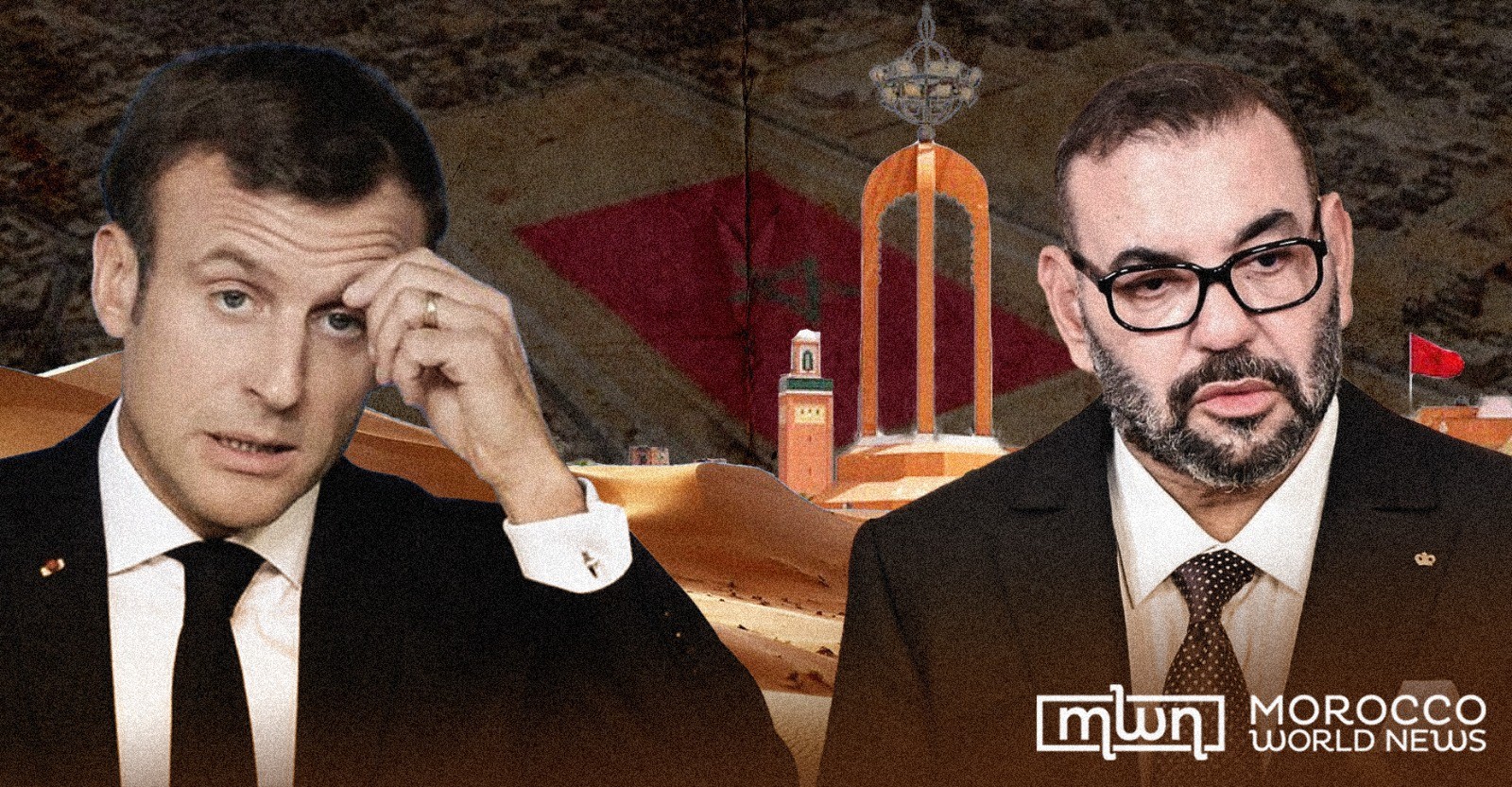
Particularly outrageous for Morocco is France’s refusal to recognize its responsibility in the dismemberment of Morocco and the fact that the Elysee Palace is, without doubt, involved in the unprecedented denigration campaign that has targeted Rabat over the past two years. Again, there is something dubious about the timing of the collective article’s proposal: it comes less than a month after President Emmanuel Macron’s meeting with the executives of major French media, a perfect illustration of the complicity that exists between politicians and the French media. With such an eye-catching coincidence, one cannot help but wonder if this proposal was not whispered by the French president to his friends from Le Monde.
It is an open secret that France has a hard time coming to terms with the fact that it is a declining power. France’s diminishing global prestige and diminished geopolitical clout have unmistakably been on display in recent months and years on both the regional and international fronts. Whether it be in Mali, Burkina Faso, Libya, and even in Lebanon and Tunisia, French diplomacy under the leadership of Macron has suffered painful setbacks.
Rightly or wrongly, one can see in the repeated diplomatic actions of the French president a certain desire to follow in the footsteps of Theophile Delcasse. At a time when France struggled to recover from the loss of Alsace-Lorraine in the 1870 war against Germany, Delcasse saw in the destruction of the Moroccan state and its subjugation a sure way to restore his country’s pride and give it back its erstwhile diplomatic aura.
Should Macron manage to do the unlikely by hosting an “international conference” on the Sahara in Paris, the French president would not only achieve the diplomatic feat of restoring his country’s diplomatic prestige; he would also be giving a second wind to Algeria’s politico-military elite.
In recent years, Morocco has achieved multiple diplomatic breakthroughs as the Algerian regime, a helpless witness, stared impotently while its dream of establishing a puppet state in southern Morocco slipped away like a mirage.
From Algeciras to Paris
What does France expect from such a conference if not to bring the diplomatic process back to square one and usurp the rightful role that the Security Council has been playing for four decades in efforts to settle the Sahara dispute? And based on what political or historical legitimacy can France claim the right to host such a conference? How could France think of playing the mediator role in a conflict that it created and for which it refuses to assume responsibility? On what historical precedent did the proposers of this conference idea rely to conclude that such an event in Paris could offer us the long-awaited or desired outcome?
Make no mistake: none of the international conferences that have been held in recent years on a plethora of geopolitical conflicts have produced the expected outcomes. Concerning Libya, for example, Berlin Conference I and II both ended in abject failure to meaningfully move toward resolving the Libyan crisis. The fate of conferences on the civil war in Syria and the war in Yemen was not any better.
When international conferences are held, political dignitaries give bombastic speeches that suggest that they are really sincere and that they care about seeing peace and stability established in the concerned countries. But as soon as those conferences are over, the same dignitaries forget all about their speeches and revert to their “business as usual” mentality. The fate of a conference on the Sahara would not be an exception to this rule, especially since France has never had the will to really contribute to the resolution of the conflict and the Algerian politico-military establishment is more determined than ever to persist in its policy of attrition toward Morocco.
How could Morocco accept a conference on the Sahara when historical experience has taught it that such a move is tantamount to political unrest, diplomatic shenanigans, and interference by foreign powers in its internal affairs? The Moroccan people still remembers how the 1906 Algeciras Conference sounded the death knell for an independent and sovereign Morocco and paved the way for the country’s subjugation by France and Spain.
At the time, Morocco was forced to appeal to Germany for the holding of an international conference after the French Minister in Morocco, Saint-Rene Taillandier, appeared before Sultan Moulay Abdelaziz, pressuring him to accept the implementation of the proposals that France sought to impose on him. France wanted to pave the way for Morocco’s occupation, even as Morocco hoped that with the support of Germany, the Algeciras Conference could help it avoid the worst outcome and stay safe from the claws of French colonialism.
The act of the conference, however, and above all its implementation by its signatories, notably France, Great Britain, and Spain, was disastrous for the kingdom. Even though these three countries expressed in their public declarations their attachment to Morocco’s independence, its territorial integrity, and the sovereignty of its Sultan, the dice of colonial occupation had already been cast since the signing of the agreements in April and October 1904 between France and Great Britain, on one hand, and France and Spain, on the other.
In his book, “Morocco in Diplomacy,” published in 1912, British journalist and author Edmund Dene Morel denounced what he called France, Spain, and Great Britain’s “dishonesty.” While the three countries openly declared themselves in favor of the independence and territorial integrity of Morocco, they spared no effort to destroy it, bring the country to its knees, and force it to submit to French tutelage.
The irreversible centrality of the UN process
In what world do the initiators of this conference proposal live to think that a people so fiercely attached to its sovereignty and proud of its history could accept the interference of other powers in a matter that only concerns Morocco?
How could they think for a single second that Morocco, given its recent string of diplomatic breakthroughs, could let any country or any regional organization monopolize prerogatives that are of the exclusive purview of the United Nations? And what precedent do they have to suggest that such a conference should count on the participation of the European Union, the Arab League, and the African Union?
An EU that blows hot and cold and some of whose member states and institutions have made a specialty out of harassing and demonizing Morocco has no legitimacy to play a role of mediation in the conflict. The EU Commission and Council have, through the various partnership agreements signed with Rabat over the past five decades, implicitly recognized Moroccan sovereignty over the Sahara through their subsequent practice. Yet other bodies of the European club, namely its Court of Justice and its Parliament, keep issuing rulings or adopting resolutions that undermine Morocco’s territorial integrity.
Moreover, although the EU is an economic giant, it remains a political dwarf on the global stage. Consider, for example, its inability to formulate a common policy or to conclusively weigh in on issues such as the crisis in Libya. And as we have seen in other conflicts – such as the war in Ukraine, or the conflict between Palestine and Israel, the EU always remains slavishly dependent on the diplomatic action of the United States.
As much can be said about the AU and the Arab League, whose political record and lack of legitimacy do not militate in favor of their mediation in the Sahara dispute. The League of Arab States is notorious for the divisions and fratricidal struggles that prevent it from playing any meaningful role on the regional or international stages. This organization has shown itself incapable of playing a decisive, life-saving role in the crises in Libya, Syria, and Yemen, not to mention Palestine. Nor was it able to play a mediating role in the Gulf crisis that pitted Qatar against Saudi Arabia, the United Arab Emirates, and Bahrain.
As for the AU, the very fact that it counts the self-styled Saharawi Arab Democratic Republic among its members disqualifies it from playing any role of mediation in the Sahara dispute.
It is striking to see that the signatories of the op-ed quite simply excluded the United States — the world’s leading power and the penholder of the UN Security Council’s efforts to settle the Sahara question — from their list participants on whom we should count for the holding of the very chimerical Paris conference.
Equally noticeable is the desire to take the conflict out of the hands of the Security Council, the only international body responsible for preserving international peace and security. This approach reflects at best the naivety of the proposers of a Paris conference, at worst their bad faith and their desire to bring the Sahara dispute back to square one. The ultimate goal in such a case, as we know, is to nullify all of Morocco’s recent diplomatic achievements.
One has to be either really foolish or disconnected from the real world to think for a second that such a proposal would hold water. This is all the truer since France no longer enjoys the confidence of Morocco, which seems to have learned lessons from French deceit at the beginning of the 20th century, but also from the bad faith of France’s political, economic, and media elites, who seem attached to an outdated and obsolete vision of French-Moroccan relations.
To many in Rabat, it has become abundantly clear that France is no longer the great power it once was; that its influence on the regional and international stages has continued to tumble in recent years. Morocco, therefore, is now working to treat France as it should: a second-class European power and a circumstantial ally whose deceit and media’s firepower Rabat must always be wary of. But above all, Morocco no longer intends to be scorned again by leaving the initiative to other countries in a matter that concerns its sovereignty and which, moreover, is exclusively in the hands of the UN Security Council.
Samir Bennis is the co-founder of Morocco World News. You can follow him on Twitter @SamirBennis.