 Join on WhatsApp
 Join on Telegram
Artificial neural networks (ANNs) are computational models inspired by the function of the human brain. The models consist of interconnected nodes that process and transmit information. ANNs have been successfully used in a wide range of applications, including the optimization of photovoltaic (PV) systems.
A photovoltaic system converts sunlight into electricity using a PV array. The performance of a PV system depends on the angle of the sun, the temperature, and the quality of the PV cells. Researchers have proposed using ANNs to improve the PV system’s operation.
The novel method to improve the performance of a photovoltaic system is based on an ANN model’s ability to predict the output power based on inputs such as solar irradiance, temperature, and other weather conditions. The ANN model is trained using historical data from the PV system and can learn to identify patterns and correlations in the data.
Once the ANN model is trained, it can be used to optimize the operation of the PV system in real-time. The model can predict the output power of the PV system based on the current weather conditions and adjust the operation of the system accordingly.
Overall, the novel method using ANN to improve the performance of a photovoltaic system offers a promising approach to optimize the operation and increase its efficiency.

Photovoltaic (PV) systems are becoming increasingly popular as a source of renewable energy. However, the output of a PV system is affected by weather conditions, shading, and the orientation and tilt of the panels. To ensure that the system operates at maximum efficiency, it is necessary to control the system’s operations in real-time. This is where artificial neural networks (ANNs) come in.
Photovoltaic array model
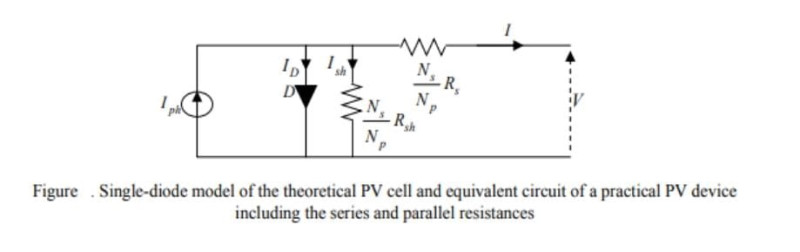
Some authors have proposed more sophisticated models that present better accuracy. The basic equation from the theory of semiconductors that mathematically describes the I–V characteristic of the PV array, equation (1) describes the single-diode model presented in Figure.
ANNs are a type of machine learning algorithm inspired by the structure and function of the human brain. They consist of layers of interconnected nodes (also known as neurons), which process and transmit information. ANNs are well-suited to recognize patterns, which makes them a useful tool for controlling PV systems.
There are several ways in which ANNs can be used to control PV systems. One approach is to use ANNs to predict the output of the system based on certain variables such as current weather conditions. This data is used to train the ANN to make accurate predictions or optimize the operation of the system.

Another approach is to optimize the operation of the system in real-time. A third approach involves training the ANN to identify the optimal operating conditions for the system based on current weather conditions and other variables. The ANN can then adjust the operation of the system to maintain these optimal conditions.
In all of these cases, the ANN must be trained using data from the PV system. This typically involves collecting data on the output of the system under different weather conditions and other variables, and using this data to train the ANN to make accurate predictions or optimize the operation of the system.
Read also: Aeronautical Company Safran Inaugurates Photovoltaic Power Station in Casablanca
Overall, the use of ANNs to control PV systems has the potential to improve the efficiency and reliability of these systems, making them a more attractive source of renewable energy.
The ability of neural networks to adapt to changing environmental conditions makes them an ideal tool for optimizing the performance of PV systems. By incorporating real-time data from sensors, neural networks can adjust parameters such as the angle and direction of solar panels to maximize energy generation. Furthermore, intelligent control systems based on neural networks can improve fault detection and allow for more efficient maintenance. These networks are thus a promising avenue for the advancement of renewable energy technologies.