
 Join on WhatsApp
 Join on Telegram
Rabat- On Thursday, literature enthusiasts and education advocates converged for a panel discussion titled “Reading for the Future – The Best Strategy for Children,” on the sidelines of the International Children’s and Youth Book Fair in Casablanca (SILEJ).
The event, held at the conference room in the fair, provided a platform for these speakers to delve into the crucial topic of cultivating a love for reading among children and devising effective strategies to shape a literary future for the younger generation.
Hosted in English, the event Moderated by Ismael Raqi, featured Nick Cherkas, representing Oxford University Press (OUP), Mohammed Adil El Mezouaghi, Education Deputy Director for the British Embassy, Gloria Beatriz Salazar, a Colombian Author, and Larbi Arbaoui Short Story Contest Project Manager.
Nick Cherkas, an Oxford University Press representative, brought a wealth of expertise to the discussion. He shared insights into the role of engaging and educational content in fostering a lifelong love for reading.
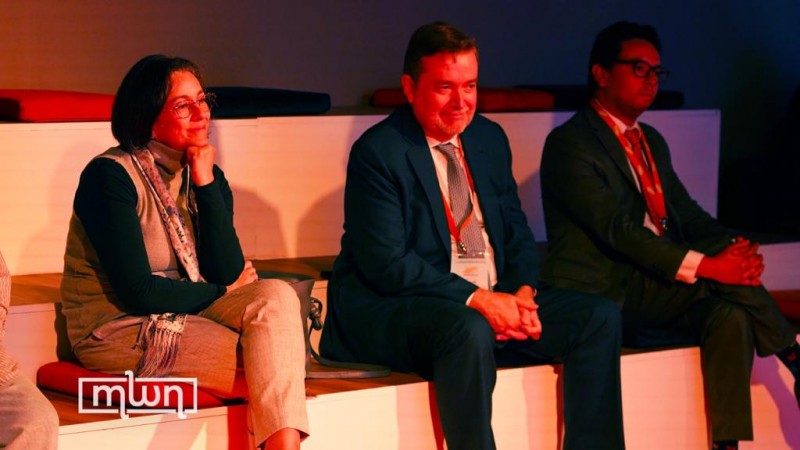
Attendees at the International Children’s and Youth Book Fair in Casablanca (SILEJ)
Cherkas also tackled the raising concerns on digital sources replacing books. “We as adults read on our devices, digital sources are not replacing books but complementing them. Digital sources are interactive, and can be used for assessment,” said Cherkas.
In the same vein, Colombian author Salazar asserted that “paper books are not going to die.” children’s books became more interactive as picture books cope with the needs of children with thousands of words.
In his speech, Education Deputy Director for the British Embassy Mohammed Adil El Mezouaghi complemented the discussion with a broader perspective on literacy strategies. Drawing from his experience, El Mezouaghi highlighted the collaborative efforts between educational institutions to promote effective reading programs.
One of the most important strategies he presented is the fractal reading strategy, which entails reading about the book and the authors, summaries, and reviews before delving into reading the book. “Fractal reading helps the students to become good academic readers. Reading is just a step, as writing is what we are looking for,” explained El Mezouaghi.
The panel further discussed the challenges of literacy in the MENA region as the Programme for International Student Assessment (PISA) found five Arab countries, namely Lebanon, Jordan, Morocco, Qatar, and Saudi Arabia in the bottom one-third among 79 participating countries.
In this context, Larbi Arbaoui, Short Story Contest Project Manager at the Morocco Library Project, shed light on the challenges facing Moroccan children in reading. “ Moroccan children learn Darija or Tamazight at home, which is not available in books, forcing children to “make multiple efforts to decode the books and then understand it.”
“Moroccans are making extra efforts to read, regardless of these embarrassing statistics,” Arbaoui added optimistically that the new generation will contribute to improvements.
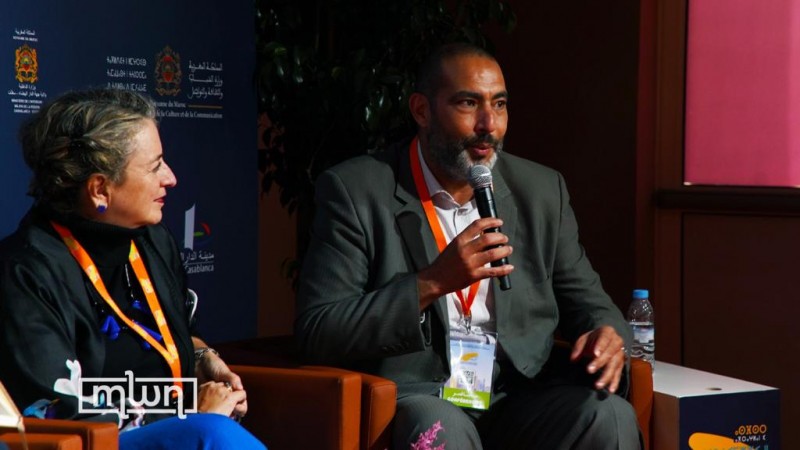
Mohammed Adil El Mezouaghi, Education Deputy Director for the British Embassy
The panel discussion abstracted that reading helps create future global citizens. “Tell me what your children are reading, and I tell you what citizens we are producing,” concluded Mohammed Adil El Mezouaghi, Education Deputy Director for the British Embassy.
The primary objective of the conference was to bring kids to books and bring the books to kids. It becomes clear that the path to fostering a love for reading requires collaboration, innovation, and commitment to nurturing the minds of the next generation.
The UK Pavilion, covering 42 square meters, exhibited the work of 5 British publishers including Lantana Publishing, Tiny Owl Publishing, and the Oxford University Press. The pavilion also showcases the work of internationally acclaimed British-Syrian author and illustrator Nadine Kaadan.
The first International Children’s and Youth Book Fair is taking place at Anfa Park in Casablanca, Morocco, from November 15 to 22. The event is organized by the Ministry of Youth, Culture, and Communications, along with local partners.
Read Also: HCP: Three out of Ten Unemployed Moroccans Are Young People