 Join on WhatsApp
 Join on Telegram
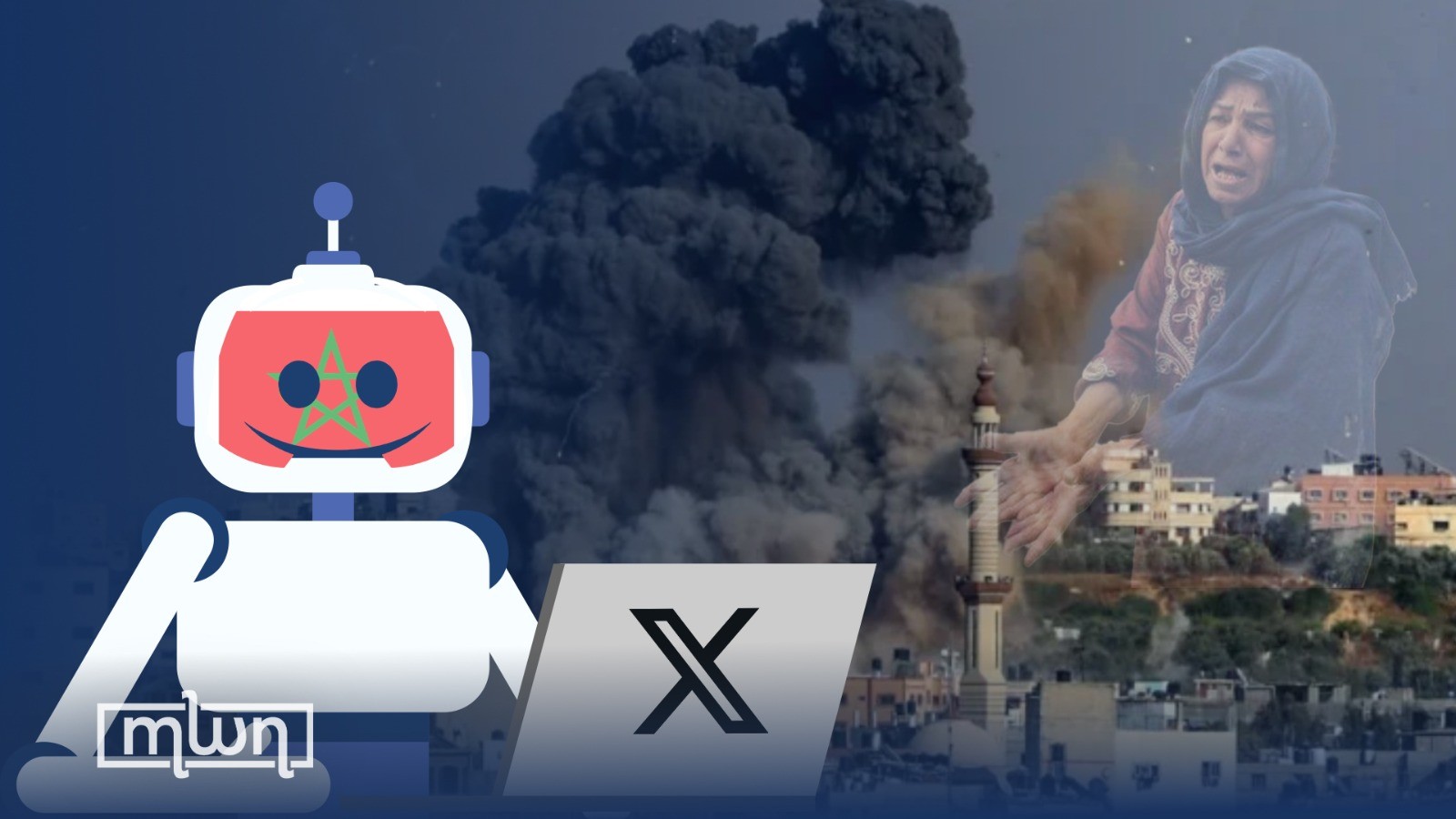
As Israel escalates its devastating, genocidal war on Gaza, the occupation power has tirelessly attempted to mold and justify its ethnic cleansing campaign through various tools – including the use of fake accounts attributed to non-existing Moroccans.
Machine guns, rifles, and tanks are not the only source of fear as technology emerges as an equally substantial security challenge amid the quest for influencing public opinion.
Bot-generated support
Sadly, it is true that Israel continues to receive substantial support from many countries in the international community following the Al Qassam brigade flooding attack on October 7.
Ignoring historical fact and Israel’s decades-long occupation of Palestinian territories, a list of countries – including the US and UK– rushed to condemn Hamas’ surprise attack, describing it as a terrorist attack while legitimizing Israeli genocidal acts as “self-defense.”
The condemnation was not limited to Western governments. It extended to the general public, including fake profiles claiming to be Moroccan.
How did this happen? A recent investigation has revealed intriguing but not shocking details about the emergence of fake Moroccan profiles on social media.
The fabricated profiles bearing either Moroccan names, Moroccan flags, or symbols attributing profiles to Moroccan owners, displayed strong condemnation of the October 7 attack against Israel, while taking side with the Jewish state’s ethnic cleansing campaign targeting tens of thousands of Palestinians – including children.
Eekad, the Arab world’s first open-source intelligence platform, released the investigation in October, raising rhetorical yet pertinent questions about the increase in the emergence of Moroccan accounts that are fiercely critical of the Al Qassam Brigades’ attack.
The platform emphasized that its team identified several accounts using X, formerly Twitter, to post reactions criticizing the resistance movement while supporting Tel Aviv.
After monitoring the accounts, the Eekad team said it had noticed repeated phrases that echo the Israeli narrative not only on X but also on other social platforms, including Facebook and YouTube.
“This investigation is not standalone; it’s a segment of an Eekad series, meticulously crafted to uncover the veiled operations of bot farms manipulating Arab discourse,” Eekad said, referring to different characteristics that drew attention to the fake accounts used as Moroccan profiles.
Particularly catching Eekad’s team’s attention was the account’s digital footprint, which was not only limited to X but also echoed similar messages across other social platforms.
The characteristic also includes repeated use of identical phrases, duplication of emojis, uniform interactions, as well as a notable trend where many altered their tweet locations to Morocco.
Read Also: Investigation Exposes Discrepancies in IDF Video of Al-Shifa Hospital Raid
Eekad posted a series of tweets from the accounts, with many using statements like “from Morocco, all support for the friendly Israeli population against the barbaric Hamas terrorism under Iranian orders.”
According to the investigation, there is ample evidence that these accounts are not “mere standalone actors,” but rather are integral pieces of a “coordinated effort designed to artificially shape a narrative of Moroccan backing for Israel.”
Eekad further emphasized that the emergence of such accounts has seen a remarkable increase since December 2020, the year in which Morocco and Israel announced the re-establishment of bilateral ties.
The emergence of such accounts is not as innocent as some may think. Rather, it is part of a deliberate strategy, including laying the “groundwork for normalization and to galvanize broad-based endorsement” for the move.
“Yet, the crowning insight from this investigation emerges from the peculiar and disproportionate upswing in account activity and engagement starting from August 2022,” which aligns with Eekad’s earlier discoveries related to the inflated engagement within Israeli-Egyptian bot farms, as well as the recent revelation of Israeli-Saudi bot farms.”
The Saudi bot farms reference to an exclusive investigation by Eekad, stressing that a surge of Saudi-affiliated accounts emerged, launching criticism against the Palestinian militant group Hamas and condemning its October 7 attack against Israel.
Bot vs reality
While the emergence of bot farms might lead some to believe that there is support for strengthening ties between Rabat and Tel Aviv, there is ample evidence suggesting otherwise.
One such evidence is a recent report by the Arab Barometer that showed that 64% of Moroccans oppose the normalization of ties between Tel Aviv and Rabat.
Of those, the survey also showed that 34% said they strongly oppose the normalization, while 30% said they oppose it.
As little as 23% said they are in favor of the establishment of relations while roughly 8% said they strongly favor the normalization of relations between Israel and Morocco.
A 2022 report from the same institute might explain why some Moroccans are favoring the normalization, stressing that the support for the re-establishment of ties could be related to a quid-pro-quo agreement whereby the US recognized Morocco’s sovereignty over Western Sahara in exchange for the country’s normalization of relations with Israel.
“It is possible that the relative popularity of normalization in both countries is the result of citizens focusing on the strategic benefits that each agreement has brought to their country,” the 2022 Arab Barometer study reads.
Vivid evidence against Israel’s war crimes
While Israel has been desperate to attract support, many other data and reports evidenced Morocco’s unequivocal support for the Palestinian cause.
The first element providing this support is the series of protests that have been taking place across Morocco to condemn Israel’s murderous and merciless shelling campaigns in Gaza and the occupied West Bank.
Small and large cities across the North African country, including Rabat, Casablanca, Tetouan, and Fez among many others attract thousands of protesters of all ages – who frequently condemn the Jewish state’s genocidal war against Gaza.
Indeed, a ranking from ACLED and the UN placed Morocco among the top 5 countries to have protested Israel’s ongoing merciless aggression in the Gaza Strip.
The data shows that the Israeli genocidal war triggered 4,200 demonstrations since the start of the conflict, with more than 3,700 pro-Palestinian demonstrations.
This means 90% of the demonstrations have been pro-Palestine, while pro-Israeli demonstrations only account for 13% of the total number. Around 55% of the demonstrations took place in the MENA region, including 267 protests in Morocco.
The four top countries responding to Israel’s war crimes through protests include the US with 600 protests, Yemen with 490 protests, Turkey with 357 events and Iran with 276 events.
Intriguing but not surprising
Whether the bot strategy is orchestrated by the Israeli government or by its supporters, the use of this mechanism should come as no surprise.
Reports earlier this year revealed that the Israeli occupation forces admitted to having engaged in a secret campaign seeking to manipulate aspects of the situation during the conflict in Gaza in March.
On March 22, the AP reported that the Israeli military acknowledged that they had made a “mistake” in launching the influence campaign to improve Israeli public view of Israel’s performance in its murderous campaign in occupied Palestinian land.
The news report emphasized that while the campaign failed to gain traction, it was one of several contentious measures by the Israeli occupation forces in their month-long genocidal war on Gaza.
The report also quoted Israeli media Haaretz, which exposed the social operation and noted that the Israeli army “employed fake accounts to conceal the campaign’s origin and engage audiences on Twitter, Facebook, Instagram and TikTok.”