

 Join on WhatsApp
 Join on Telegram
Rabat – The National Library in Rabat is hosting an international debate on universal human rights, bringing together diverse perspectives from experts around the world.
Organized by the National Human Rights Council (CNDH) to mark the 75th anniversary of the Universal Declaration of Human Rights, the event provided a platform for nuanced discussions on unresolved challenges and the universal application of human rights.
Navigating Complex Challenges
Nomawele Njongo, an author from South Africa and panelist at the event, addressed the enduring challenges in the human rights landscape, emphasizing the need to bridge gaps in standards and universal application.
“There are still a lot of things in the human rights landscape that need to be addressed. There’s still a gap in the human rights standards and also universal application of human rights,” she told Morocco World News.

Nomawele Njongo, an author from South Africa and panelist at the event
Drawing parallels with South Africa’s history of apartheid, she highlighted the lingering legacies of racial discrimination and the necessity to address them for the sake of universal human rights.
“It’s going to be interesting to hear different contexts, but at the end of the day, we need to have a context that will not be biased,” she added, calling for a context that considers various viewpoints, including Western and African applications.
Universal Human Rights as an Act of Faith
Raphael Liogier, a French professor in philosophy and sociology, brought a unique perspective, urging for a connection between universality and faith.
He argued that to achieve true universality in human rights, there needs to be an act of faith, a belief in something greater than cultural definitions.
Liogier called for a desire for human rights, making them not just acknowledged but desirable.
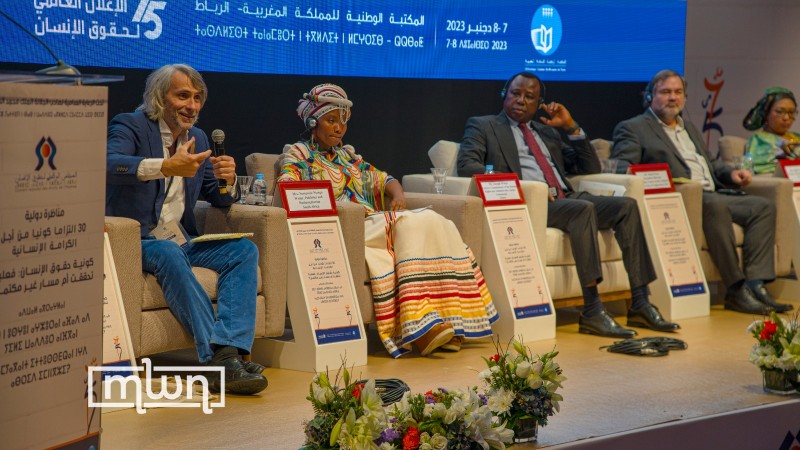
Raphael Liogier, a French professor in philosophy and sociology, speaking during a panel discussion
“So maybe we could now, instead of pretending we are modernity… we could look to the south this time to renew the real dream, the real promise of modernity,” he told MWN.
Liogier offered a compelling perspective on desire and heroism in human rights. He emphasized the need to create a “mystical eroticism,” a desire for human rights that goes beyond acknowledging them, making them truly desirable.
“That way, people will want to be bigger, greater than they are. It’s called heroism, and we need heroism today,” he added.
Business Ethics and Human Rights
Dante Pesce Gonzalez, with expertise in the role of business and society, delved into the intersection of universal human rights and business practices.
Hailing from Chile, Gonzalez articulated his view that businesses historically have been more of a part of the problem rather than the solution, often based on exploitation and abuse of both people and the environment.
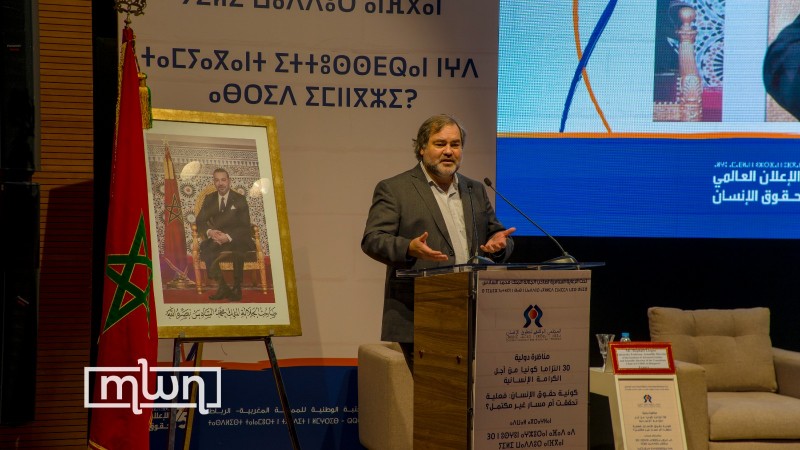
Dante Pesce Gonzalez, expert in the business and human rights
He challenged the notion that competitiveness should be based on exploitation, asserting that true competitiveness must be grounded in fairness and respect.
His stance reflected a commitment to reshaping business practices to align with human rights principles.
In this respect, he underlined the success story of the UN Principles for Business and Human Rights, emphasizing the importance of businesses respecting human rights as a smart and legitimate choice.
“Doing the right thing; respecting human rights, is the smart thing to do. And I really fully endorse that position,” he told MWN.
‘The Road is Still Very Long’
For her part, the European Union Ambassador to Morocco Patricia Llombart, underlined the EU’s commitment to the universal implementation of human rights.
However, she acknowledged that the road to universal respect and promotion of human rights faces significant challenges. She identified conflicts, the impact of climate change, increasing inequality, racism, and hate speech as contemporary issues that demand attention and action.
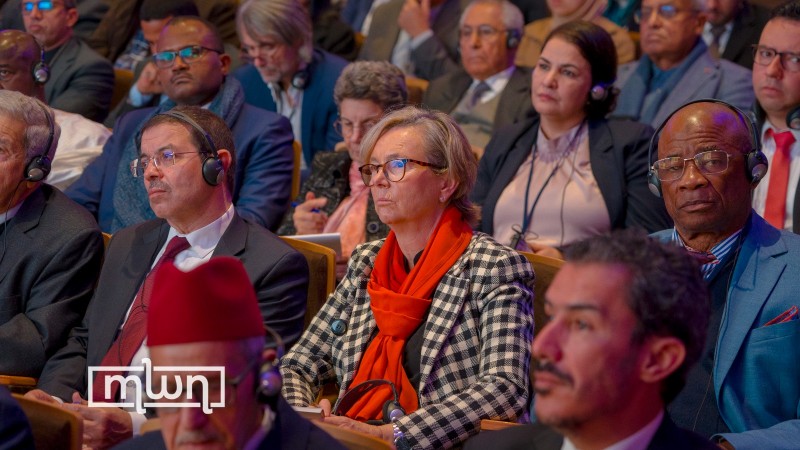
The European Union Ambassador to Morocco Patricia Llombart among the audience at the event
“But the road is still very long. The trend in the respect and the promotion of human rights universally is not a positive one,” Llombart told MWN. She stressed, “There is a lot still to do, and this requires a lot of commitment and engagement.”
She added that today, 75 years after the adoption of the Universal Declaration of Human Rights, is the time for intellectual contemplation, action, and engagement.
The two-day event, taking place on December 7 and 8, featured the active participation of authors, philosophers, historians, journalists, artists, Moroccan intellectuals, and experts from around the world.
The debate sessions were structured around six key themes, including the ever-changing contexts of human rights, Africa’s position in the international system, and the role of art and imagination in promoting a universal human vision.

Attendees at the two-day event
Liogier expressed hope for the outcome of the event to transcend the typical discourse and routine discussion on human rights.
“Yes, it’s so great … human rights … Everybody knows it, everybody likes it, and everybody agrees with it. But [we need] more talking about the desire for human rights .. not treating the people of the Earth like big kids,” he said.