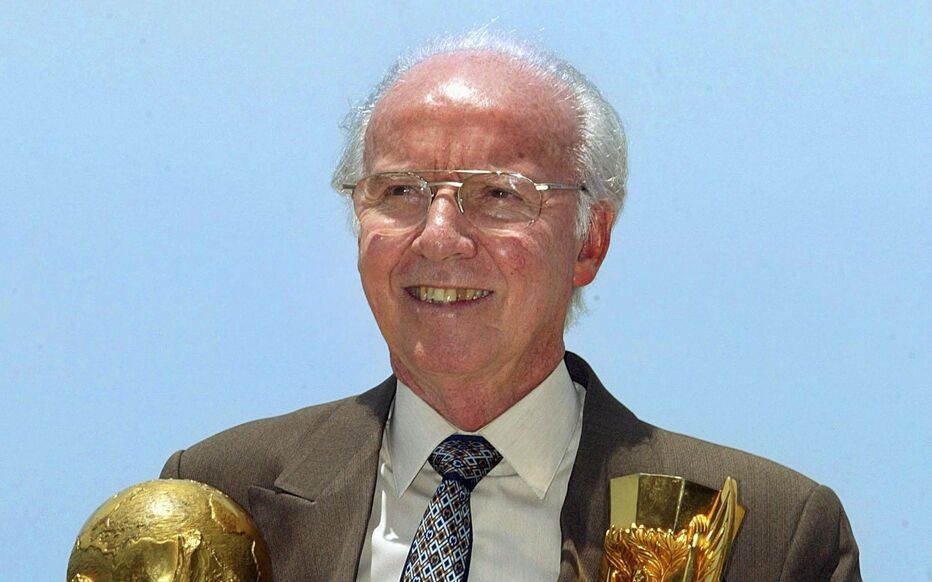
Rabat – On Friday, January 5, the official Instagram account of Mario Zagallo confirmed the passing of the Brazilian football icon at the age of 92.
The post read, “It is with great sadness that we inform you of the death of our eternal four-time world champion Mario Jorge Lobo Zagallo.
The brief statement went on to describe him as a dedicated father, loving grandfather, caring stepfather, loyal friend, victorious professional, and a great human being, leaving behind a legacy of remarkable achievements.
Mario Zagallo, often referred to as “the Professor,” will forever hold the distinction of being the first person to have won the FIFA World Cup as both a player and a coach, solidifying his place as a pivotal figure in the tournament’s history.
His crucial involvement contributed to four out of the five world titles claimed by the Seleção. Ednaldo Rodrigues, president of the Brazilian Football Confederation (CBF), declared an official seven-day mourning period in honor of the legendary figure.
Hospitalized in August in Rio de Janeiro for a urinary infection, and later for a respiratory infection, following the demise of Pelé in December 2022, Zagallo’s health had been a cause for concern.
His impact, however, extended beyond the touchline, as he steered Brazil to victory in 1970 in Mexico and served as an assistant coach during the triumphant 1994 campaign in the United States.
Zagallo’s legacy is marked not only by his coaching prowess but also by his achievements as a player, clinching two World Cup titles, in 1958 in Sweden and 1962 in Chile.
Born on August 9, 1931, in Maceio, Brazil, into a family of Lebanese and Italian descent, Mario Jorge Lobo Zagallo began his football journey with the modest club America de Rio de Janeiro in 1948.
Making his international debut in May 1958, Zagallo lifted the Jules Rimet trophy at the age of 27 alongside legendary teammates Pelé, Garrincha, Didi, and Vava, securing a 5-2 victory against the host nation, Sweden.
Pelé, reflecting on their bond, once stated, “Zagallo is like a brother to me. When we arrived in Sweden for the 1958 World Cup, I was 17 and the youngest member of the team. Zagallo, along with Zito and Gilmar, took me under their protection.”
With his statue standing tall outside the Nilton Santos Stadium in Rio, Mario Zagallo leaves an indelible mark on Brazilian football, celebrated not only for his tactical acumen but also for his contributions as a player and mentor.