 Join on WhatsApp
 Join on Telegram
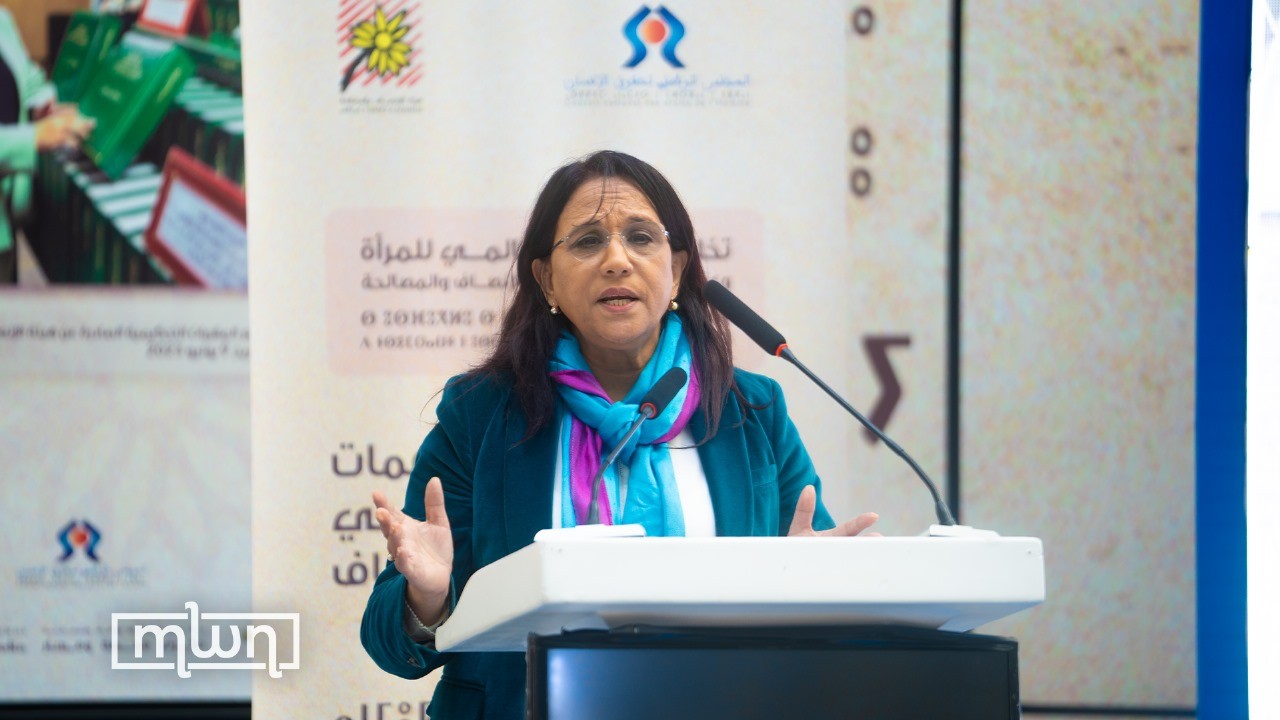
Rabat – Women’s rights are an integral part of the Moroccan identity, Amina Bouayach, the president of the Moroccan National Human Rights Council (CNDH), told Morocco World News (MWN) on Friday.
Bouayach explained that upholding women’s rights contributes to the creation of “a balanced, inclusive, and cohesive society that safeguards and upholds the dignity of women throughout transitions and societal changes.”
Her statement was made on the sidelines of celebrating International Women’s Day and the twentieth anniversary of the establishment of the Authority of Equity and Reconciliation.

The celebration at CNDH’s headquarters in Rabat
Bouayach further told MWN that the council is celebrating this year’s International Women’s Day in conjunction with the commemoration of the National Human Rights Council’s 20th anniversary of the Equity and Reconciliation Commission this year.
“We deeply understand the value of women, their roles, and their significance in the journey of transitional justice, not only as victims but also as active participants,” she explained.
“This celebration has had a profound and meaningful impact on social transformations towards democracy.”
In her speech to attendees of the event, Bouayach stressed the importance of commemorating International Women’s Day within the broader context of the Twentieth Anniversary of Truth, Justice, and Reconciliation in Morocco.

CNDH’s headquarters in Rabat
With a call for respect and recognition of the struggle of Palestinian women, the CNDH chief highlighted the need for immediate action to address the ongoing humanitarian crisis in Palestine.
“Thank you for your interaction and for standing in respect for the daily resistance of Palestinian women against killings and the starvation of their families,” she said while urging for collective efforts to ensure the safety and well-being of all women.
Read Also: Women’s Day: HCP Outlines Acute Gender Inequality in Morocco’s Urban Job Market
Drawing attention to the pivotal role of Moroccan women in shaping the country’s social fabric, Bouayach pointed out the need for inclusive approaches towards transitional justice.
“To transcend the Moroccan experience, the Authority of Equity and Reconciliation has dealt with transitional justice approaches that sometimes treated women merely as victims,” she said, calling for a holistic understanding of women’s roles in social development.
“The path of the Moroccan woman is an inspiring and rich path with its past and present events,” Bouyach affirmed.
The CNDH president further reiterated her commitment to advancing women’s rights in Morocco.
“We are fully aware that every approach to the subject of equality and parity requires understanding the interactions between legal, social, and developmental aspects,” she noted.
As Morocco commemorates the 2024 International Women’s Day, a recent by the country’s Higher Commission for Planning (HCP) shed light on the continuing gender plaguing the country’s economy.
The report shows that the gender pay gap remains persistent in Morocco’s urban job market despite strides in gender equality efforts I er the past decade.
Shockingly, the report reveals that even at equivalent qualifications, women consistently earn less than men, perpetuating systemic inequality.