 Join on WhatsApp
 Join on Telegram
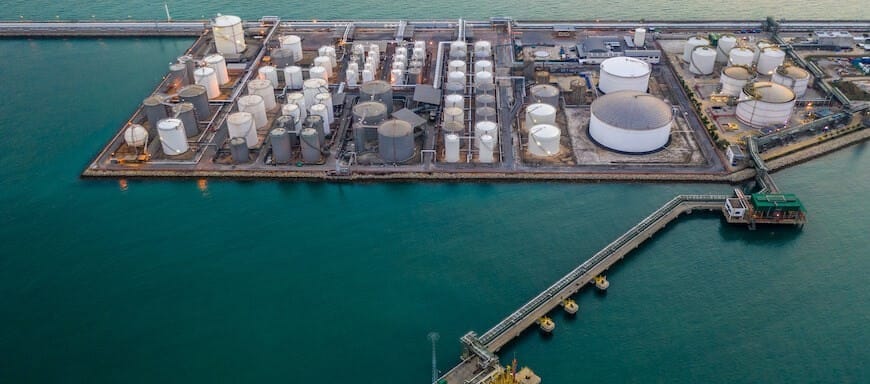
Rabat – Morocco is set to launch a tender this summer for the construction of a floating liquefied natural gas (LNG) terminal at the northeastern Nador West Med port, a senior official from the Ministry of Energy announced on Friday.
The head of oil and gas at the ministry, Abdelghafour El Hadjaoui, revealed these plans during a presentation viewed by Reuters.
The project aims to achieve financial close by 2025, with construction, commissioning, and commercial operations expected to commence in 2026.
Liquefied Natural Gas (LNG) is natural gas that has been cooled to a liquid state, making it easier and more cost-effective to transport.
The new terminal will be connected to an existing pipeline, facilitating the import of 0.5 billion cubic meters (bcm) of LNG annually from Spanish terminals, enough to power two small electricity production plants.
Morocco’s energy strategy also includes plans to link this pipeline to emerging gas fields in the eastern and western regions of the country.
The Ministry of Energy projects that the nation’s natural gas demand will surge to 8 bcm by 2027, a substantial increase from the current 1 bcm.
The Nador West Med port, a deepwater facility currently under construction, is projected to have a capacity of 3.5 million containers. This port development is a significant component of Morocco’s broader effort to bolster its LNG infrastructure.
In March, five Moroccan governmental bodies signed a Memorandum of Understanding (MoU) in Rabat to advance the country’s LNG infrastructure.
The agreement, part of the Sustainable Gas Infrastructure Development Program, outlines objectives for enhancing LNG capabilities and expanding natural gas storage and transportation infrastructure.
Read Also: Morocco to Build Terminal at Nador West Med, New Pipeline for LNG
The program’s immediate goals include supporting pipelines that connect domestic gas production to consumers, developing the LNG terminal at Nador West Med, and constructing a new pipeline to link the terminal to the Maghreb-Europe Gas Pipeline.
The MoU was endorsed by the Ministries of Interior, Economy and Finance, Equipment and Water, and Energy Transition and Sustainable Development.
Public agencies involved include the National Ports Agency (ANP), the National Office of Electricity and Drinking Water (ONEE), the National Office of Hydrocarbons and Mines (ONHYM), Nador West Med (NWM), and the National Motorway Company of Morocco (ADM).
The initiative is expected to expedite the development of renewable energy projects, jump-start Morocco’s green hydrogen sector, and reinvigorate the Atlantic-Africa Gas Pipeline Project.
Morocco entered the LNG market in February 2022, despite the high costs associated with LNG infrastructure. Energy Minister Leila Benali has defended the investment, stating it is “worth the premium.”
The country currently lacks the infrastructure to regasify LNG, necessitating an arrangement with Spain to process LNG at Spanish facilities and redirect it back to Morocco through the Maghreb-Europe Gas Pipeline.
This influx of gas from Spain has to date enabled Morocco to restart two major electricity-generating plants in Tahaddart and Ain Beni Mathar.
While LNG has alleviated Morocco’s energy security concerns, the high cost of gas poses challenges, especially given the country’s significant subsidies for gas and electricity.